 In 30 Seconds




In April 1756 the old Nawab Alivardi Khan died at Murshidabad, and Bengal passed to his grandson Siraj ud Daulah, a young man in his early twenties, quick tempered, insecure on a throne ringed by rivals, and heir to a quarrel with the English that his grandfather had managed but never resolved. Within fifteen months the quarrel had cost Siraj his capital’s dignity, then his throne, then his life, and had cost India far more.
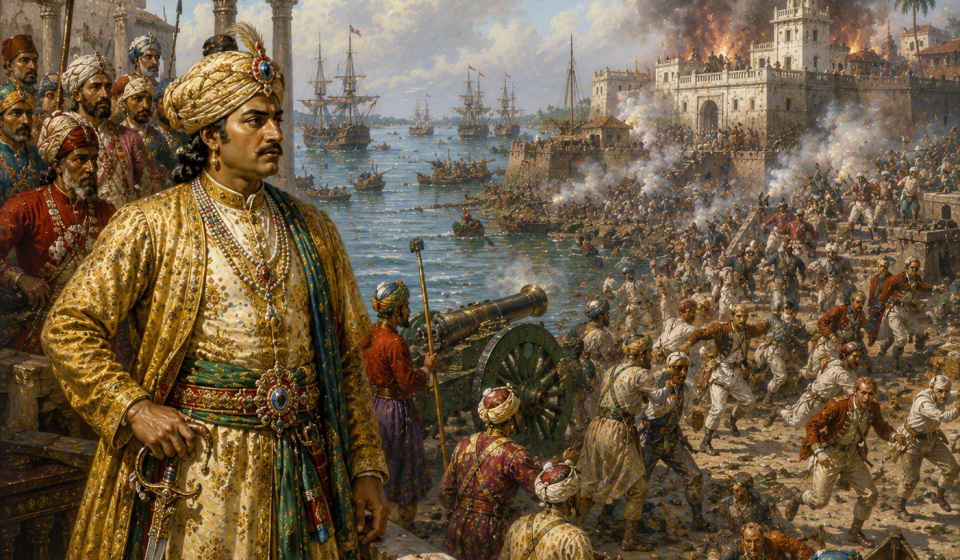
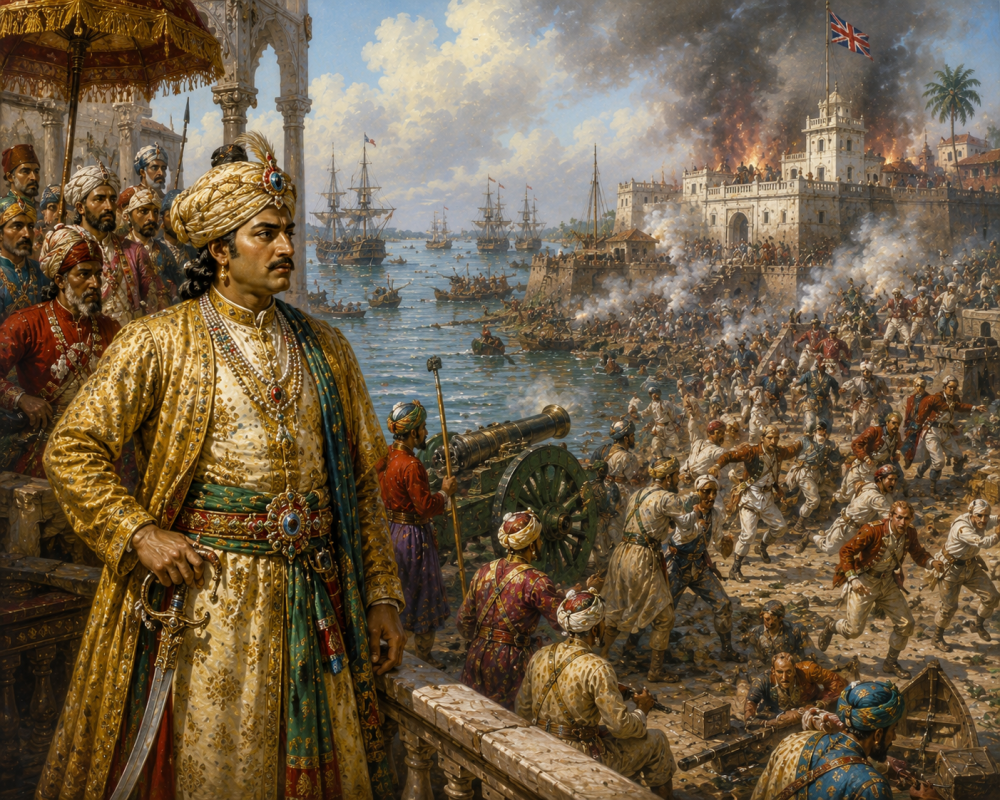
The new Nawab’s grievances against Calcutta were substantial and largely just. The English, anticipating a new European war with France, were strengthening the fortifications of Fort William without his leave, an assertion of sovereignty no ruler could ignore, and when ordered to stop, as the French at Chandernagore prudently did, they returned evasions. The old abuse of the dastak, the trade passes that leaked duty free privilege into private and Indian hands, continued to bleed his customs revenue. And Calcutta had given shelter to Krishna Das, son of a fugitive official carrying treasure and secrets from a faction the Nawab feared, and declined to give him up. To Siraj the pattern was plain, a nest of foreign merchants behaving as a state within his state. In June 1756 he marched on Calcutta with his army.
The English defence collapsed in days, less from the weight of attack than from rottenness within. The fortifications were decayed, the garrison feeble, and the leadership disgraceful. Governor Drake, the military commander and many of the council fled to the ships with the women and what they could carry, abandoning the remainder of the garrison, an act of desertion that even British historians have never attempted to defend. The abandoned remnant under John Zephaniah Holwell held the fort briefly and surrendered on 20 June 1756. Siraj renamed the town Alinagar, installed a governor, and returned to Murshidabad reasonably supposing the matter closed.
That night occurred the event around which empire later built its founding atrocity story. The surrendered prisoners were confined in the fort’s own small punishment cell, the Black Hole, in the killing heat of June, and by morning most were dead of suffocation and crushing. Holwell, a survivor, published an account setting the numbers at one hundred and forty six confined and twenty three alive at dawn, a narrative that British writers repeated for two centuries as justification for all that followed. Modern historians treat Holwell as a self promoting and unreliable witness, reckon the numbers far smaller, perhaps sixty odd confined, and find no evidence that Siraj ordered or knew of the confinement, which bears every mark of a jailers’ blunder in a chaotic night. That men died horribly is not in doubt. That the tragedy was inflated into imperial propaganda is not in doubt either.
The response came from Madras. The Company diverted the force it had assembled for the French war, and in December 1756 Admiral Watson’s squadron and Colonel Clive’s troops entered the Hooghly. Calcutta was retaken in January 1757 with little difficulty, and after an inconclusive night action against the Nawab’s camp that unnerved both sides, Siraj signed the Treaty of Alinagar in February, restoring the Company’s privileges, permitting the fortifications and promising compensation. Had matters rested there, history would record a border quarrel firmly settled.
Matters did not rest, because each side now believed the other’s destruction necessary. Clive, against orders of caution, attacked and took French Chandernagore in March, removing the counterweight Siraj had hoped to use and terrifying the Nawab with proof that treaties restrained the English no more than they restrained him. Siraj, oscillating between defiance and appeasement, corresponded with the French and with everyone, and around his throne the injured interests of Bengal, generals he had insulted, the Jagat Seth bankers he had threatened, courtiers he had displaced, began to consider whether a more convenient Nawab might be arranged. The English, they discovered, were considering the same thing. The conspiracy that would meet its moment at Plassey was already forming, and the young Nawab, whose real offence had been to insist on his sovereignty a decade too late, had scarcely a friend left to warn him.
1707 to 1765 - The Empire Cracks, the Company Rises
Part 8 of 10 in this chapter.