 In 30 Seconds




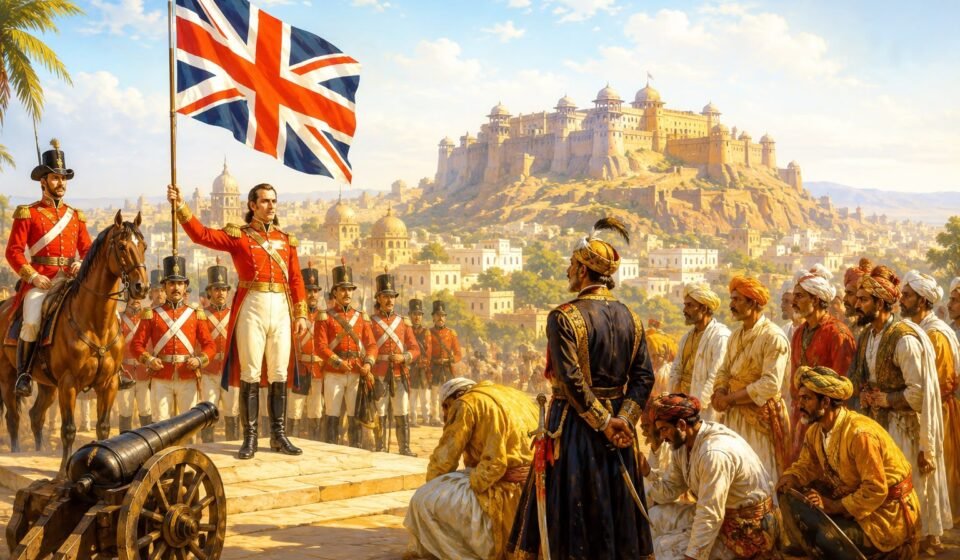
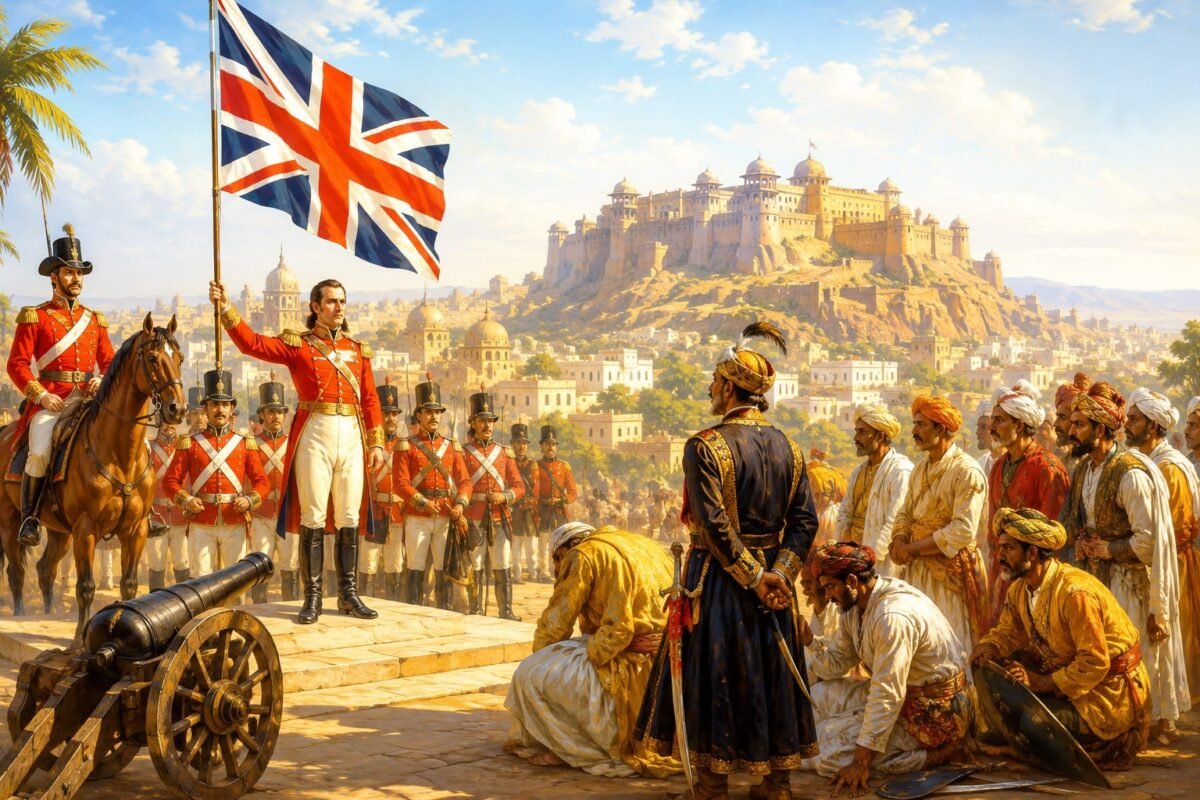
Every empire has a year in which the fighting for mastery ends and the mastery begins. For British India that year was 1818. When the Peshwa surrendered in June and the pen finished what the guns had started, the East India Company stood, for the first time, without a rival in the subcontinent, and a trading corporation chartered to buy pepper had become the paramount power of India. The two centuries that began at Surat had reached their astonishing conclusion, and everything afterward, until 1857, was administration and digestion.
The settlement of 1818 redrew the political map with a completeness no previous power had achieved. Directly ruled British India now ran in a great arc from Bengal through the Gangetic plain to Delhi, down through the newly annexed Peshwa dominions of the west, and across the Madras presidency in the south, embracing the richest lands and all the coasts. Around and within this arc lay the other India, the states, Hyderabad and Awadh, Mysore and Baroda, Gwalior, Indore and Nagpur, and, in the desert flank, the Rajput kingdoms, Jaipur, Jodhpur, Udaipur and their fellows, who in 1817 and 1818 accepted British protection in a sheaf of treaties that ended a generation of Maratha and Pindari extortion. Each state kept its throne, its ceremonies and its internal government, and surrendered its foreign relations, its quarrels and its future to the Company. Paramountcy, the doctrine that would govern a third of India until 1947, was now a fact awaiting its name.
Above the whole arrangement, in a Delhi palace, sat the shadow that made it legitimate. The Mughal emperor, blind Shah Alam’s successor Akbar Shah II, reigned as a Company pensioner, his name still read in the Friday prayers, his image still struck on the Company’s own coins until 1835, sovereignty and power having parted company so completely that each could be politely ignored. Beyond the Sutlej one Indian power alone remained truly independent, the Sikh kingdom of Ranjit Singh, with whom the Company had fixed a boundary in 1809 and would keep peace while the great Maharaja lived. India’s political destiny, for the first time since Aurangzeb, had a single address, and it was Calcutta, or behind Calcutta, London.
The men who completed the conquest were already asking what it obliged them to do. The generation of administrators formed in these wars, Thomas Munro in Madras, Mountstuart Elphinstone in the conquered Peshwa territories, John Malcolm in central India, were soldiers who wrote like philosophers, and their minutes and settlements founded the tradition of the district officer governing, as they insisted, through Indian institutions and toward Indian welfare. Munro told a parliamentary committee that British rule could only be justified if it prepared Indians, one day, to govern themselves, a sentence that would echo, quoted and unredeemed, through a century of nationalist argument. Elphinstone, settling the Deccan gently on Maratha foundations, predicted that the most desirable end of British rule was its honourable supersession by an Indian government it had itself educated. The empire’s conscience and the empire’s power were born in the same year, and spent the next century and a quarter in argument.
The costs of the achievement were equally permanent. The Company’s debts had grown with its dominions, and the machinery of extraction built in Bengal was now extended across India, land revenue settlements pressed to their limits, an army of a quarter million consuming the surplus, and the drain of wealth flowing home through investment, remittance and charge. Deindustrialisation’s long shadow was falling as Lancashire’s cloth, riding free trade and the new peace, began to hollow the weaving towns whose fabrics had once drawn England to India. Political unification and economic subordination arrived together, in the same ships.
In 1600 India had produced a quarter of the world’s wealth and England a fraction. In 1818 an English company ruled India. The reversal had taken seven generations, and had been accomplished less by any single conquest than by a compounding of advantages, sea power, Bengal’s treasury, the sepoy army, Indian division and European finance, each feeding the next. The age of acquisition was over. The age of consequences, reform, resentment, revolt, awakening, had begun, and its first great explosion was thirty nine years away.
1765 to 1818 - Conquest
Part 10 of 10 in this chapter.