 In 30 Seconds




India economy growth news: This news analysis explains India economy growth news for readers searching for clear, current and useful context from an India-focused global news outlet.
India economy growth news: key context for readers
The reason India economy growth news matters is that it connects headline developments with policy choices, markets, technology, diplomacy and the way India is understood by audiences in the West. This article keeps the search intent simple: what happened, why it matters, and what readers should watch next.
In focus: India fastest growing economy. This analysis explains why India fastest growing economy matters for readers in India and the West, and how it connects to policy, markets, technology or diplomacy.
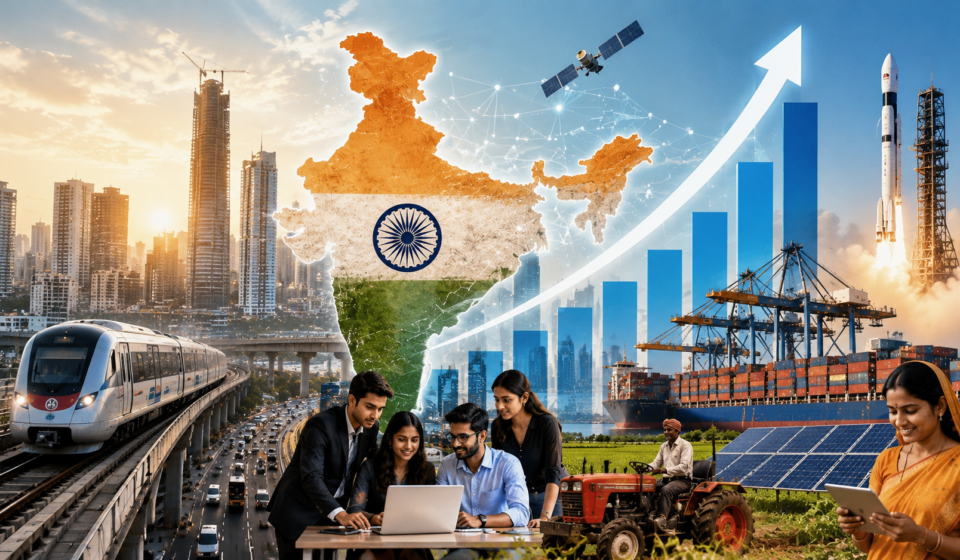
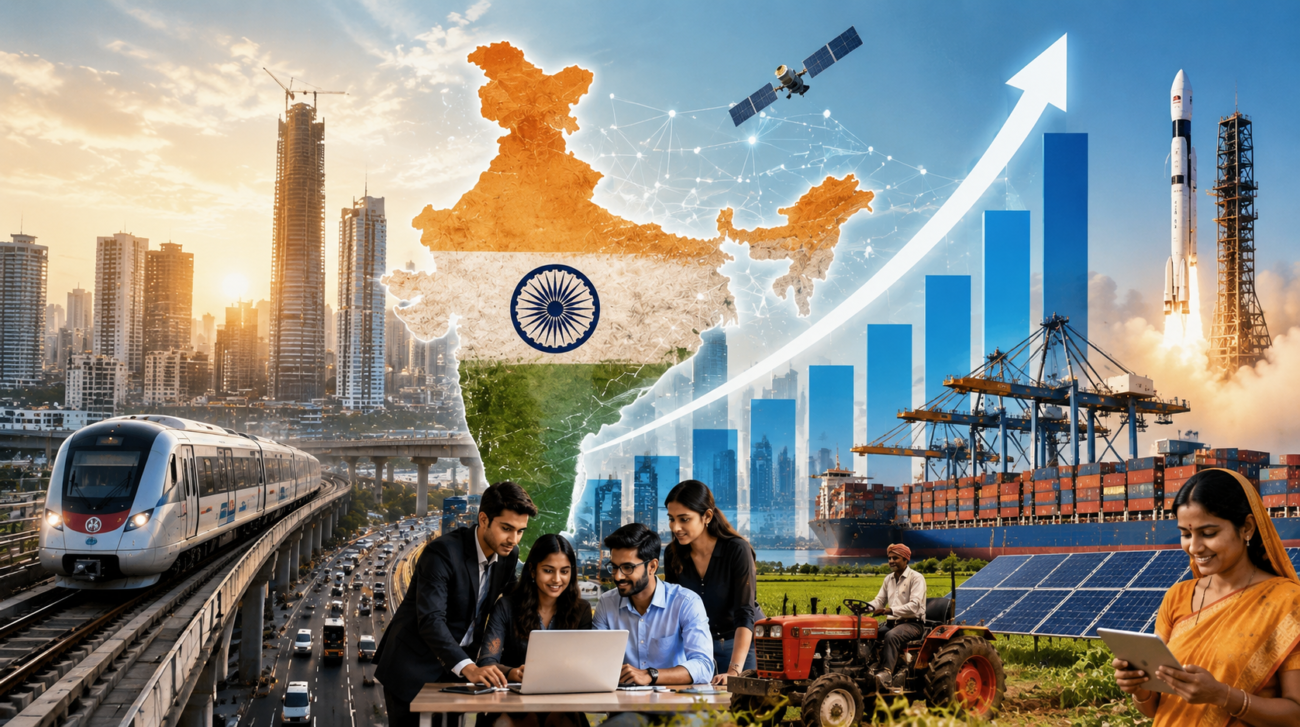
India’s economy grew at seven point eight percent in the quarter ending March 2026, a figure that on its own would be remarkable for almost any major economy in the world, and yet within the context of India’s own recent quarters, it actually represents a slight slowing from the upwardly revised eight percent growth recorded the period before. That sentence captures something important about how to read Indian economic data right now, which is that even the slowdowns are happening from an extraordinarily high base, and the country remains, by a clear margin, the fastest growing major economy on the planet.
For the full 2026 fiscal year, India’s GDP expanded by seven point seven percent, the strongest full year performance since the rebound from the pandemic recession in fiscal 2022. The composition of that growth tells its own story about where the strength is concentrated. Trade, hotels, transport and communication expanded twelve point five percent over the year, financial and real estate services grew ten point four percent, and construction rose eight point four percent, more than offsetting comparatively modest growth in mining and agriculture. Private consumption, often the most closely watched single number in any large economy because it reflects how ordinary households are actually faring rather than how policymakers wish they were faring, expanded eight point seven percent, an acceleration from the previous period and a sign that domestic demand remains genuinely robust rather than propped up entirely by government spending.
This resilience is particularly striking given the headwinds India has had to absorb over the past year. The United States imposed tariffs as high as fifty percent on a range of Indian exports in August of last year, a serious external shock for any economy that depends meaningfully on trade with America. India’s growth rate not only weathered that shock but remained, throughout the period, the highest among G20 economies, helped along by an increase in government spending and by cuts to the Goods and Services Tax designed specifically to support consumer confidence and private investment at a moment when external demand looked uncertain. Net external demand did, in fact, contribute negatively to overall growth in the most recent quarter, as imports rose faster than exports, a reminder that India’s growth story right now is being carried substantially by its own domestic engine rather than by trade.
International forecasters have been revising their India numbers upward through the year rather than down, which is itself a useful signal. Goldman Sachs recently lifted its calendar year 2026 GDP growth forecast for India to six point eight percent, citing the recent United States Iran peace deal and the resulting decline in crude oil prices as a significant tailwind, since cheaper oil eases pressure on India’s import bill, its current account deficit and its inflation outlook all at once. The bank also lowered its inflation forecast to four point four percent and trimmed its current account deficit projection to one point one percent of GDP, alongside an improved outlook for the rupee, all flowing from the same underlying logic, that a calmer Middle East translates fairly directly into a more comfortable macroeconomic position for an economy as dependent on imported energy as India’s.
None of this erases the genuine structural challenges India still faces, a per capita GDP that remains low by global standards even as aggregate GDP climbs toward fourth or sixth place worldwide depending on which measure you use, and a persistent need to convert the country’s demographic dividend, a median age still under thirty, into productive employment at a scale that absorbs the millions of young people entering the workforce each year. But on the specific question of momentum, whether the Indian economy is currently moving in the right direction and at a meaningful pace, the data through the first half of 2026 leaves remarkably little room for doubt.
Why this matters for India and the West
For Indian readers, this story matters because it connects to national interest, economic security, technology access or India as a force in a changing world. For readers in the West, it offers a clearer view of India as an active decision maker in global affairs.
Key takeaways
- Main search intent: India fastest growing economy.
- India angle: the issue can affect policy, markets, diplomacy, technology access or public debate.
- Western angle: it helps explain how global decisions are shaped by India scale, demand and strategic choices.
- What to watch: follow official statements, market reactions, policy updates and company announcements.
Explore more: Economy coverage | How a Middle East Ceasefire Quietly Rescued India’s Growth Forecast | What the GST Cuts Actually Bought India
Frequently asked questions
What is the main focus of this article?
The main focus is India fastest growing economy, explained with context rather than headline noise.
Why should Indian readers care?
Because the issue may influence India economy, foreign policy, technology base, public policy or strategic autonomy.
Why does it matter to readers in the West?
Because India choices increasingly affect supply chains, energy, technology, diplomacy and investment decisions beyond South Asia.
Sources and further reading
Latest news context
Readers looking for India economy growth news are usually trying to understand the current development, the background behind it and the likely impact. The Indic Journal frames this story for an audience in India and the West, with emphasis on credible facts, calm analysis and useful next steps.
How should readers follow this story?
Follow official statements, market signals, diplomatic updates, company announcements and policy documents. For continuing coverage, check the Economy section and related analysis across The Indic Journal.