 In 30 Seconds




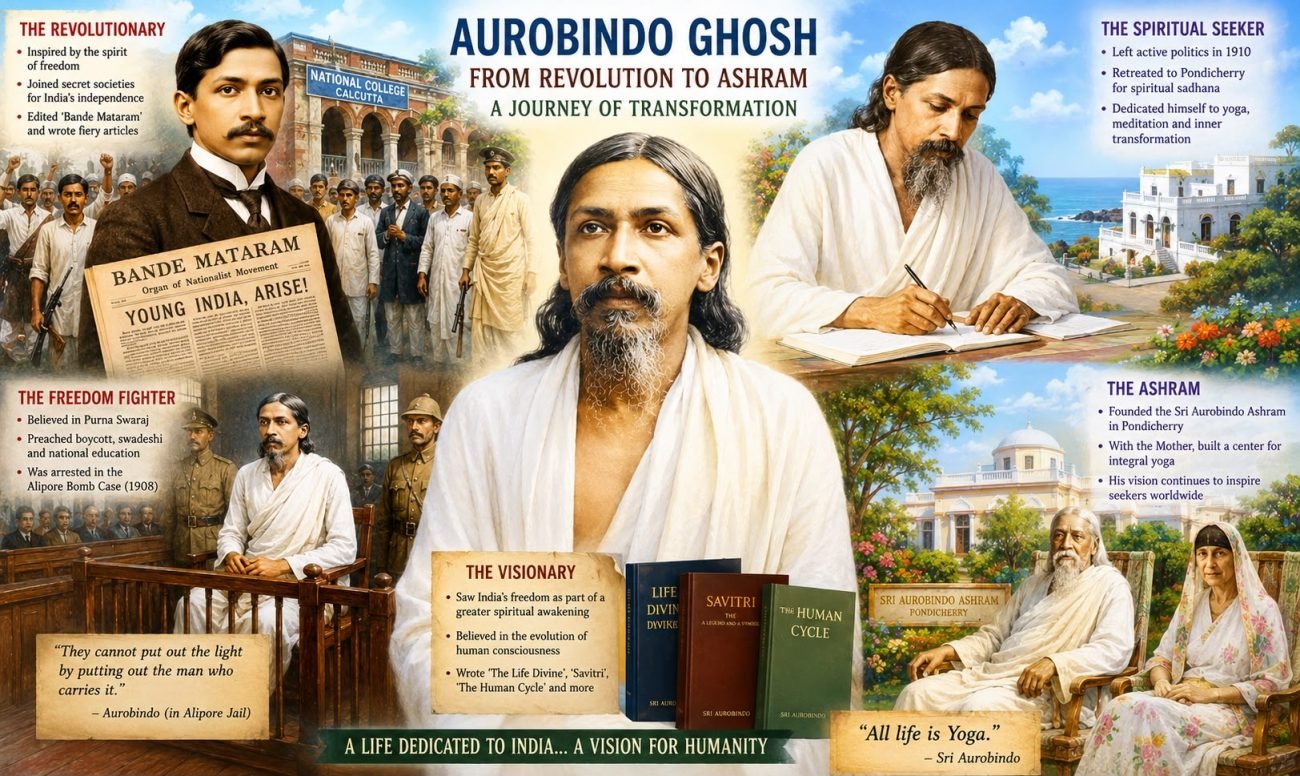
No life in the freedom struggle turns so sharply as Aurobindo Ghosh’s. For four years he was the most dangerous man in India by the government’s own estimate, prophet of complete independence when the Congress dared not name it, editor whose leaders the Raj read as war communiques, and patron of the secret societies whose bombs announced a new age. Then, in 1910, at the height of his legend, he walked out of politics into French Pondicherry and spent the remaining forty years of his life in yoga, emerging as Sri Aurobindo, the philosopher of consciousness whose ashram draws the world. The two halves have puzzled every biographer, and he himself insisted they were one work.
The making was paradoxical. Born in Calcutta in 1872 to an anglophile civil surgeon who wanted no India in his sons, he was sent to England at seven, raised entirely in English and Latin and Greek, took a brilliant degree at Cambridge, passed the ICS examination and escaped the career by declining, with quiet deliberateness, to appear for the riding test. He returned at twenty one to the service of the Maharaja of Baroda, and there, teaching, writing and reading himself into his own civilisation, he became what his father had prevented, an Indian. From Baroda through the 1890s he sent unsigned articles mocking the Congress as new lamps for old, and quietly seeded revolutionary groups in Bengal through emissaries, his younger brother Barindra among them, on the Irish and Italian models he had studied.
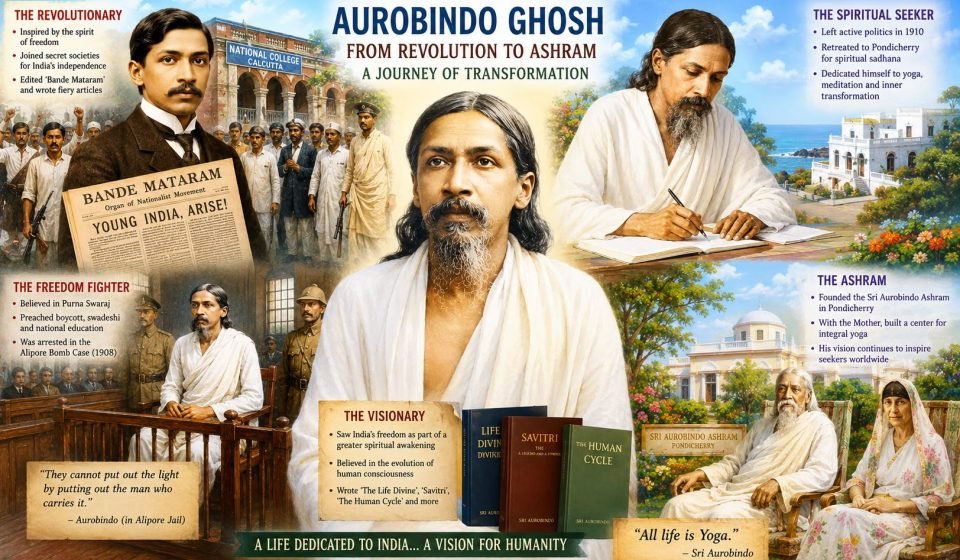
The partition of 1905 called him to the open stage. He came to Calcutta as principal of the new Bengal National College and made the daily Bande Mataram, which he edited with Bipin Chandra Pal, the voice of the new party, its doctrine his lasting political legacy, that the goal was complete independence, purna swaraj a generation before the Congress adopted the words, and the method organised passive resistance, boycott of goods, courts, schools and administration together, the theory of non cooperation written out in 1907 in a series whose reader, years later in South Africa, acknowledged the debt. Prosecuted for sedition in 1907 over Bande Mataram and acquitted when authorship could not be proved, he became, after Surat, where he presided over the Extremist councils with Tilak, the recognised head of the new party in Bengal.
The state’s answer arrested him in May 1908 in the roundup after Muzaffarpur, and the year in Alipore jail as an undertrial in the bomb conspiracy case became the hinge of his existence. In his cell, by his own account, the Gita opened itself to him, Vasudeva appeared in the magistrate, the prosecutor and the prison bars alike, and the nationalist entered a universe larger than the nation. C R Das’s defence, closing with the celebrated peroration that his client would stand, long after the controversies were hushed, as the poet of patriotism and prophet of nationalism, secured his acquittal in May 1909, and Aurobindo emerged into a movement decapitated, Tilak in Mandalay, the party scattered. His Uttarpara speech that month announced the change of key, the nation as an instrument of the eternal dharma, and his new weeklies preached a nationalism become spiritual discipline. Warned in early 1910 of imminent deportation, he withdrew, on what he called an inner command, first to Chandernagore and then, in April 1910, to Pondicherry, beyond British writ. He never returned, and never recanted, declining British India’s later invitations while following the movement’s course, blessing the Cripps offer of 1942 against the Congress’s judgment, and marking, with a message he called an interposition of fate, that independence arrived on his own birthday, 15 August.
Pondicherry’s four decades built the other monument, the Life Divine and Savitri, the yoga of a divinised earth, the ashram with the Mother at its head, work he described as a continuation of the first by deeper means, the freeing of India having been, he said, but a first step toward the freeing of man. Politics remembers its own. The republic’s historians rank his four public years among the founding acts of the independence idea, the man who named the goal, theorised the method, and sanctified the struggle, then vanished at thirty eight into a silence that still speaks.
1905 to 1911 - Swadeshi, Revolutionaries and Reform
Part 6 of 10 in this chapter.