
 In 30 Seconds




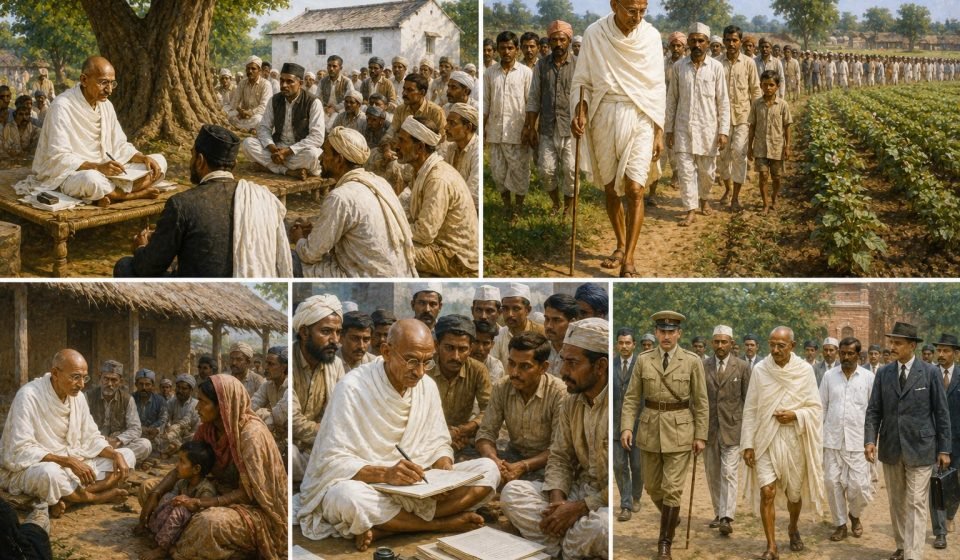
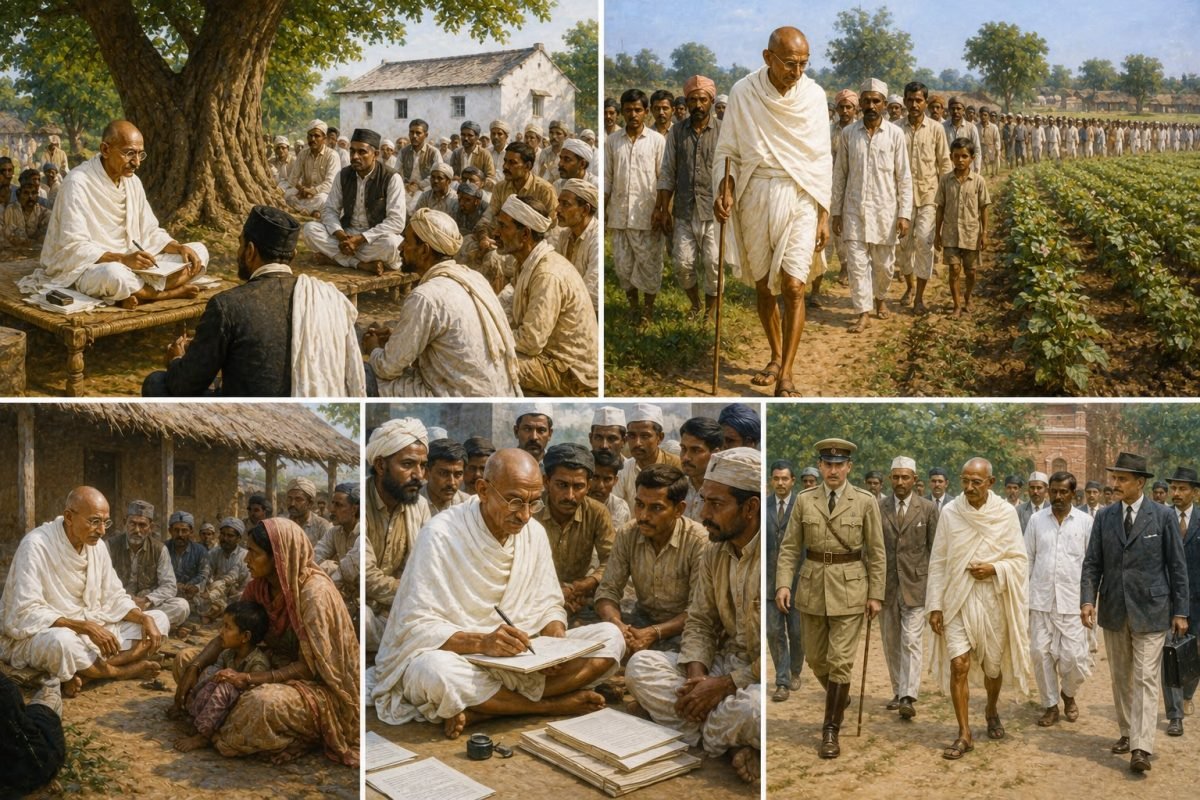
In December 1916, at the Lucknow Congress, a peasant from north Bihar attached himself to Mohandas Gandhi with a single obstinate request, that the Mahatma of South Africa come and see with his own eyes what the indigo planters did in Champaran. Raj Kumar Shukla could not have framed the historical stakes, and did not need to. His persistence, session after session and city after city, brought Gandhi in April 1917 to a district he could not have placed on a map, and the Champaran satyagraha that followed was the first application of Gandhi’s method on Indian soil, the campaign in which, as he later wrote, he first met the real India face to face.
Champaran’s grievance was a system called tinkathia. Under it, tenants of the European indigo concerns were bound to plant three kathas in every twenty of their holding with indigo for the factory, at prices and terms the factory set, and around this core obligation the concerns had grown a jungle of exactions, illegal cesses called abwabs for every occasion of the planter’s household, and, as synthetic dye killed the indigo market, agreements releasing tenants from the crop in exchange for crushing enhancements of rent and lump sums called sharahbeshi and tawan, extracted, the record later showed, with the whip of the factory’s own peons. The district’s peasants had petitioned, rioted locally and litigated for a decade, and the government of Bihar had inquired and filed. What they had never had was a witness the empire could not ignore.
Gandhi’s procedure, watched with bewilderment by officials and lieutenants alike, invented Indian satyagraha as it went. He came, he announced, not to agitate but to ascertain facts. The Commissioner ordered him out of the district as a danger to the public peace, and Gandhi, in the act that electrified the country, declined to go, submitting instead to trial at Motihari on 18 April 1917 and reading to the magistrate a statement that reframed the empire’s law in a sentence, that he had disobeyed the order not for want of respect for lawful authority but in obedience to the higher law of conscience. Tens of thousands of peasants ringed the courthouse, the district administration’s nerve wavered before the spectacle of a defendant demanding his own conviction, and on instructions from above the case was withdrawn, the government of India overruling its local officers, the first victory of civil disobedience in India won without a blow or a slogan.
What followed was less dramatic and more consequential. Through the summer, Gandhi and the band of young Bihar lawyers who had joined him, Rajendra Prasad, first among them, with Brajkishore Prasad, Anugrah Narayan Sinha, J B Kripalani and, summoned to manage the ashram side, Mahadev Desai, took down the sworn statements of some eight thousand ryots, village by village, a mountain of evidence assembled with judicial care while the planters fumed. The government, conceding the method by adopting it, appointed a committee of inquiry with Gandhi himself a member, and its unanimous report, translated into the Champaran Agrarian Act of 1918, abolished tinkathia outright and ordered partial refund of the extorted enhancements. Gandhi accepted a fraction of the refund claims to break, he said, the planters’ prestige rather than their purses, a compromise argued over ever since, and the planters, their system’s spine cut, sold out and left the district within a decade. Alongside the inquiry he planted the other half of his method, volunteers opening village schools, sanitation work and the first ashram style constructive program, Kasturba teaching in the villages, the pattern of struggle joined to service that every later campaign repeated.
Champaran’s yields were the movement’s future itself. It gave Gandhi his Indian legend, the lawgiver who had beaten the planters, carried by folk song across the Gangetic plain ahead of his travels. It gave him his men, Rajendra Prasad’s generation binding Bihar to him for life, and the working proof of satyagraha’s central claim, that the disciplined acceptance of law’s penalty could defeat law’s injustice. And it fixed the movement’s compass, away from the councils and toward the village, where, Gandhi henceforth insisted, India actually lived. Shukla’s name survives in the first sentences of every account, the sharecropper who summoned the Mahatma, and the summons, half a century of history confirms, was the freedom struggle’s true beginning on Indian ground.
1913 to 1919 - Ghadar, War and Gandhi Arrives
Part 6 of 10 in this chapter.