 In 30 Seconds




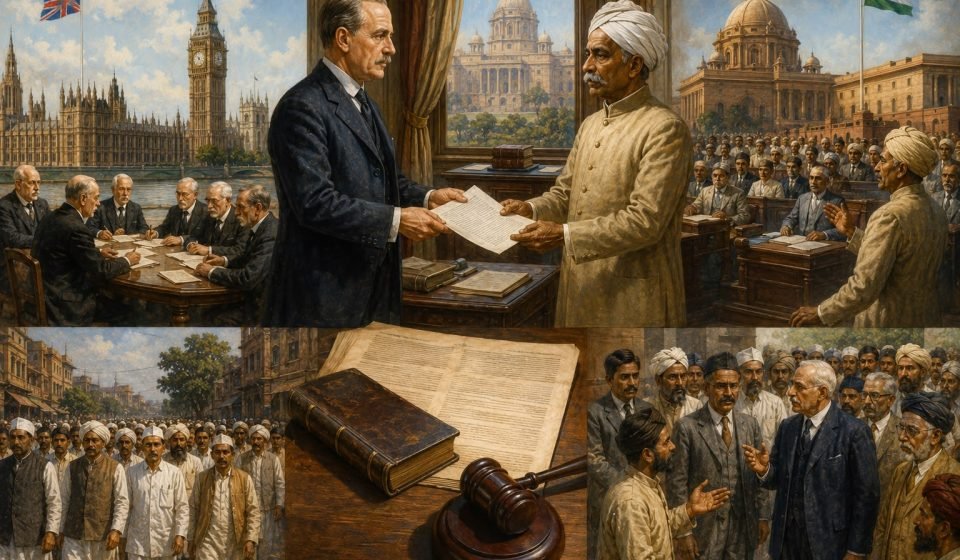
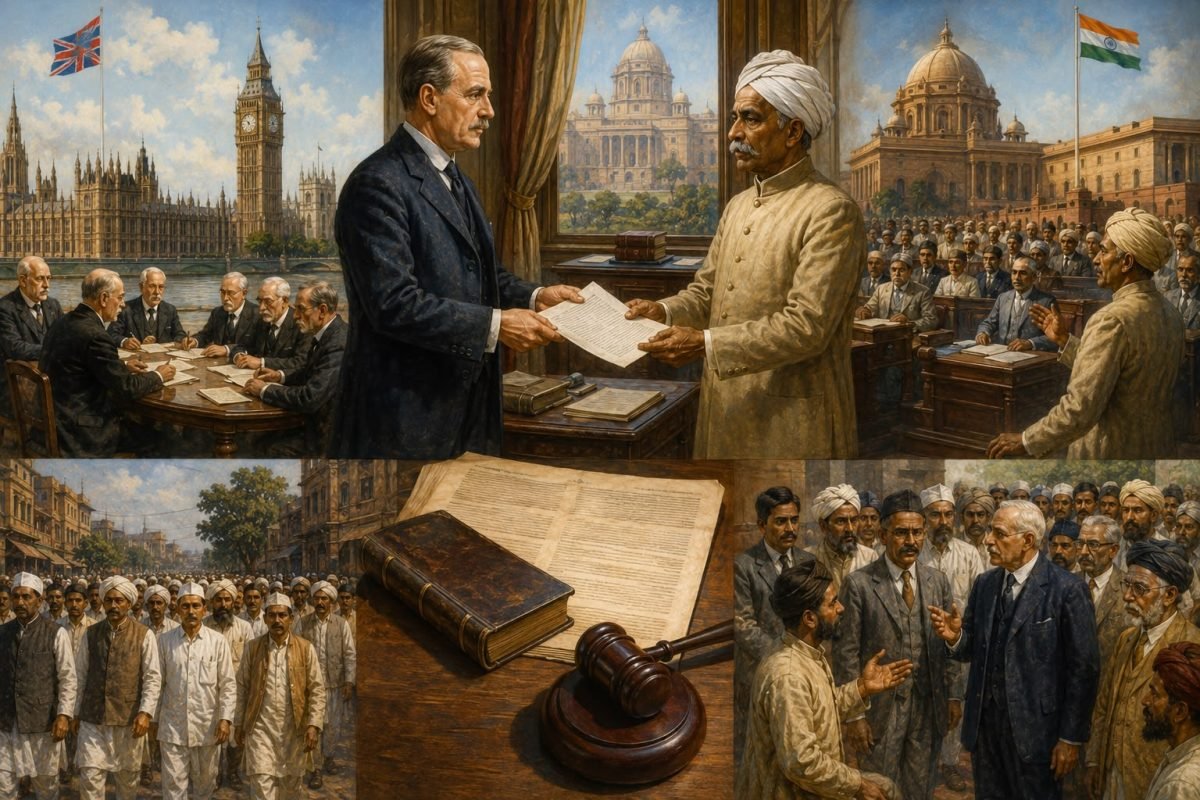
On 20 August 1917, with the war at its darkest and India’s loyalty its most needed, Edwin Montagu, Secretary of State for India, rose in the House of Commons and read the sentence that changed the constitutional destination of British rule, that the policy of His Majesty’s Government was the increasing association of Indians in every branch of the administration and the gradual development of self governing institutions, with a view to the progressive realisation of responsible government in India as an integral part of the British Empire. Responsible government, ministers answerable to elected legislatures, the substance of dominion life, was now the promised end of the Raj by the Raj’s own declaration, and every subsequent argument between India and Britain was an argument about the sentence’s pace, never again about its direction.
The declaration’s fulfilment was drafted on the road. Montagu came to India that winter, the first Secretary of State to tour the country in office, and with the Viceroy Lord Chelmsford heard everyone from the princes to the Home Rule Leagues, recording in a diary of undiplomatic candour his impressions of the machine he was to liberalise. The Montagu Chelmsford Report of 1918 that resulted, and the Government of India Act of 1919 that enacted it, built the strangest constitutional device of the imperial era, dyarchy, double government in the provinces. Provincial subjects were divided into two lists. The transferred subjects, education, health, local government, agriculture, industries, passed to Indian ministers responsible to the new legislatures. The reserved subjects, land revenue, police, justice, the press, remained with the Governor’s executive councillors answerable to London alone. Above this half responsible structure the centre remained wholly irresponsible, its enlarged bicameral legislature, an Assembly and a Council of State, elected in majority but advisory in effect, the Viceroy armed with certification powers to enact whatever it refused. The franchise, extended to about one Indian in ten among adult males on property lines, created real electorates for the first time, and the communal electorates of 1909 were not merely retained but extended, to Sikhs, Europeans and Anglo Indians, the separatist principle compounding with each reform. Two further clauses shaped the sequel, the promise of a statutory commission after ten years to weigh the next advance, and the fiscal convention that at last let India raise tariffs against Lancashire itself.
India’s reception was the tragedy of timing. The Congress, meeting in 1918, split over the reforms, the old Moderates seceding for good to work them as the Liberal Federation, the majority declaring the scheme disappointing and unsatisfactory, and even that verdict was overtaken within months, for the same government that offered dyarchy with one hand delivered with the other the Rowlatt Act, the Punjab’s martial law and Jallianwala Bagh, and the Khilafat wound besides. Gandhi, who had counselled cooperation with the reforms into 1919, concluded that a government capable of the Punjab’s deeds forfeited cooperation with its constitutions, and the Non Cooperation movement of 1920 called upon the country to boycott the very councils the Act had built. The first elections of 1920 thus proceeded over a Congress boycott, and dyarchy began its decade worked by Liberals and loyalists in half empty legitimacy.
Worked it was, nonetheless, and the working taught. Indian ministers in the provinces, on starved transferred budgets, built the first expansions of education and local government under Indian responsibility, and discovered dyarchy’s designed frustration, ministers responsible for development without control of the purse or the police, the finance member reserved, the system, as one of its own authors conceded, criticisable as the worst of both worlds. The central Assembly, once the Swarajists entered in 1924, became the theatre where Motilal Nehru and Jinnah dissected the government’s certified budgets before the country. And the ten year commission clause detonated on schedule, the all white Simon Commission of 1927 uniting India against it and forcing the pace toward the next constitution. The declaration of 1917 had conceded the destination, the Act of 1919 had built a deliberately slow vehicle, and the movement spent the interwar decades commandeering the vehicle while holding the driver to the announced address, an address reached, thirty years and two acts later, at midnight in August 1947.
1913 to 1919 - Ghadar, War and Gandhi Arrives
Part 8 of 10 in this chapter.