
 In 30 Seconds




Story
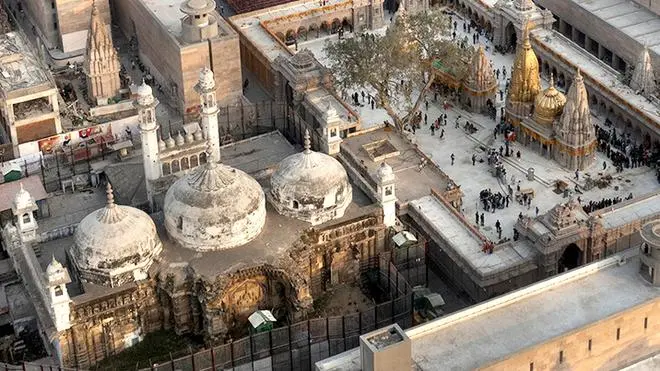
At the heart of the world’s oldest living city stands its most layered hundred metres. The Kashi Vishwanath temple, seat of Shiva as lord of the universe and one of the twelve jyotirlingas, shares a boundary wall with the Gyanvapi mosque, and between, beneath, and around the two runs a history that India is still litigating. This article states that history as the record holds it, which is the only way this series knows how.
The Vishwanath shrine’s sanctity is ancient, the presiding deity of Kashi itself, praised in the Puranic literature and central to the city’s promise of liberation. Its buildings, however, have lived a repeatedly interrupted life. The temple was destroyed during the Ghurid invasions at the close of the twelfth century, rebuilt, and destroyed and rebuilt again across the sultanate centuries, with a major reconstruction in the sixteenth century associated with Raja Todar Mal and the scholar Narayana Bhatta under Akbar’s tolerant dispensation. The decisive rupture is documented in the Mughal court’s own chronicle. In 1669, Aurangzeb ordered the temple’s demolition, an event the Maasir i Alamgiri records, and the Gyanvapi mosque was erected on the site, portions of the temple’s plinth and southern wall remaining visibly incorporated into the mosque’s structure, a fact acknowledged across the scholarly literature. The name the precinct kept, Gyanvapi, the well of knowledge, belongs to the sacred well that stands between the structures, predating both.
The present temple is a Maratha restoration, built in 1780 by Ahilyabai Holkar of Indore beside the mosque, its spire gilded in the following century with gold donated by Maharaja Ranjit Singh of Punjab. Around this pairing the old city pressed close for two centuries, temple and mosque wall to wall in a maze of lanes, an arrangement that functioned, with episodic friction and occasional riot recorded from the colonial period onward, because daily life mostly required it to.
The modern legal history must be stated carefully, for it is live. Suits over the precinct date to 1991, when worshippers sought the site’s restoration, proceedings long stayed under the Places of Worship Act of 1991, the law that freezes the religious character of sites as they stood at independence, with the Ayodhya dispute alone exempted. The question of whether that Act bars the Gyanvapi suits, or permits at least an inquiry into the site’s character, has been argued up to the Supreme Court and remains, as of this writing, judicially unresolved. In 2021 and 2022 a fresh suit by five Hindu women seeking worship rights at the mosque’s outer wall triggered a court ordered survey, during which a stone object was found in the wazukhana, the ablution tank, that the plaintiffs identify as a shivling and the mosque committee describes as a fountain, characterisations this series attributes and does not adjudicate. The Archaeological Survey of India, directed by the district court to examine the premises excluding the sealed tank, submitted a report made public in 2024 concluding that a large Hindu temple existed at the site prior to the mosque’s construction, findings the mosque committee contests. Courts have since permitted Hindu prayer in the structure’s southern cellar, orders under appeal, and the litigation proceeds on multiple tracks. Both parties’ positions deserve plain statement. The Hindu plaintiffs assert a continuing sanctity never extinguished. The Anjuman Intezamia Masajid asserts the mosque’s status as a mosque for three and a half centuries and the protection of the 1991 Act. The courts will say the rest.
While the courts deliberated, the state rebuilt the setting. The Kashi Vishwanath corridor, inaugurated in December 2021, cleared some three hundred buildings between the temple and the Ganga, opening for the first time in centuries a direct processional way from the sanctum to the river, with museums, halls, and ghatside gates. Admirers call it the grandest act of temple urbanism since the Marathas, and pilgrim numbers, now counted in crores annually, have vindicated its capacity. Critics, including displaced residents and some conservationists, mourned the demolished fabric of the old lanes and read the project’s politics in its timing. Both readings are part of the record.
What the visitor sees today, then, is the whole argument of this series compressed into one precinct. A jyotirlinga radiant with renewed grandeur, a mosque under police protection and legal siege, a well older than the quarrel, and queues of ordinary pilgrims moving through history’s most contested hundred metres toward the darshan their ancestors sought. Kashi has outlived every one of its previous chapters. The present chapter is still being written, in courtrooms, and this series will keep its account current with them.