 In 30 Seconds




If any Indian power was destined to inherit the Mughal empire, it was the Marathas. From Shivaji’s hill forts their confederacy had spread until its horsemen watered at the Indus and its Peshwa’s writ ran, through chiefs and chauth, across the widest dominion in eighteenth century India. Three wars against the East India Company, spanning forty three years, decided that the inheritance would go elsewhere, and the last of them, in 1818, ended the contest for India itself.
The confederacy’s strength and weakness were the same thing, its structure. The Peshwa at Poona presided over great regional houses, Scindia of Gwalior, Holkar of Indore, the Bhonsle of Nagpur, the Gaekwad of Baroda, allies in theory, rivals in practice, whose quarrels invited every enemy in. The catastrophe of Panipat in 1761, where an Afghan army destroyed a generation of Maratha manhood, had checked but not broken them. Under the great minister Nana Fadnavis at Poona and the soldier statesman Mahadji Scindia in the north, the confederacy rebuilt, and Scindia raised, under the Savoyard Benoit de Boigne, disciplined brigades with modern artillery that made him master of Delhi and keeper of the blind emperor Shah Alam.
The First Anglo Maratha War, from 1775 to 1782, grew from Bombay’s meddling in a disputed Peshwa succession and produced the Company’s deepest humiliation of the century, the convention of Wadgaon in 1779, when a Bombay army, surrounded in the ghats, bought its life with surrendered gains. Warren Hastings, refusing the disgrace, sent armies across India in marches that redeemed the war, and the Treaty of Salbai in 1782 restored the balance for twenty years, both sides having learned respect. It was in those twenty years that the balance quietly broke, for Bengal’s revenues, Wellesley’s treaties and the deaths of Mahadji Scindia and Nana Fadnavis, the last statesman of the confederacy, left Poona a cockpit of faction.
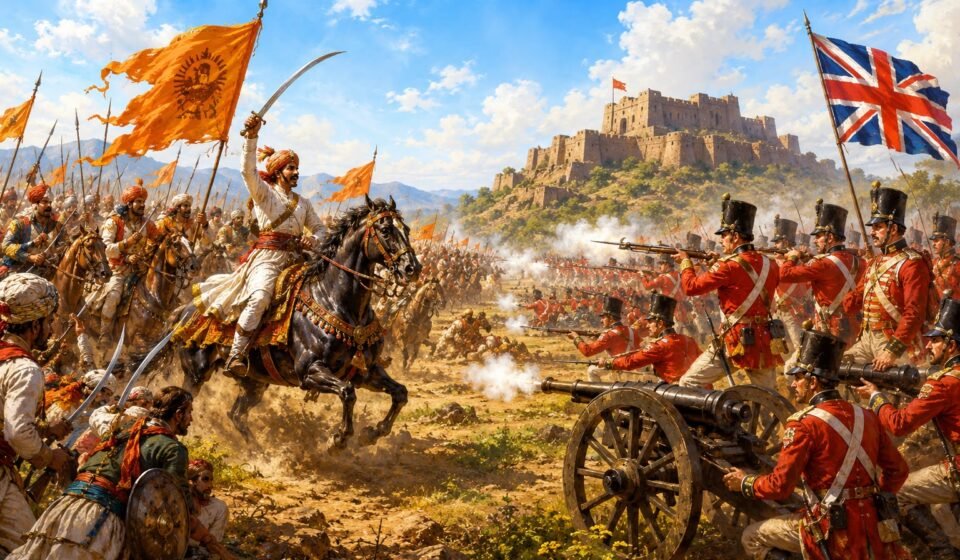
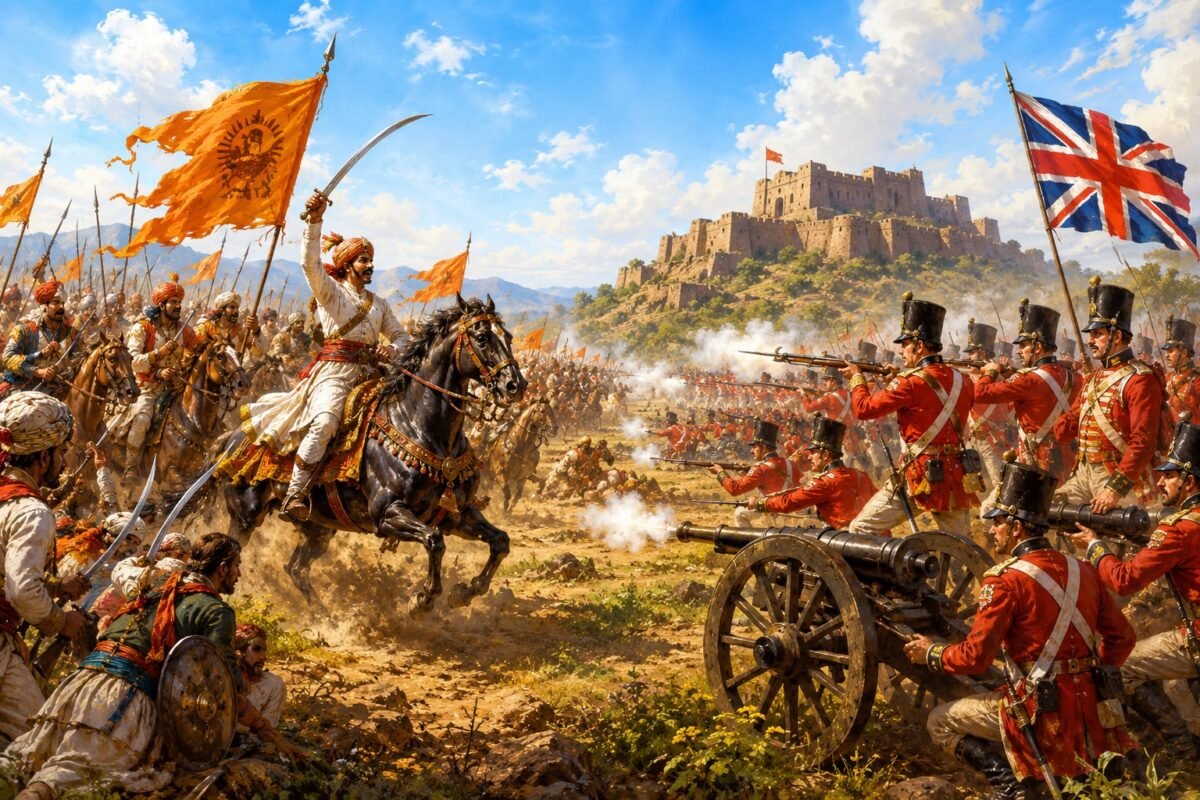
In 1802 Holkar’s guns settled a Poona quarrel, the young Peshwa Baji Rao II fled to the British, and by the Treaty of Bassein purchased restoration at the price of a subsidiary alliance, selling, as the other houses saw it, the confederacy’s sovereignty for his own throne. Scindia and Bhonsle fought, and the Second Anglo Maratha War of 1803 to 1805 was the true battle for India. Arthur Wellesley stormed Ahmednagar and at Assaye in September 1803, with an army outnumbered many times over, broke Scindia’s regular brigades in an afternoon he later called the hardest fighting of his life, harder, he implied, than the field of Waterloo where he finished it. In the north Lake shattered Scindia’s remaining brigades at Delhi and Laswari and took the imperial city, where Shah Alam passed from Maratha to British keeping, the sovereignty of India changing hands with the custody of a blind old man. Holkar, entering the war late and alone, ran rings around his pursuers, destroyed Monson’s retreating column, and fought on until money and allies failed, but the treaties of 1805 left the Company paramount in Hindustan and the Maratha houses caged, sovereign still, but fenced from one another and from the future.
The end came a decade later, less as a war between states than as a policing operation that became a revolution. The Pindaris, freebooting hosts sheltered in Maratha territories, gave the Marquess of Hastings his occasion, and in 1817 he ringed central India with the largest army Britain had ever assembled in Asia, over a hundred thousand men. The Maratha courts, seeing in the noose their last hour, rose. The Peshwa attacked the Residency at Kirkee, Bhonsle at Sitabuldi, Holkar’s army fought at Mahidpur, and each was defeated in detail within months. The settlement of 1818 was surgical. The lesser houses survived as subsidiary princes. The Peshwaship itself, the headship of the Maratha world, was abolished, Baji Rao II pensioned to Bithur near Kanpur, and his adopted heir, Nana Saheb, would nurse the extinguished title until 1857. The Raja of Satara, Shivaji’s line, was set up as a small Company client, history rearranged into heraldry.
With Poona’s fall the last Indian claimant to empire was gone, and the Company stood without rival from the Sutlej to the sea. The Maratha wars had been the real war for India, and India’s new master now turned, for the first time, from conquest to the question of what its conquest was for.
1765 to 1818 - Conquest
Part 9 of 10 in this chapter.