
 In 30 Seconds




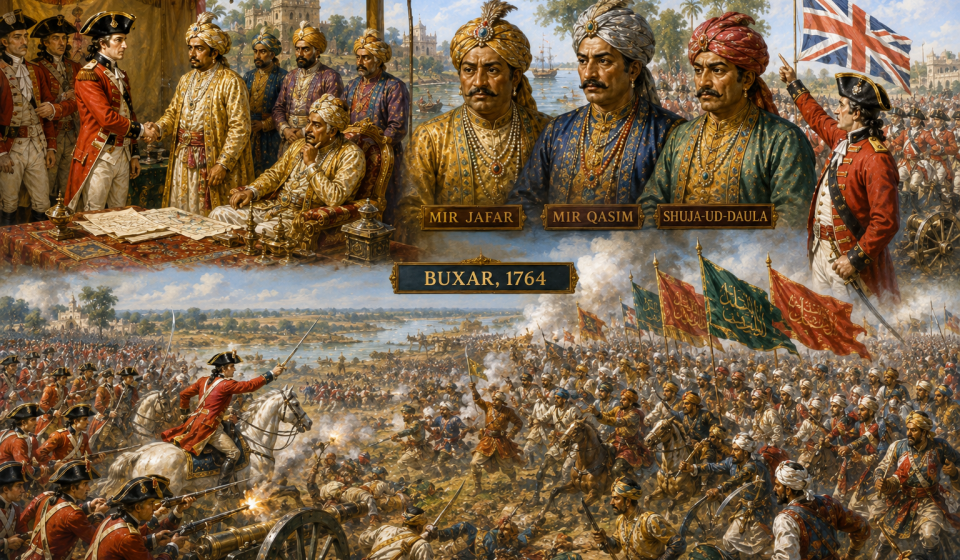
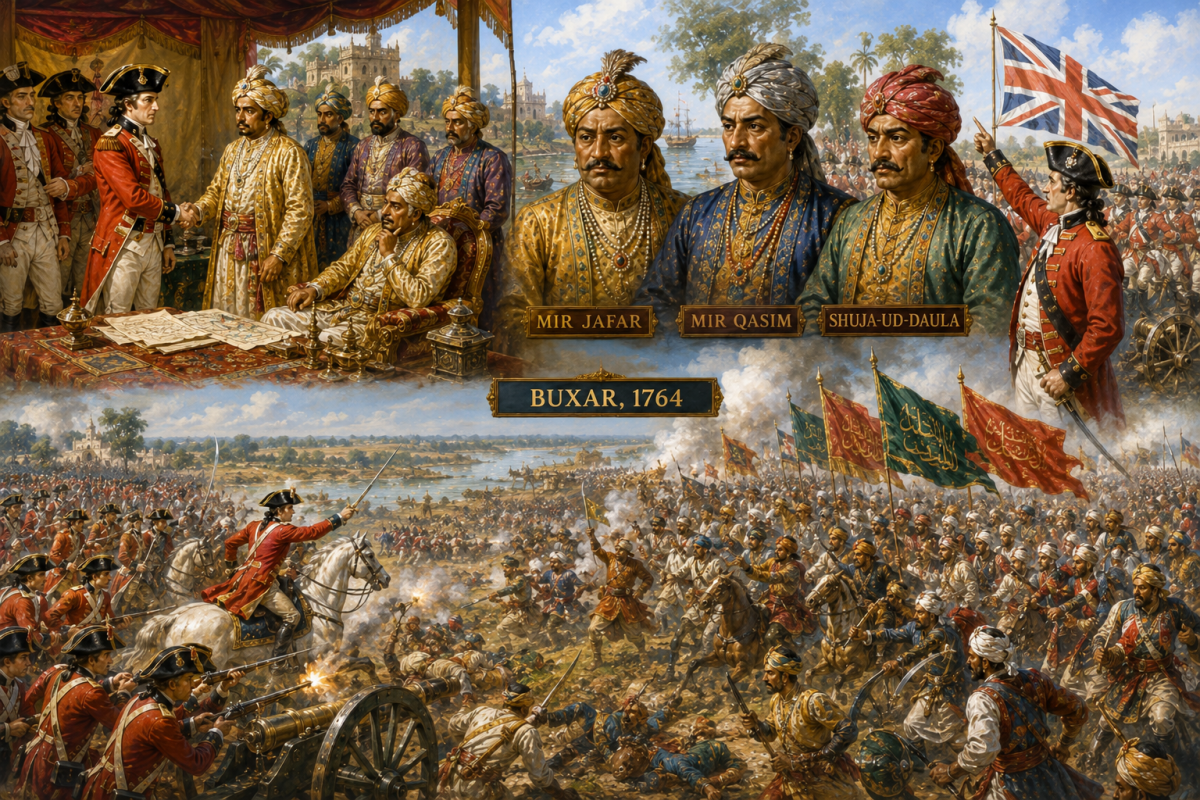
Plassey made the Company kingmaker in Bengal. Buxar, seven years later, made it king. The battle fought on 22 October 1764 beside the Ganga at Buxar is less famous than Plassey and was incomparably more decisive, for it was won not by conspiracy but by arms, against not one ruler but three, and its prize was not a puppet’s throne but the legal sovereignty of the richest provinces of India.
The road from Plassey to Buxar was paved with the failures of puppet government. Mir Jafar, installed in 1757, found his treasury drained by the promised payments and his authority mocked by the power behind him, and when he groped toward the Dutch as a counterweight, the Company crushed the Dutch expedition at Bedara in 1759 and, the next year, deposed him. His replacement, his son in law Mir Qasim, proved the opposite problem, a ruler of ability. Mir Qasim paid the new instalments by ceding districts, then set about building a real state, moving his capital upriver to Monghyr beyond Calcutta’s easy reach, reforming the revenue, and raising an army drilled on the European model under an Armenian general, Gurgin Khan.
The collision came over the old poison of the private trade. Company servants, waving dastaks, now traded duty free in the inner commerce of Bengal, in salt, betel and grain, ruining Indian merchants who paid duties and defying the Nawab’s officers who tried to collect. Mir Qasim protested, negotiated, and finally, with a logic that exposed the whole fraud, abolished internal customs duties for everyone, Indian and English alike, so that the Company’s servants would at least enjoy no advantage over his own subjects. Calcutta’s response revealed the age. The council declared the equal abolition of duties an outrage upon English rights and went to war. Mir Qasim fought hard, was beaten in a series of battles in 1763, and in the fury of defeat massacred his English prisoners at Patna before fleeing west into Awadh.
There he assembled the coalition that gave Buxar its meaning. Shuja ud Daulah, Nawab Wazir of Awadh, joined him with the largest army in northern India. With them rode Shah Alam II, the wandering Mughal emperor himself, titular sovereign of them all. Together they represented everything that remained of legitimate power in Hindustan, and in October 1764 their combined host, perhaps forty thousand strong, met the Company’s army of about seven thousand, mostly sepoys, under Major Hector Munro, near the fortress of Buxar. There was no conspiracy this time and the fighting was severe, the allies attacking with resolution and the sepoy battalions standing their ground through hours of close combat. By afternoon the allied army was broken, with thousands dead, and Munro’s casualties, though real, were a fraction of theirs. The verdict of the Adyar, that drilled infantry ruled the Indian battlefield, had been confirmed at the scale of empire, and this time against the emperor of India himself.
The peace that followed was designed by Clive, returned to Bengal to harvest what Buxar had sown. By the Treaty of Allahabad in August 1765, Shuja ud Daulah recovered Awadh as a buffer state, paying an indemnity and binding himself to the Company’s interest. Shah Alam II, in return for a pension and the districts of Kora and Allahabad, granted the Company the diwani of Bengal, Bihar and Orissa, the imperial office of revenue collection and civil justice over some twenty million people. The transaction took minutes, conducted, contemporaries sneered, from a throne improvised atop a dining table in Clive’s tent. A merchant company was now, by the emperor’s own seal, the lawful financial sovereign of the richest provinces of his empire.
Clive’s arrangement, the dual system, left the Nawab of Bengal responsible for order and justice while the Company took the revenue, power divorced from responsibility with consequences that would turn catastrophic within five years. But the constitutional revolution was complete. After Buxar and the diwani there was no Indian authority in the east that could lawfully or forcibly call the Company to account. Plassey had opened the treasury. Buxar delivered the title deeds.
1707 to 1765 - The Empire Cracks, the Company Rises
Part 10 of 10 in this chapter.