 In 30 Seconds




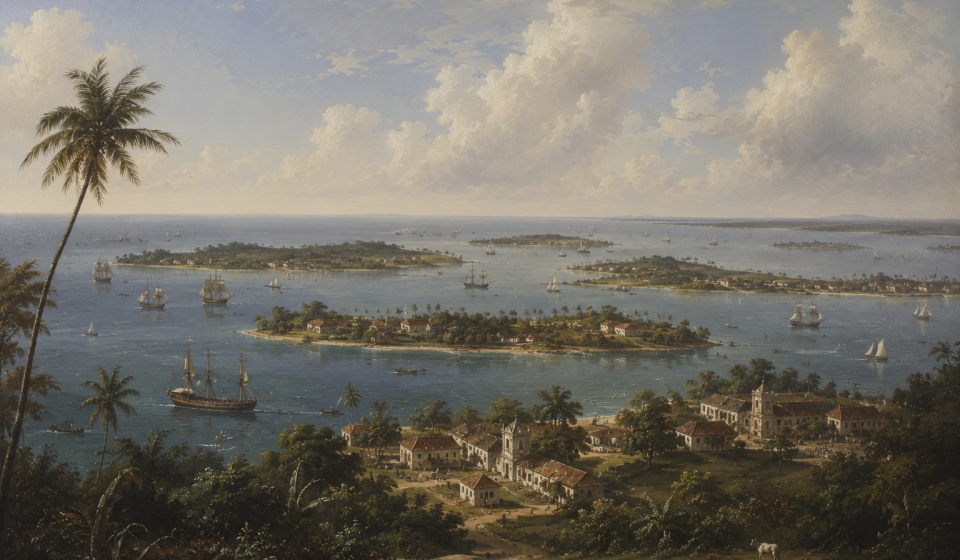
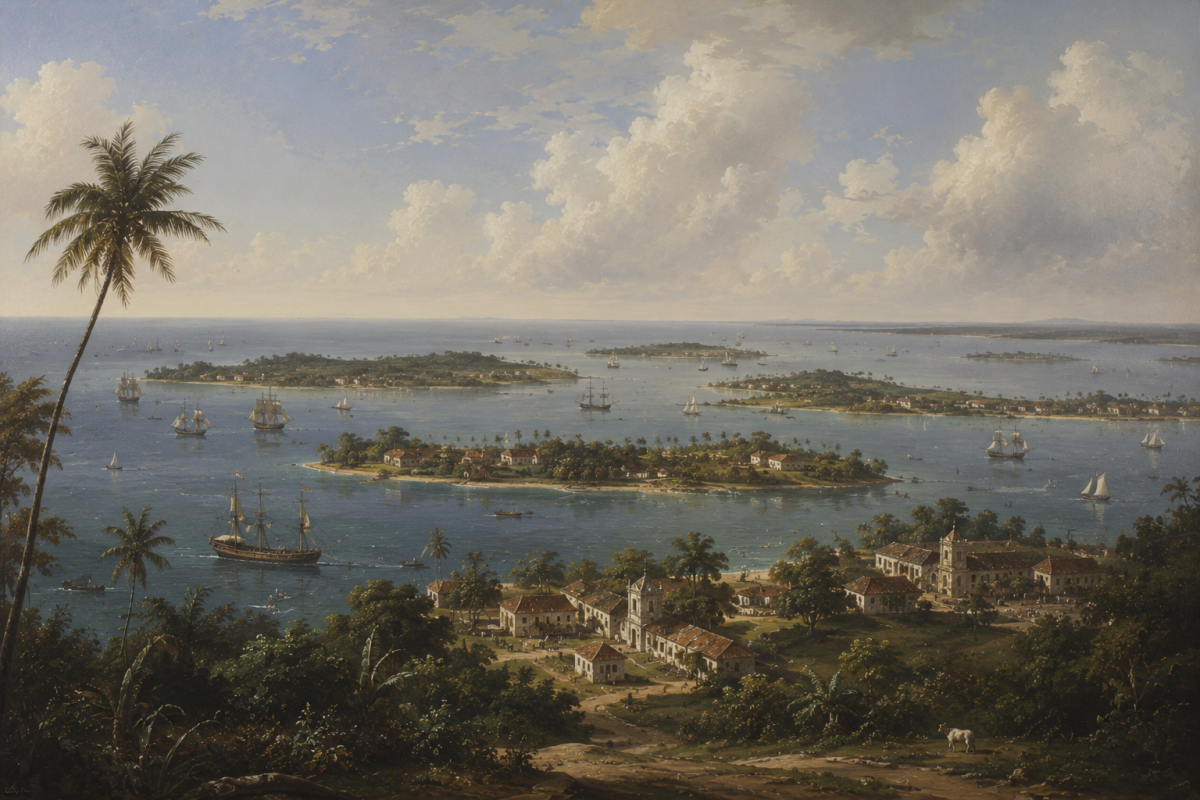
Few great cities have a stranger title deed than Bombay. In 1661, when King Charles II of England married the Portuguese princess Catherine of Braganza, her dowry included, alongside Tangier and a fortune in money and sugar, the port and island of Bombay on the western coast of India. Portugal, hard pressed in its war with Spain and losing ground to the Dutch in Asia, paid in territory for an English alliance. A cluster of malarial islands held by Portugal since 1534 thus changed sovereigns through a marriage contract signed in Europe.
The transfer itself was farce before it was history. The Portuguese authorities on the spot, appalled at the bargain made in Lisbon, obstructed the handover for years, quibbling over whether the grant meant the island alone or its dependencies, and the English fleet sent to take possession in 1662 was refused landing, its soldiers left to sicken and die on a barren islet nearby. Possession was finally yielded in 1665. The Crown then discovered what it had acquired, a distant, unhealthy possession costing money and returning nothing. In 1668 Charles II solved the problem in character, leasing Bombay to the East India Company for a rent of ten pounds a year in gold. For the price of a modest annuity, the Company obtained what Surat could never be, a harbour of its own under its own flag.
The making of Bombay was above all the work of Gerald Aungier, president of Surat and governor of Bombay in the 1670s, who saw in the swampy archipelago the city which, by God’s assistance, is intended to be built. Aungier fortified the harbour, established courts and a militia, guaranteed liberty of conscience in an age of persecution, and deliberately invited merchants and artisans of every community. Gujarati banias, Parsi shipbuilders and traders fleeing the insecurity of the mainland, Armenian and Jewish merchants, weavers and goldsmiths came under promises of toleration and protection. The Parsis in particular made the city their own, and the shipyards later led by the Wadia family would build vessels for the Company and the Royal Navy for two centuries.
Geography and politics drove the rise. Surat, the old headquarters, lay up a river under Mughal authority, and its vulnerability was advertised to the world when the Maratha leader Shivaji sacked the city in 1664 and again in 1670, sparing the English factory only after hard fighting. A defensible deep water harbour, subject to no inland power, looked more valuable with each alarm. In 1687 the Company transferred its western headquarters from Surat to Bombay, completing the pattern that now ran down the coasts of India: three English settlements, Madras, Bombay and soon Calcutta, each fortified, each under Company government, each filling with Indian subjects who chose its protection.
Growth was neither smooth nor safe. The climate devoured Europeans, and a governor could reckon his council’s mortality by the season. In 1683 the garrison itself rebelled under Captain Richard Keigwin, holding the island against the Company for a year in the name of the King before submitting. The war that the Company’s London chairman Sir Josiah Child provoked with the Mughal empire in the 1680s brought the Sidi admiral of the Mughals onto the island, and Bombay was nearly lost before peace was begged. The city that would one day be called the gateway of India spent its first decades learning humility.
Yet the foundations held. The islands were slowly joined by causeways and reclamations into a single landmass, a labour that continued into the nineteenth and twentieth centuries. The harbour drew the trade of the western ocean, cotton and later opium moving to China, and the city became the Company’s window on Persia, Arabia and Africa. When steam and the Suez Canal came, Bombay’s position made it the first port of India and its commercial capital, a rank it has never surrendered.
The dowry islands, leased for ten pounds a year, became the richest city of the subcontinent. History rarely offers a plainer lesson in the difference between what rulers value and what time does.
1600 to 1720 - The Arrival
Part 5 of 10 in this chapter.