
 In 30 Seconds




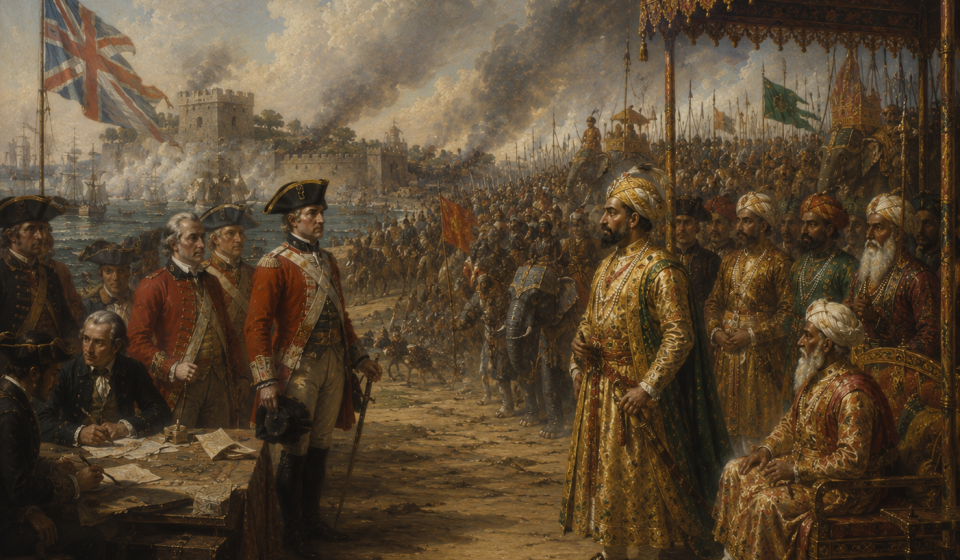
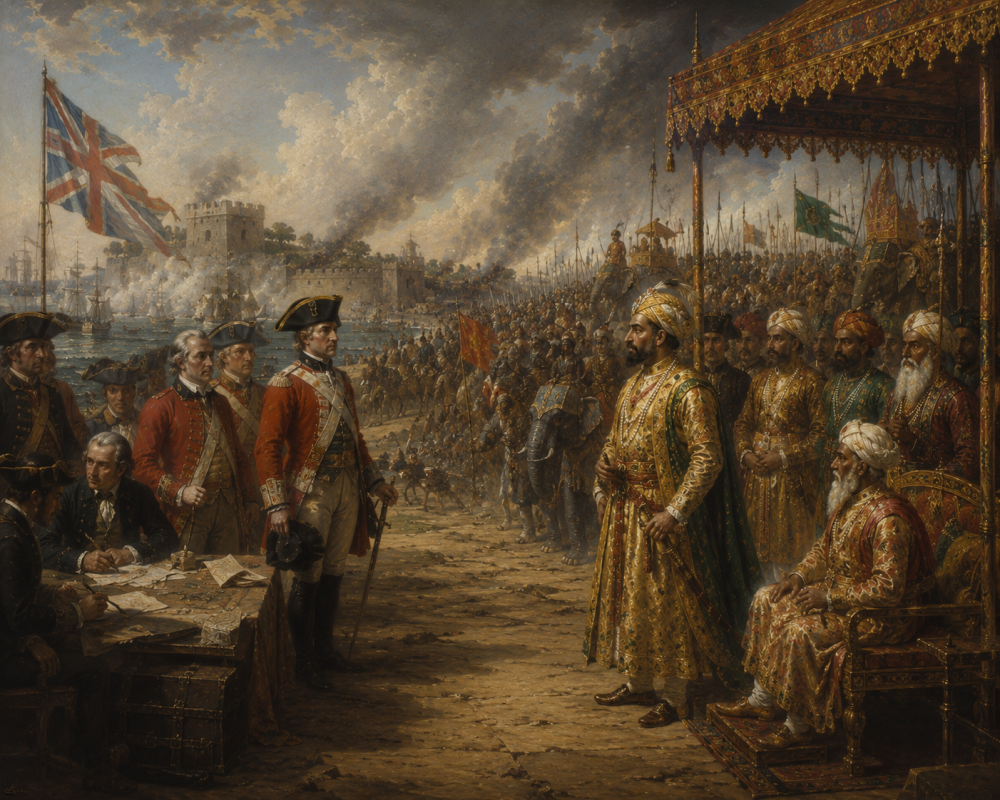
In the 1680s the East India Company committed the most spectacular blunder of its first century. Intoxicated by rising profits, new fortifications and the theories of its domineering London chairman, Sir Josiah Child, the Company declared war on the Mughal empire of Aurangzeb, the greatest military power in Asia. The conflict, remembered as Child’s War, lasted from 1686 to 1690 and ended with the merchants of London kneeling, through their agents, before the emperor’s throne.
The road to war ran through Bengal. The Company’s trade there had grown enormous, but so had its grievances, real and inflated. Mughal governors levied customs and demanded presents in ways the English considered extortion, while the English stretched their trading privileges in ways the Mughals considered fraud. The deeper cause was a change of doctrine in London. Josiah Child, who dominated the Company’s courts in the 1680s, had abandoned the old wisdom of Sir Thomas Roe that profit lay in quiet trade. The Dutch had shown, he argued, that trade in Asia rested on power. The Company must become a sovereign presence, holding fortified places by right and not by favour, so that its commerce would rest, in the words of the directors, on the foundation of a large, well grounded, sure English dominion in India for all time to come. It was the first open statement of imperial intent, made seventy years before Plassey, and it was made about a century too early.
The war plan was grandiose, the forces comic. An expedition of a few hundred soldiers was sent to seize Chittagong and coerce Bengal, and after delays and confusion the English under Job Charnock found themselves fighting skirmishes on the Hooghly, retreating downriver from Hooghly town to Sutanuti and finally to the fever island of Hijli, where disease destroyed what fighting had spared. On the west coast the Company’s ships took Mughal vessels as prizes, and Bombay prepared for glory. The empire’s response was unhurried and crushing. The Sidi of Janjira, the Mughal admiral, landed on Bombay island in 1689, penned the English into their castle and occupied most of the island for over a year. Surat’s factors were arrested, trade stopped everywhere, and the Company faced simple extinction in Asia.
Aurangzeb could have finished the English altogether, and some at his court urged it. He chose instead the contempt of mercy, influenced by the useful services English shipping performed for the pilgrim trade and by the sound Mughal principle that foreign merchants were a source of revenue not worth exterminating. The Company sued for peace in terms of abject submission. Its envoys appeared at court, by the accounts that delighted its rivals, with hands bound in token of guilt, and the emperor’s farman of 1690 pardoned the English upon payment of an indemnity and the restoration of good behaviour. That same year Charnock returned quietly to Sutanuti, and from the wreckage of the war the settlement of Calcutta was born, a strange fruit of catastrophe.
The humiliation preserved the Company but transformed its position in ways no one fully grasped. In the years that followed, the English were permitted to fortify Calcutta as useful auxiliaries against rebellion and piracy, and the three presidency forts, William, St George and Bombay castle, hardened into small armed states in waiting. Child’s doctrine, discredited in the field, survived in the charters, which retained the rights of war, coinage and government. The Company had learned not that dominion was wrong but that it was premature. Against Aurangzeb at the height of Mughal power, forty years of empire building ambition had been swatted like an insect. Against the successor states of a fractured empire, sixty years later, the same ambitions would meet no such wall.
Child’s War thus occupies a peculiar place in the story of British India. It was defeat as prophecy. The war revealed, in embryo, everything that was coming, the imperial doctrine, the presidency armies, the readiness to fight Indian powers for commercial ends, and it revealed equally that the timetable of empire would be set not by London’s ambitions but by the strength or weakness of India itself. When the Mughal peace dissolved in the eighteenth century, the heirs of the men who had knelt before Aurangzeb picked up the sword their predecessors had been forced to drop.
1600 to 1720 - The Arrival
Part 7 of 10 in this chapter.