 In 30 Seconds




In the late summer of 1751 the English cause in southern India had shrunk to a single besieged city. Their candidate for the Carnatic throne, Muhammad Ali, was penned inside Trichinopoly by the French backed Nawab Chanda Sahib with the bulk of his army, and Madras could neither raise the siege nor afford to lose it. Into this stalemate stepped a twenty six year old former clerk with a plan of pure audacity, to attack not the besiegers but their capital.
Robert Clive had come to India at eighteen as a writer, the lowest grade of Company servant, homesick, quarrelsome and twice, by the legend, driven to attempt his own life. The wars had released him from the ledgers. He had escaped from captured Madras in disguise, fought as a volunteer, and shown at the siege of Devikottai a talent that his superiors noted. Now, holding a temporary commission, he persuaded the governor of Madras that a stroke at Arcot, Chanda Sahib’s capital, would compel the Nawab to divide his forces before Trichinopoly. He was given what could be spared, which was almost nothing, around two hundred European soldiers and three hundred sepoys, with three small field guns, and eight officers of whom half had been, like himself, clerks weeks before.
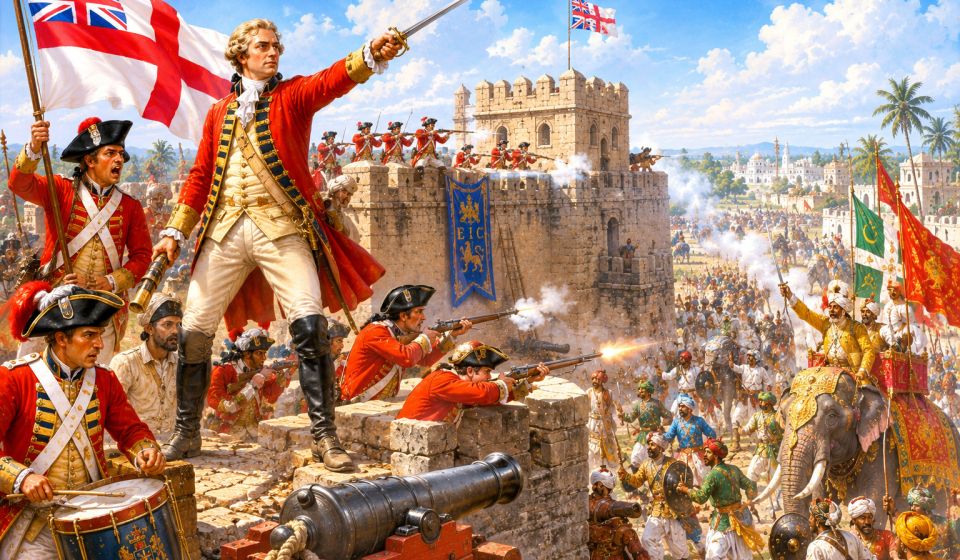
The capture was theatre. Clive’s little force marched the sixty odd miles from Madras through a violent thunderstorm, and the garrison of Arcot, hearing that the English came on through lightning that should have scattered them, decided such men were not to be faced and abandoned the fort. Clive occupied it without a shot on 1 September 1751 and set about preparing for the counterblow he had invited. It came within weeks. Chanda Sahib detached a strong force under his son Raza Sahib, with French support, and by late September Clive was shut inside a decayed fort with a garrison already whittled by sorties to fewer than a hundred and twenty Europeans and two hundred sepoys, facing an army reckoned in the thousands.
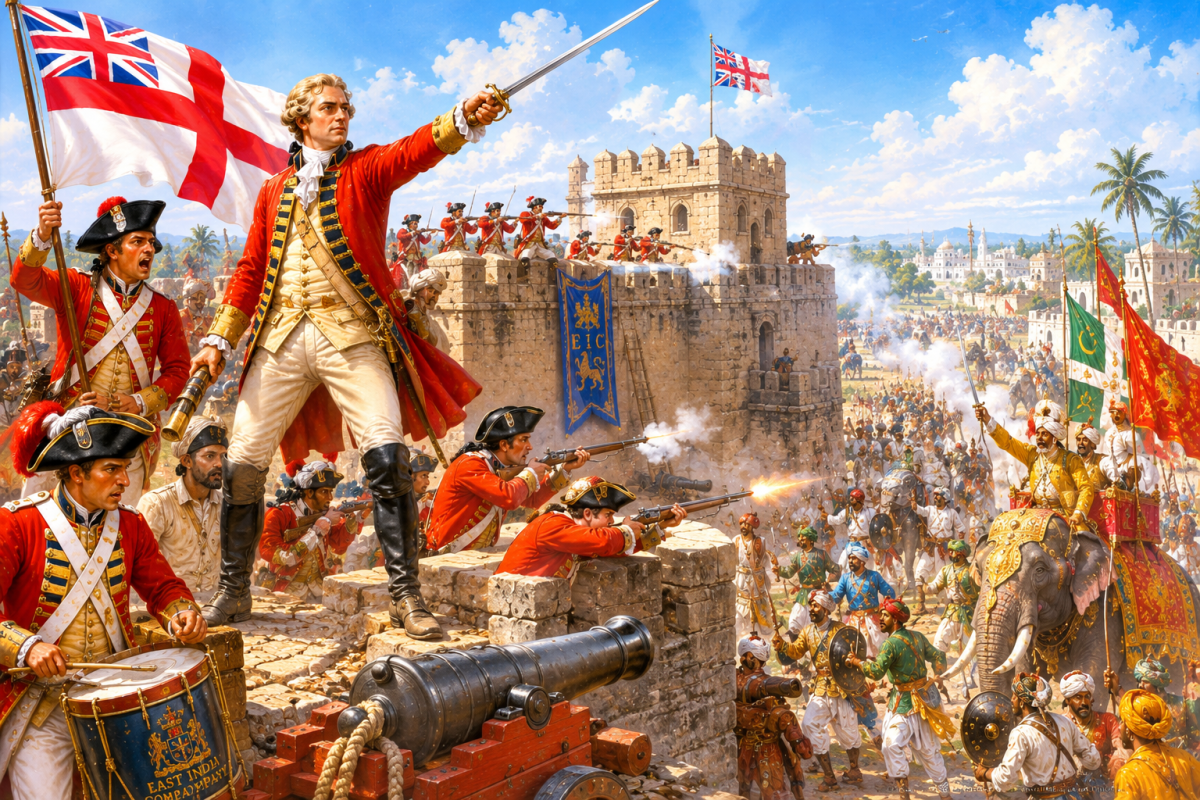
The siege lasted fifty days and made the reputation on which British India was built. The defenders repaired breaches under fire, dragged their few guns from wall to wall, and beat back assaults at the breach and the gates, Clive himself serving a gun at the crisis. The story told ever afterward, and preserved by the historian Orme, was that the sepoys of the garrison offered to yield the thin rice ration to the Europeans and sustain themselves on the water it was boiled in, a tale that became the founding legend of the sepoy army’s loyalty. On 14 November, after a final grand assault led by armoured elephants whose iron plated heads turned back maddened under musketry, Raza Sahib raised the siege and marched away.
Strategically the fifty days achieved exactly what Clive had promised. The siege of Trichinopoly slackened as forces were drawn off, allies rallied to a cause that suddenly looked alive, and in the campaigns that followed, at Arni, at Kaveripak, and finally before Trichinopoly itself, the French party’s grip on the Carnatic was broken. Chanda Sahib surrendered to Tanjorean allies of the English and was put to death. By 1752 Muhammad Ali, the Company’s client, was effectively Nawab, and though war smouldered on until Dupleix’s recall, the verdict of Arcot stood. In London, William Pitt the Elder hailed Clive in Parliament as a heaven born general, a phrase that pursued him, in praise and irony, for the rest of his life.
Arcot deserves its fame, but it deserves clear sight more. It was a small action in a proxy war, won by audacity, luck and the new infantry discipline, and its deepest significance was psychological. It taught the English that the French system could be beaten at its own game, taught India’s princes that English protection was worth bidding for, and taught Clive what he could dare. Six years later, on a mango grove battlefield in Bengal, that lesson in daring would be applied with consequences beside which the Carnatic wars were a rehearsal. The road to Plassey began at Arcot.
1707 to 1765 - The Empire Cracks, the Company Rises
Part 7 of 10 in this chapter.