
 In 30 Seconds




In 1744 the War of the Austrian Succession, a European quarrel over a German throne, reached the Coromandel coast, and the century old truce of the trading companies collapsed. The First Carnatic War that followed, from 1746 to 1748, decided little on paper, for the peace treaty restored everything taken. But one afternoon’s fighting beside the Adyar river outside Madras changed the military assumptions of a subcontinent, and nothing in India was ever quite the same.
The war began at sea and went badly for England. The French governor Dupleix, whose Pondicherry lay exposed, proposed neutrality in India, but the arrival of a British squadron made the offer moot, and the French answer came from the ocean. Bertrand La Bourdonnais, the tempestuous governor of the French islands, built and led a fleet across the bay, fought the British squadron to a standstill, and in September 1746 landed before Madras. The English town, weakly fortified and poorly led, surrendered within days. Among the junior clerks who escaped the captured city, disguised, by night, to the English refuge at Fort St David, was a moody young writer named Robert Clive, whose profession the war was about to change.
Victory immediately split the victors. La Bourdonnais, influenced by considerations that included a substantial private payment, agreed to ransom Madras back to the English. Dupleix furiously repudiated the bargain, held the city, and saw his rival sail home to eventual imprisonment. But Dupleix had a second problem. To keep the peace on the coast he had promised Anwaruddin, the Nawab of the Carnatic and nominal sovereign of both European settlements, that Madras when taken would be handed to him. Dupleix now declined to deliver, and the Nawab sent his army, ten thousand horse and foot under his son Mahfuz Khan, to take the city from the French.
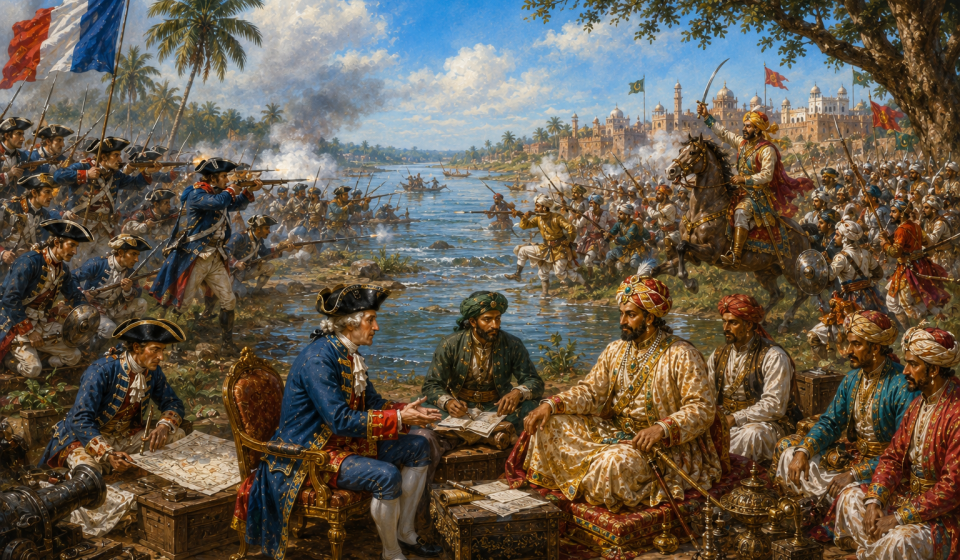
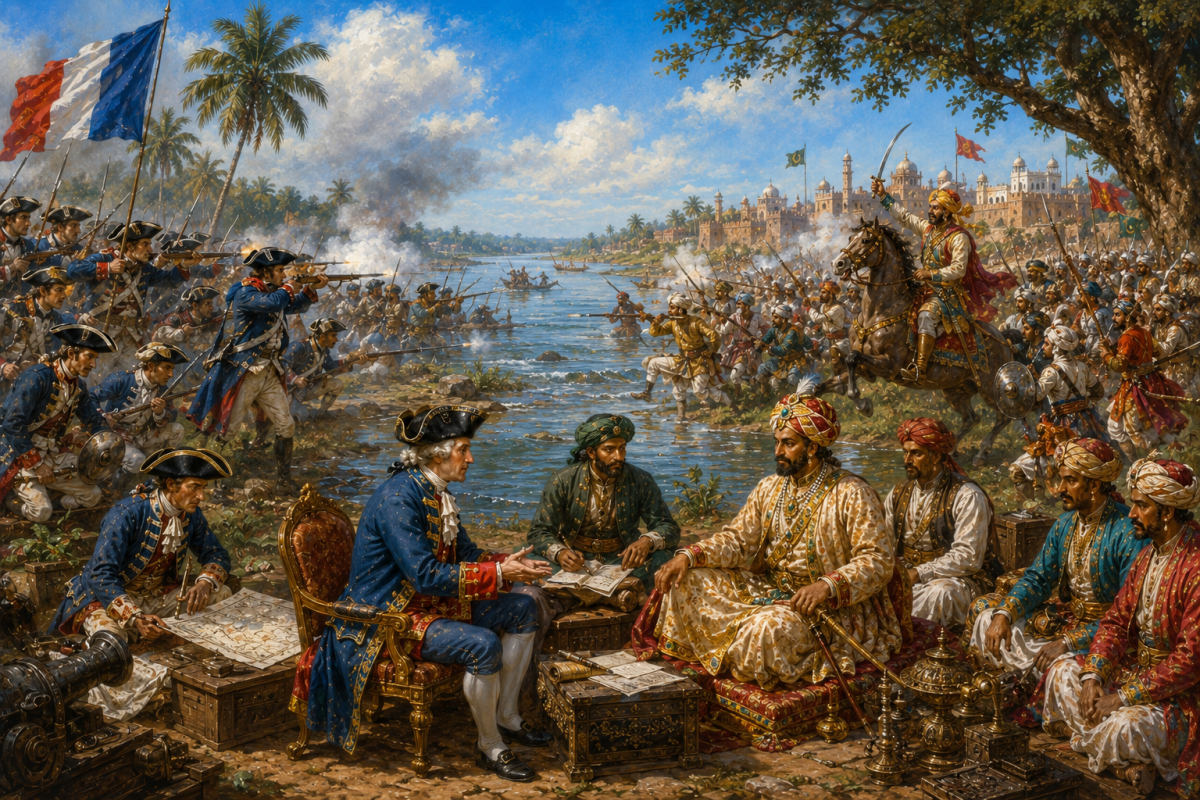
The armies met at the crossing of the Adyar river on 24 October 1746. The French force was absurd by every conventional measure, a few hundred European soldiers and a somewhat larger body of newly drilled Indian sepoys, barely a thousand muskets in all, under a Swiss engineer named Paradis. Military wisdom, Indian and European alike, held that such a detachment must be swallowed by the Nawab’s host. Instead Paradis attacked. His infantry crossed the river under fire, formed, and delivered disciplined volleys by platoon, a continuous rolling fire no Indian army of the day could match, then went in with the bayonet. The Nawab’s cavalry, brave but unable to close through the musketry, broke. The army that was to have retaken Madras dissolved in an afternoon with trifling French loss.
Contemporaries on both sides understood at once that something fundamental had been revealed. The battle of Adyar, wrote observers, disclosed the secret that disciplined infantry with rapid fire and field guns could defeat Indian cavalry armies many times their size. The secret lay not in courage, which the Nawab’s horsemen had in plenty, nor in any mystery of race, but in drill, in the socket bayonet, in improved flintlocks and in the platoon firing systems perfected on European battlefields, none of which Indian armies had yet absorbed. Dupleix drew the further conclusion that sepoys, Indian soldiers trained and equipped in the European manner, could multiply a company’s power indefinitely at Indian rates of pay. Both companies began recruiting in earnest. The sepoy army, the instrument that would conquer India largely with Indian hands, was born on the Adyar’s banks.
The rest of the war anticlimaxed. Dupleix besieged Fort St David and failed. A British fleet and army besieged Pondicherry in 1748 and failed in their turn, the defence conducted by Dupleix with skill and celebrated by France. Then word arrived that the war in Europe was over, and the treaty of Aix la Chapelle traded Madras back to England in exchange for a fortress in the Americas, as though nothing had happened.
Everything had happened. The companies now possessed armies, the knowledge of what those armies could do against Indian powers, and a coast full of Indian succession disputes inviting intervention. Peace between the crowns of Europe merely meant that the next war in India would be fought, with barely a pause, through Indian proxies. Dupleix was already choosing his.
1707 to 1765 - The Empire Cracks, the Company Rises
Part 5 of 10 in this chapter.