
 In 30 Seconds




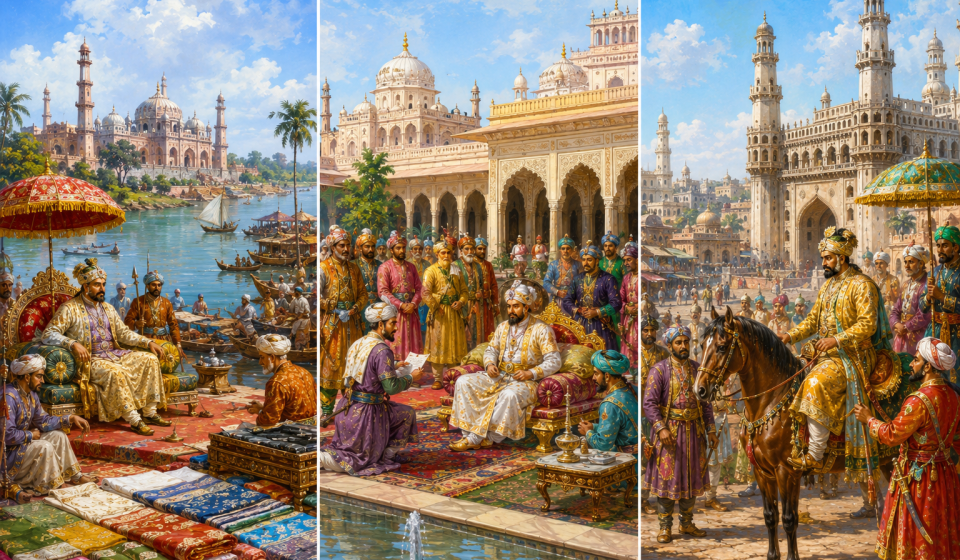
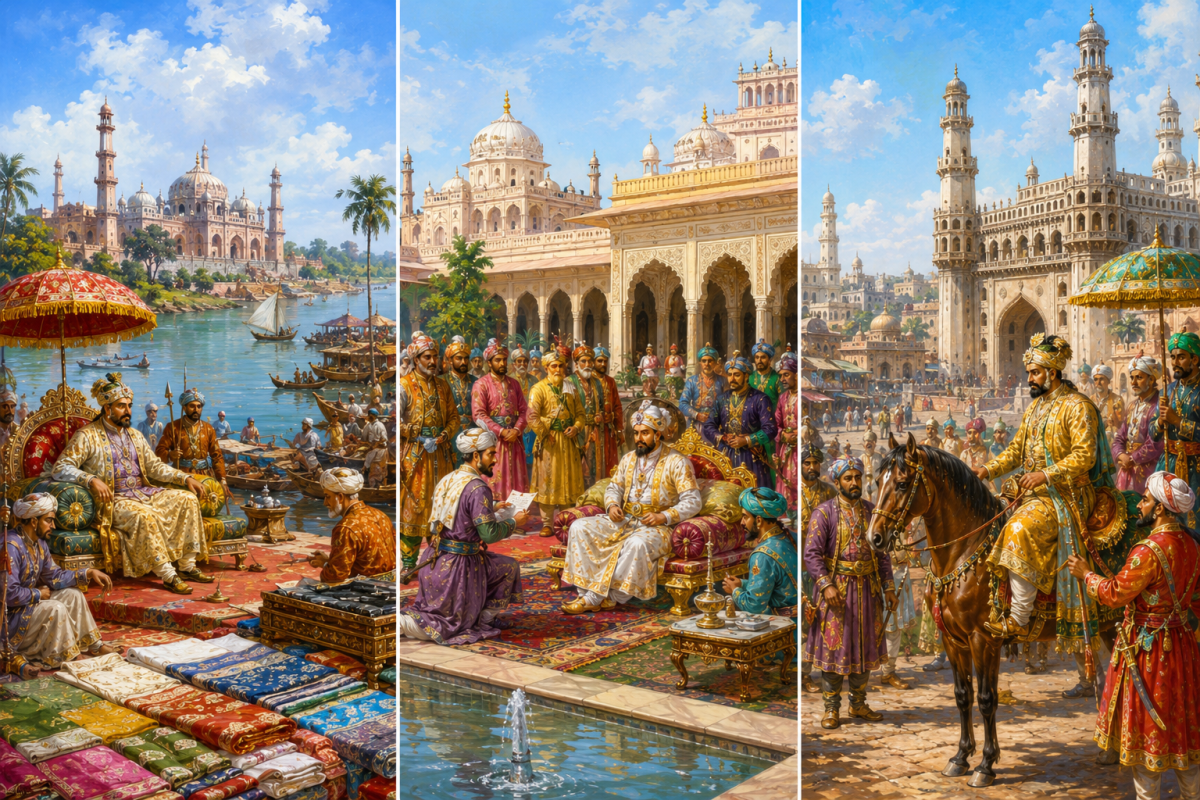
The Mughal empire did not shatter like glass. It dissolved like a great estate whose stewards quietly became owners, keeping the portraits of the old family on the walls. The three greatest of these stewards built the states that dominated the politics of the eighteenth century and shaped the destiny of the East India Company: Bengal, Awadh and Hyderabad.
Bengal came first and mattered most. Murshid Quli Khan, a revenue officer of genius who had risen from obscure origins, was appointed to Bengal’s finances under Aurangzeb and gradually gathered the offices of diwan and nazim, finance and government, into his own hands. He moved the capital from Dhaka to a city that took his name, Murshidabad, and reorganised the revenue system with a rigour that made Bengal the most profitable province of the empire, its annual surplus flowing to Delhi long after other provinces had stopped paying. When he died in 1727, the office passed within his family, and after a coup in 1740 to the able soldier Alivardi Khan. The succession was blessed, for a price, by Delhi, but the reality was a hereditary kingdom. Under these Nawabs Bengal prospered mightily, its silk and muslin, saltpetre and rice drawing the trade of all nations, its bankers, above all the house of the Jagat Seths, financing state and commerce alike. The province’s wealth was the envy of India, and envy, in time, would be its undoing.
Awadh was founded in 1722, when the Persian noble Saadat Khan Burhan ul Mulk was appointed its governor. He subdued the turbulent zamindars of the Gangetic plain, doubled the revenues, and made the province a power. His successors, styled Nawab Wazirs, for they held the hereditary vizierate of the empire, ruled from Faizabad and then from Lucknow, a court that became the last great flowering of Indo Persian high culture. Awadh’s position made it the hinge of northern India, the buffer between whatever powers held Delhi and Bengal, a role that would place it at the centre of the wars of the 1760s and keep it, mutilated but alive, a British ally and victim until 1856.
Hyderabad was the creation of the most formidable politician of the age. Nizam ul Mulk Asaf Jah, twice disgusted by the faction ridden court of Delhi, where he had briefly served as the emperor’s chief minister, withdrew to the Deccan, defeated the governor sent to displace him at the battle of Shakar Kheda in 1724, and thereafter ruled the vast Mughal Deccan as his own dominion. He never renounced the emperor, never struck coins in his own name, and never obeyed an order that displeased him. His state, squeezed between Maratha power to the west and the coastal ambitions of Europeans to the east, survived by diplomacy, playing every rival against every other, a habit the dynasty retained for two centuries. It was in the succession struggles of Hyderabad and its Carnatic dependency, after the old Nizam died in 1748, that the French and English first fought their proxy wars for the mastery of India.
These successor states were not decadent fragments. Recent historians have stressed their vigour, their administrative sophistication, their thriving economies and their genuine attempts to build stable rule out of imperial decline. Bengal under Alivardi held off the devastating Maratha raids of the 1740s. Awadh’s revenue machinery impressed even its conquerors. Hyderabad’s chancery was a school of statecraft. Their weakness lay elsewhere, in the problem none of them solved, which was legitimacy and succession. Because each throne was formally a Mughal governorship, every succession was contestable, every contender sought allies and money, and the readiest source of disciplined troops and naval power was European. The Europeans, for their part, discovered in these succession disputes a commodity more profitable than cloth, which was kingmaking.
The successor states thus prepared their own subordination, not through weakness of arms but through the openness of their politics. Bengal fell first, at Plassey in 1757, precisely because it was richest. Awadh was defeated at Buxar and converted into a buffer. Hyderabad survived by embracing subordination early, becoming the first great subsidiary ally in 1798. The stewards had become owners, and the owners, one by one, acquired a partner who would not leave.
1707 to 1765 - The Empire Cracks, the Company Rises
Part 2 of 10 in this chapter.