
 In 30 Seconds




In the spring of 1739 the richest city on earth was given over to massacre and plunder by a Persian conqueror, and the myth of Mughal invincibility, already hollow, was broken in a manner all Asia could see. The invasion of Nadir Shah was brief, barely a year from border to departure, but its consequences ran through the rest of the century, and among its beneficiaries, at the far end of the chain, sat the East India Company.
Nadir Shah was a soldier of fortune who had risen from Khurasani obscurity to seize the throne of Persia, expelling Afghan usurpers and rebuilding the Persian army into the finest fighting machine in Asia. His wars needed money, and beyond the Khyber lay the fabled treasury of Hindustan, guarded by an empire whose weakness was advertised by every ambassador. The pretexts were ready, Mughal failure to seal the border against fleeing Afghans and the discourtesies of a distracted court. In 1738 he took Kandahar, then Kabul, then Peshawar, and crossed the Indus. Lahore bought its safety with tribute. The empire finally assembled its grand army, and in February 1739, at Karnal, north of Delhi, the two hosts met.
The battle lasted a few hours. The Mughal army, enormous, splendid and commanded by rivals who barely spoke to one another, was shattered by Persian musketry and mobile tactics. Saadat Khan of Awadh was captured, the veteran Khan Dauran mortally wounded, and the emperor Muhammad Shah came to Nadir’s camp as a guest who was also a prisoner. The two monarchs entered Delhi together in March, and for a moment it seemed the affair might end as an enormous extortion politely conducted.
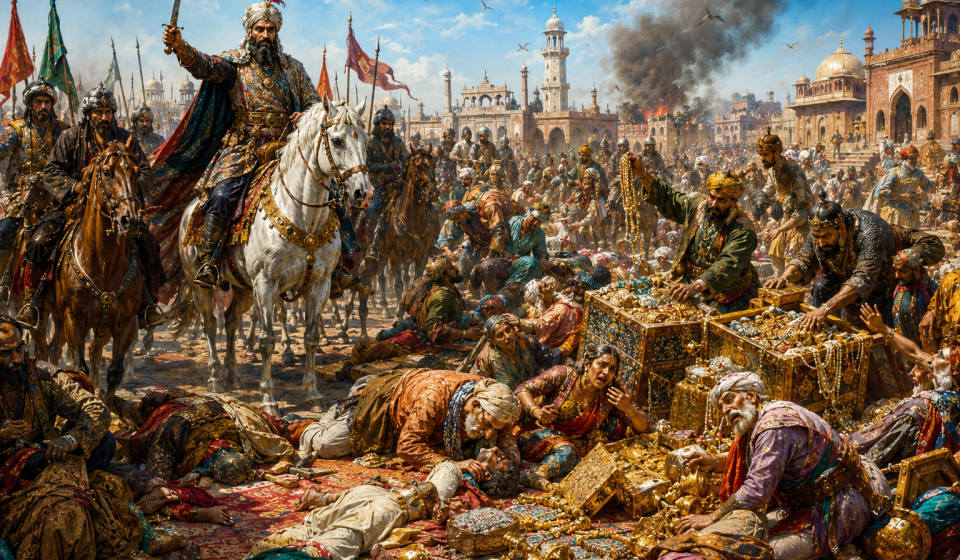
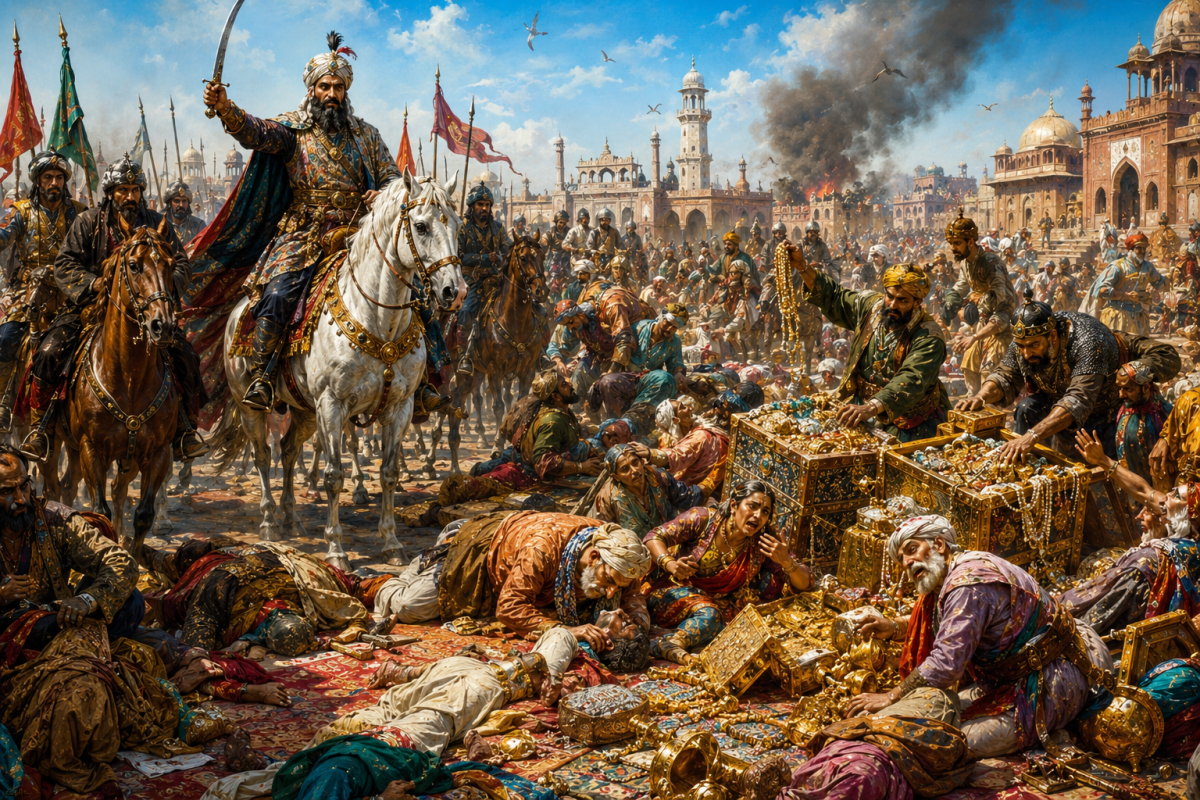
Then the city rose. A rumour of Nadir’s death sparked riots in which Persian soldiers were killed, and on 22 March 1739, from the roof of the Sunehri Masjid in Chandni Chowk, Nadir Shah ordered a general massacre. For the better part of a day his troops killed methodically through the lanes of Old Delhi, the toll commonly reckoned at twenty thousand and by some accounts far higher, while quarters of the city burned. The emperor’s ministers at last begged mercy, and Nadir, having demonstrated the price of resistance, called off the slaughter with a word, a discipline more chilling than the rage.
The plunder that followed was the greatest transfer of treasure in early modern history. The accumulated wealth of two centuries of Mughal splendour, coin, plate, jewels, the Peacock Throne of Shah Jahan itself, with the Koh i Noor and Darya i Noor diamonds, was inventoried and packed for Persia. Contemporary estimates of the total ran to seventy crores of rupees and beyond, a sum so vast that Nadir remitted the taxes of Persia for three years. He annexed everything west of the Indus, married his son into the imperial house, restored Muhammad Shah to a throne now stripped of its jewels, and marched away in May 1739 leaving a wounded, humiliated shell.
The consequences cascaded. The empire’s treasury and prestige never recovered, and the frontier defences were gone, so that when Nadir was assassinated in 1747 his Afghan general Ahmad Shah Abdali inherited both his best troops and his Indian ambitions, returning to invade India repeatedly through the 1750s and 1760s. Delhi’s weakness invited every power to help itself. The Marathas pushed north into the vacuum, setting up the collision with the Afghans that would come at Panipat in 1761. Bengal’s Nawab watched the lesson and trusted Delhi’s protection no further. And on the coasts, the European companies drew the deepest conclusion of all. The empire that had once made Child’s War hopeless could no longer defend its own capital. An observer in Calcutta or Pondicherry in 1740 could reasonably calculate that armed force, applied at the right moment in Indian politics, would meet no imperial answer.
Nadir Shah took the treasure and broke the spell. The half century that followed his sack of Delhi was a scramble among successors, and the eventual winner of that scramble was already ashore, keeping its books, drilling its first sepoys, and waiting for its moment.
1707 to 1765 - The Empire Cracks, the Company Rises
Part 3 of 10 in this chapter.