 In 30 Seconds




In 1772 the East India Company, sovereign of the richest provinces in Asia, could not pay its bills. The diwani years had produced fortunes for individuals and insolvency for the corporation, and when the directors applied to the British government for a loan of a million pounds, Parliament attached its price. The Regulating Act of 1773 was the first assertion of the British state’s authority over the Company’s Indian empire, and with it began both the constitutional history of British India and the extraordinary governorship of Warren Hastings.
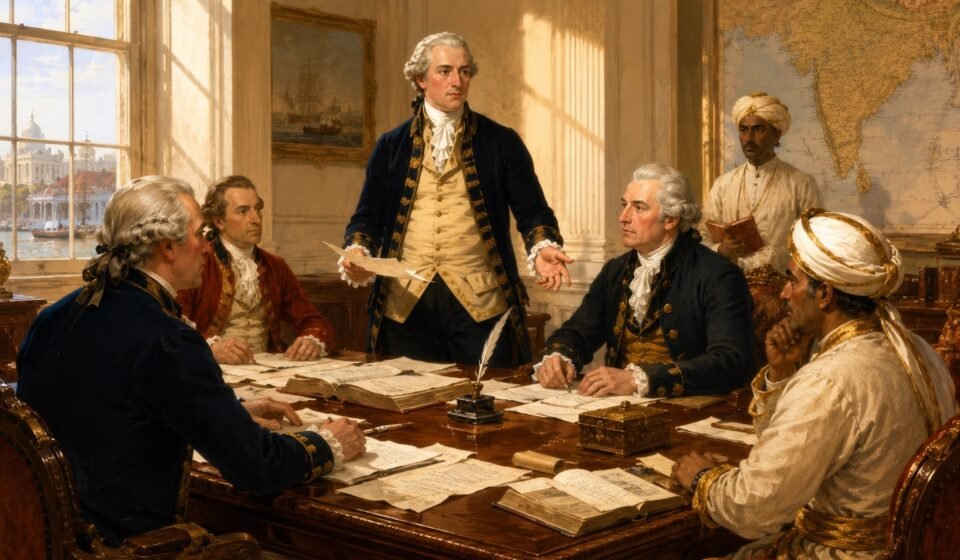
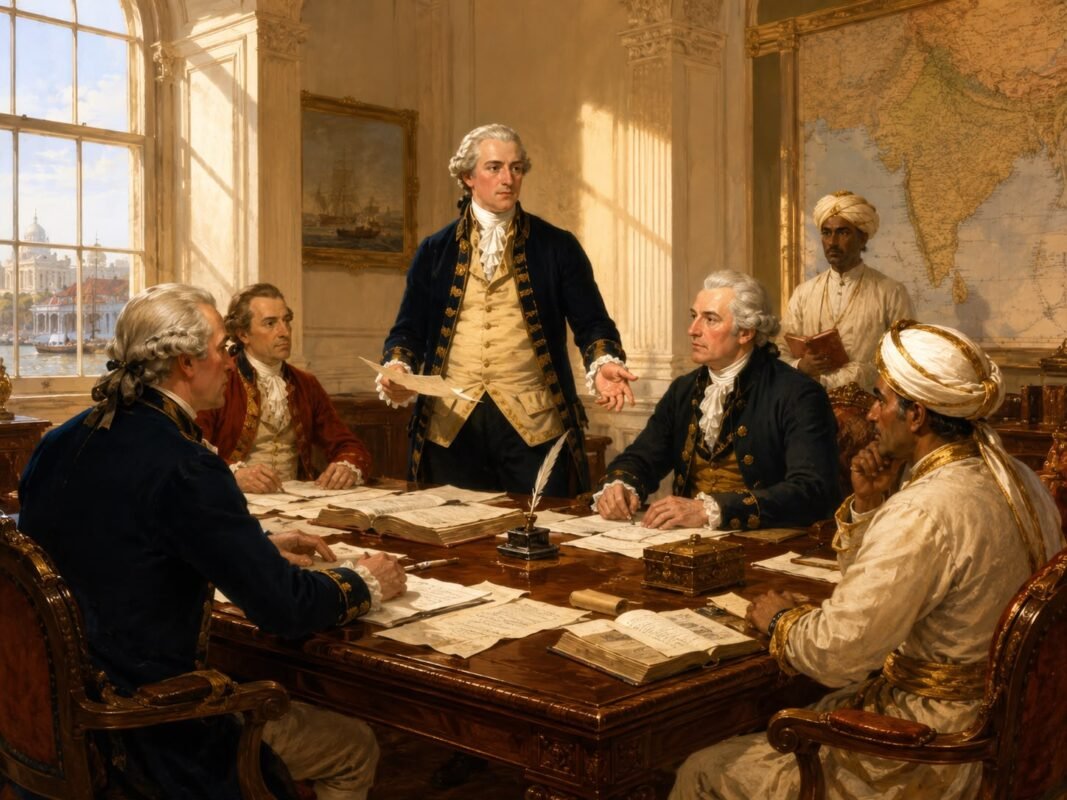
The Act’s machinery was clumsy and its every clause bred future quarrels, but its principles were momentous. The Governor of Bengal became Governor General of Fort William, with a supervising authority over Madras and Bombay, so that British India acquired, in embryo, a single head. He was to govern with a council of four, decisions by majority, a design that assumed harmony and produced war. A Supreme Court of royal judges was established at Calcutta, English law planted beside Indian society with a jurisdiction so ill defined that court and council were soon at each other’s throats. The Company’s home constitution was reformed, and its correspondence laid open to ministers. The state had put its hand upon India and would never remove it.
Warren Hastings, named in the Act as the first Governor General, was already governor and already remaking Bengal. A Company servant since boyhood, fluent in Urdu and Persian and steeped in the country as few of his nation ever were, he had in 1772 ended Clive’s dual system, dismissed the Indian deputy diwans, and brought the revenue administration under direct Company management, with English collectors in the districts and a Board of Revenue in Calcutta, the true beginning of British administration in India. He reorganised the courts into a hierarchy of civil and criminal jurisdiction, and he ordered the compilation of Hindu and Muslim law for the guidance of judges, insisting that Indians be governed by their own laws, a principle from which much good and much mischief would flow.
His rule was immediately poisoned by the Act’s own creations. Three of his new councillors, led by the brilliant and venomous Philip Francis, arrived from England in 1774 convinced of his corruption and determined on his ruin, and for years the government of Bengal was a civil war conducted by minute and majority. Into this feud fell the case that has stained Hastings ever since. Maharaja Nandakumar, an old power at Murshidabad, laid charges of corruption against Hastings before the hostile majority. Shortly afterward Nandakumar was prosecuted for forgery, on a private complaint years old, before the new Supreme Court under Chief Justice Elijah Impey, Hastings’ lifelong friend. Convicted under an English statute making forgery capital, he was hanged in August 1775, to the horror of Calcutta. No evidence has ever proved collusion between Hastings and Impey, and no historian has ever quite believed the timing innocent. The affair, judicial murder to its critics, remains the darkest question mark of the age.
Hastings governed through storms that would have sunk a lesser seaman. The Rohilla war of 1774, in which he lent the Company’s brigade to Awadh to crush the Rohilla Afghans for a subsidy, was denounced as the hiring out of English arms. When the Maratha war and Haidar Ali’s invasion of the Carnatic threatened British India with destruction after 1778, Hastings stripped Bengal of money and troops to save Madras and Bombay, and found the money by methods that became the articles of his impeachment, the pressure upon Chait Singh, Raja of Benares, whose deposition sparked a rising, and the confiscations forced upon the Begums of Awadh. He fought his enemies with every weapon, including, in 1780, a pistol, wounding Francis in a duel. And amid it all he founded, with Sir William Jones, the Asiatic Society of Bengal, patronised the first English translation of the Bhagavad Gita, and left a tradition of orientalist scholarship that honoured the civilisation his masters were despoiling.
He sailed home in 1785, having preserved and organised British India, to face the vengeance of his enemies in the greatest political trial of the century. But the structure he and the Regulating Act had built, a Governor General, a council, a supreme court, an administration of districts and regulations, endured beneath every later reform. The empire had acquired its skeleton.
1765 to 1818 - Conquest
Part 3 of 10 in this chapter.