 In 30 Seconds




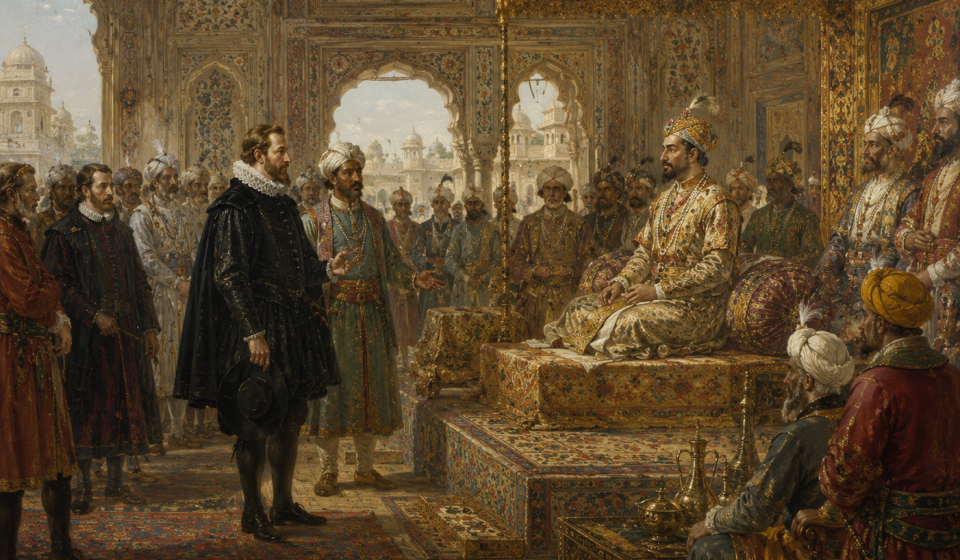
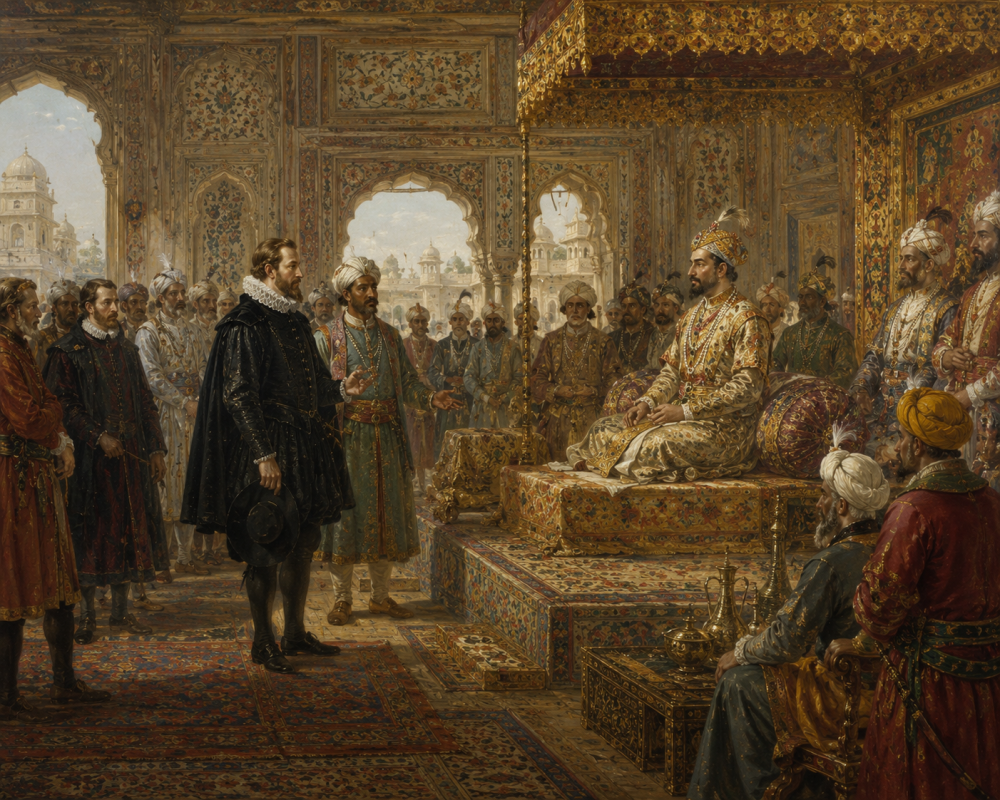
In September 1615 an English gentleman of good family and modest fortune landed at Surat as the accredited ambassador of King James I to the court of the Great Mughal. Sir Thomas Roe had been a courtier, a member of Parliament and an explorer of the Amazon. For nearly four years he would follow the peripatetic court of the emperor Jahangir from Ajmer to Mandu to Ahmedabad, keeping a journal that remains one of the most vivid European accounts of Mughal India, and pursuing, with limited success, a treaty that the empire saw no reason to sign.
The Company had asked for a royal ambassador because its merchants were being outmanoeuvred. Factors negotiating with governors could be squeezed, delayed and played against the Portuguese. Only the dignity of a king’s envoy, the directors reasoned, could secure firm privileges at the fountainhead of power. Roe took his dignity seriously. He refused the customary prostrations, insisted on European courtesies, and fought a running battle over precedence and gifts, painfully aware that his presents of English broadcloth, mirrors and paintings looked poor beside the jewels that crossed the Mughal court daily. Jahangir, a connoisseur of curiosities, was more taken with an English miniature portrait than with anything else the embassy offered, and once challenged his artists to copy it so exactly that Roe could not tell the original, a contest the ambassador diplomatically declared too close to call.
Roe’s journal records an empire at the summit of confidence. He describes the daily durbar where Jahangir appeared at the jharoka window, the weighing of the emperor against gold and silver on his birthday, the drinking bouts to which the emperor summoned him late at night, and the machinery of a court whose revenues dwarfed those of all Europe combined. He saw clearly what the disparity meant. England had nothing the Mughals needed, and the embassy of a distant island king was, from Agra’s perspective, a minor courtesy extended to a merchant nation that was useful at sea against the Portuguese.
The formal treaty of commerce that Roe sought never came, for the Mughal chancery did not make treaties with trading companies, and the concept of a binding agreement between equals had no place in its diplomacy with such petitioners. What Roe obtained instead were farmans and assurances, permissions to trade and reside at Surat and elsewhere, protection from arbitrary exactions, and a settled English position that outlasted his departure in 1619. It was less than London had dreamed of and more than the Portuguese wished to see.
The most consequential thing Roe brought home, however, was advice. Reflecting on the Portuguese, whose forts and garrisons consumed the profits of their trade, and on the Dutch, who were arming heavily in the islands, he wrote to the Company a sentence that became its scripture for a century. War and traffic, he warned, are incompatible. Let this be received as a rule, that if you will profit, seek it at sea and in quiet trade, for without controversy it is an error to affect garrisons and land wars in India. The Company took the advice to heart. Through the seventeenth century it remained, by policy and not merely weakness, an unarmed merchant in the Mughal world, its wars confined to the sea and to rivalry with Europeans.
The one great departure from Roe’s rule in that century, the reckless war against Aurangzeb in the 1680s, ended in humiliation and seemed to prove him right forever. Yet times changed as empires do. When Mughal authority dissolved in the eighteenth century, the heirs of Roe’s cautious merchants found that quiet trade required soldiers, then allies, then provinces, until the rule of 1619 was inverted and the Company itself became the garrison power he had warned against.
Roe went on to embassies at Constantinople and in Europe, and died in 1644 with India a memory. His journal survived him as both a source and a symbol, the record of a moment when an Englishman stood before the Mughal throne as a petitioner among the magnificences of an empire that could not imagine, any more than he could, how strangely the balance would turn.
1600 to 1720 - The Arrival
Part 3 of 10 in this chapter.