 In 30 Seconds




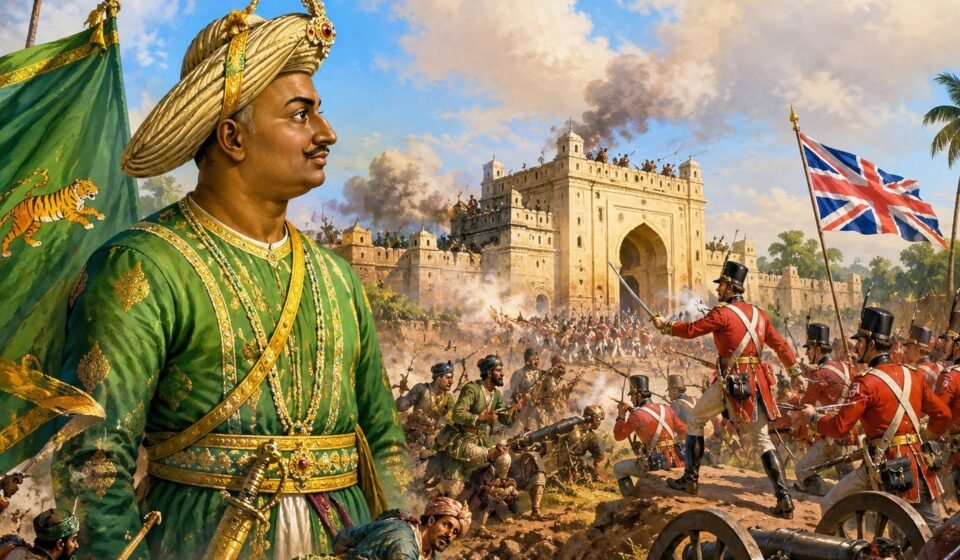
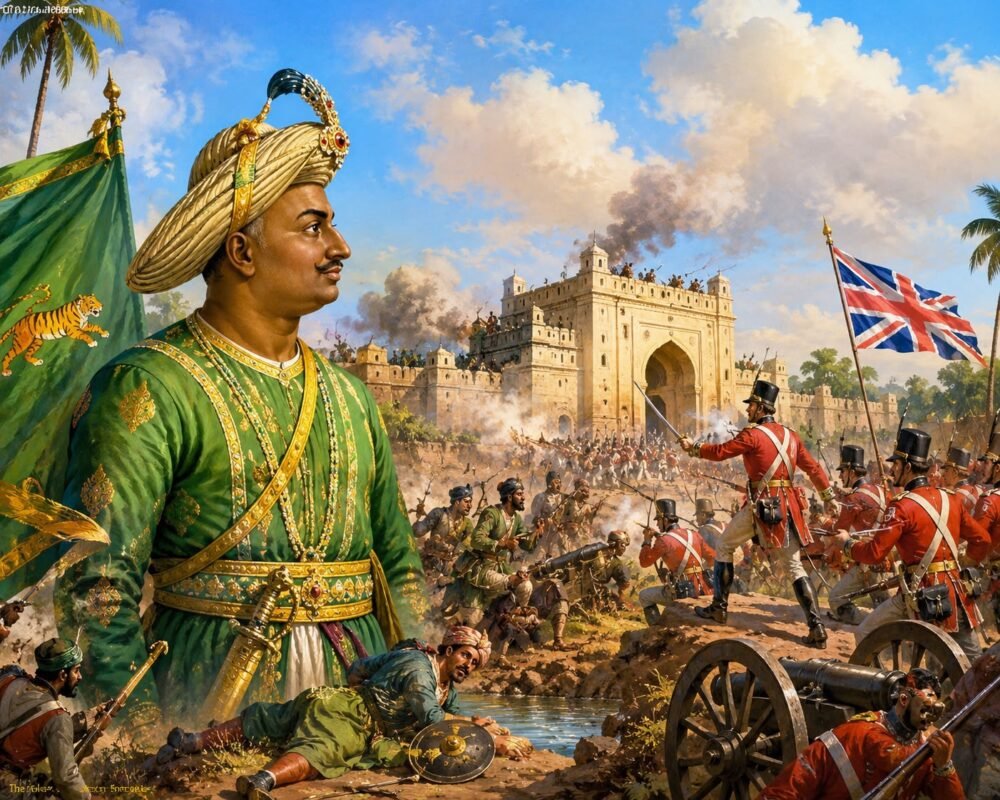
On 4 May 1799 the fortress capital of Mysore fell to a British storm, and among the heaped dead at the water gate the victors found, toward evening, the body of the Sultan, shot at close range, his sword still with him. Tipu Sultan had told his French officers that it was better to live one day as a tiger than a thousand years as a sheep, and he died by the sentence of his own maxim, the last ruler of an independent Indian power of the first rank to fall in battle against the Company.
He had inherited in 1782, at his father Haidar Ali’s death, a war, a modern army and an unfinished project, the making of Mysore into a state strong enough to survive the age. To that project Tipu brought an energy that astonished friend and enemy. He pressed the Second Mysore War to the honourable peace of Mangalore in 1784, then turned to construction. His government reached deeper than perhaps any in India, curbing intermediaries, dealing directly with the cultivator, founding state trading houses with factories abroad, planting sericulture that remains Karnataka’s inheritance, experimenting with a navy, new coinage, a new calendar, and the iron cased rockets that startled British armies and, studied at Woolwich afterward, entered the world’s arsenals. His library, his correspondence and his restless ordinances reveal a ruler of the workshop and the ledger as much as the saddle, an Indian contemporary, in spirit, of the modernising monarchs of Europe.
He was also a hard master of a conquered periphery, and it is on this ground that his memory is still fought over. In rebellious Malabar and Coorg his rule struck with mass deportations and forced conversions recorded in his own letters and remembered bitterly in those regions, while in his heartland his administration protected and endowed Hindu institutions, the Sringeri math above all, whose Shankaracharya he addressed in terms of reverence and restored after Maratha horsemen had plundered it. Historians continue to weigh a sovereign who was by turns protector and scourge, and honest accounts decline to flatten him into either the tyrant of colonial memory or a saint of retrospect. What no account can take from him is the consistency of his central purpose, which was resistance.
Alone among the princes of his generation, Tipu never accepted that the Company’s rise was weather to be endured. He sought counterweights across the world, embassies to Constantinople and to Louis XVI, correspondence with revolutionary France and with Zaman Shah of Kabul, a Jacobin club planted, however curiously, in Srirangapatna. The British answered in kind. Cornwallis built the coalition of the Third Mysore War, and in 1792, with the Nizam and the Marathas at his side, brought Tipu to a peace that cost him half his kingdom, an indemnity of three crores, and two of his young sons delivered as hostages, a scene British painters reproduced with sentimental relish.
The end came when Napoleon landed in Egypt with India in his proclamations, and Richard Wellesley reached Calcutta resolved on a final solution to the Mysore question. Tipu’s correspondence with the French, magnified into conspiracy, supplied the pretext, and impossible demands prepared the war. In the spring of 1799 two armies converged on Srirangapatna with the Nizam’s subsidiary force beside them, the breach was opened by May, and the storm was over in an hour. Tipu, urged to escape by his officers, chose the breach. The plunder of his capital passed into legend and into British museums, where his mechanical tiger, forever mauling a prostrate European soldier, still draws crowds in London, captive and eloquent.
Wellesley restored a child of the old Wodeyar house to a shrunken Mysore bound by subsidiary treaty, and the tiger throne was broken up for prize money. Yet Tipu escaped the oblivion prepared for him. To the British he became the arch enemy whose defeat justified empire, which preserved his fame in the telling. To later Indian nationalists he became a first martyr of resistance, and to historians a standing proof that the Indian eighteenth century could produce a state as innovative and determined as any that conquered it. He asked to be remembered as the tiger of one day. Two centuries of argument have granted him considerably more.
1765 to 1818 - Conquest
Part 7 of 10 in this chapter.