 In 30 Seconds




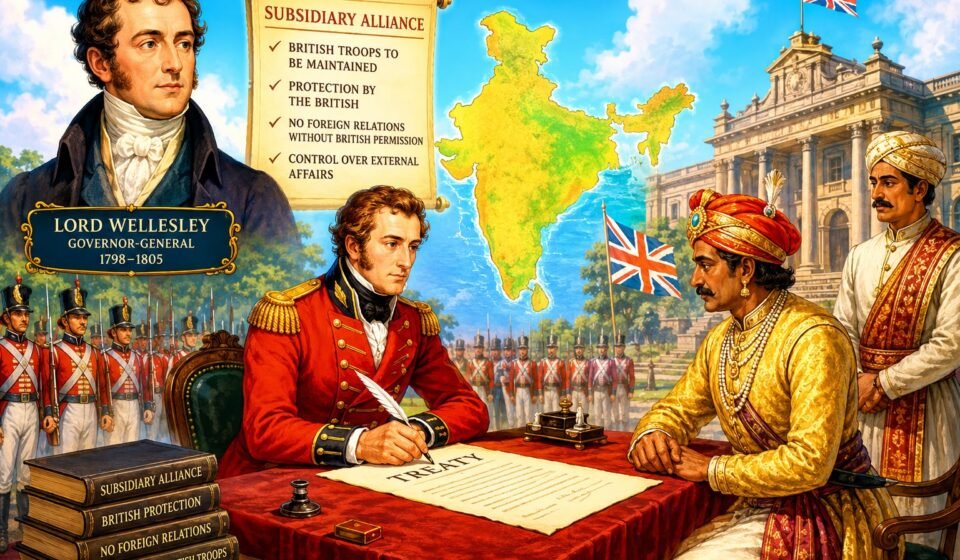
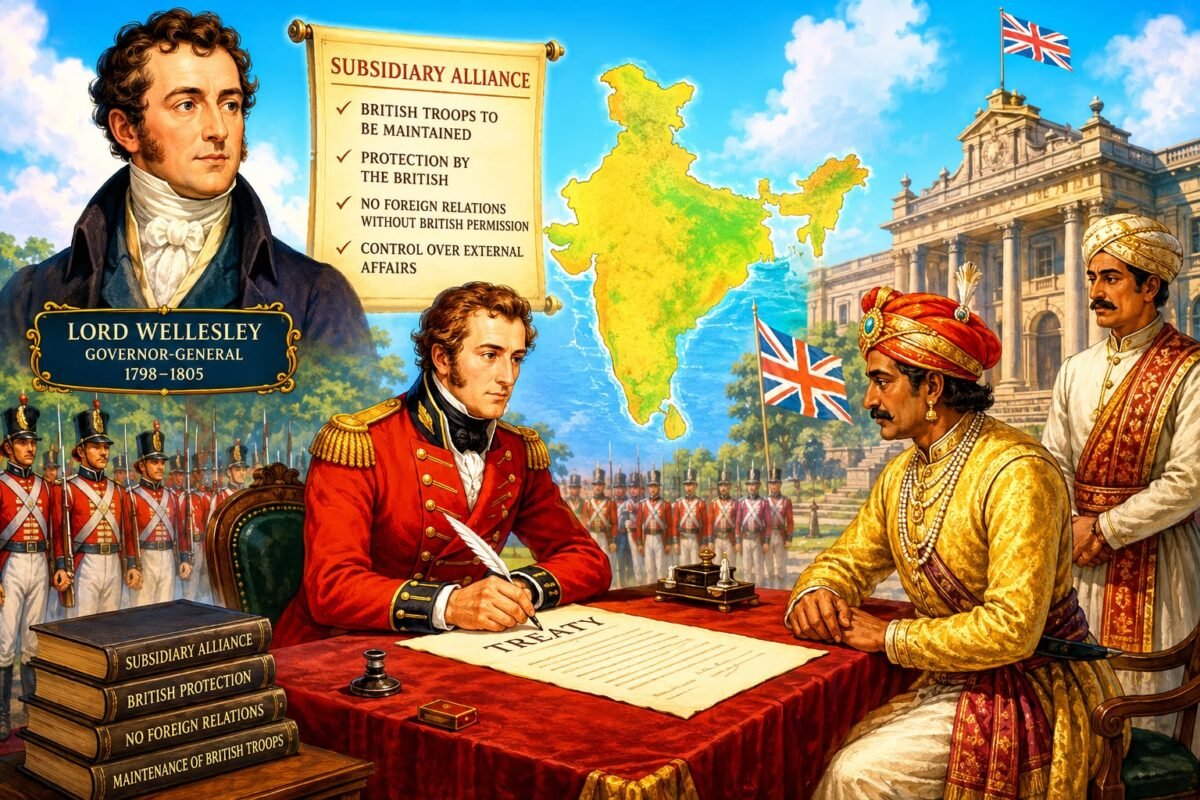
Richard Wellesley arrived in Calcutta in 1798 with the conviction that trade followed the flag poorly and that safety lay in supremacy. In seven years he doubled the reach of British power in India, and his chosen instrument was not, in the main, the battlefield. It was a contract. The subsidiary alliance, refined by Wellesley from the improvisations of Dupleix and his own predecessors, was the most efficient machine of imperial expansion ever devised, an arrangement by which Indian states purchased their own subjection and paid the running costs of the army that enforced it.
The terms of the standard treaty were simple and lethal. The Indian ruler received a permanent force of Company sepoys, stationed in his territory for his protection, and the Company’s guarantee against his enemies. In exchange he paid a subsidy for the force, or, in the developed form Wellesley preferred, ceded territory outright whose revenues would maintain it, since cessions, unlike cash, never fell into arrears. He admitted a British Resident to his court, dismissed all Europeans of other nations from his service, and surrendered his foreign relations wholly to the Company, undertaking to negotiate with no other state. In return he was confirmed in his internal sovereignty, secured on his throne against rivals foreign and domestic, and relieved forever of the burdens of an independent existence.
Each clause concealed a trap. The protecting force made rebellion by the protected impossible and made every neighbouring state’s accession more urgent, for the unallied faced the allied with the Company’s army already at their border. The subsidy was set at figures that strained treasuries, and arrears matured naturally into cessions of territory, as Awadh and the Nizam discovered. The Resident, formally an ambassador, evolved into a supervisor and then a master, the channel through which succession disputes, ministerial appointments and in time the daily business of durbars passed under British influence. And the guarantee of internal sovereignty removed the ancient discipline of Indian politics, the fear of overthrow, leaving rulers secure against every consequence of misgovernment. The system, as critics from Thomas Munro onward observed, tended to preserve the throne and rot the state.
Wellesley worked the machine with a speed that alarmed his employers. Hyderabad signed the first of the new model treaties in 1798, disbanding its French trained corps and admitting the subsidiary force whose cost was later fixed by the cession of the very districts Bussy had once held. Mysore was reconstituted under the system in 1799 upon Tipu’s body. Tanjore and Surat were absorbed, the Carnatic annexed outright in 1801 upon evidence of the Nawab’s correspondence with Tipu, and in the same year Awadh, the richest prize, was compelled to cede Rohilkhand and the lower Doab, half the kingdom, to pay for its enlarged subsidiary force. The Peshwa himself, fleeing a Maratha civil war, signed the Treaty of Bassein in 1802, and the attempt to enforce that treaty upon the other Maratha houses brought Wellesley the great war of 1803 to 1805 against Scindia and Bhonsle, victory at Assaye and Delhi, and the emperor of India as a Company pensioner.
By then the costs had outrun even Bengal’s purse, and Holkar’s stubborn war exposed the machine’s limits. The directors, watching debt climb toward ruin, recalled their proconsul in 1805. Wellesley went home to censure motions and a long sulk, complaining of being checked by cheesemongers. But his system stayed and spread, completed by Hastings of the next decade, until nearly six hundred states, a third of India’s area and a quarter of its people, lived under treaties descended from his drafts.
The subsidiary alliance solved the Company’s oldest problem, how to rule India cheaply, by making Indian revenue pay for Indian subjection, prince by prince, signature by signature. It froze the princely map of India as it stood in the early nineteenth century and preserved it, embalmed under paramountcy, until 1947, when another negotiation, conducted by V P Menon with instruments of accession instead of subsidiary treaties, unwound in two years what Wellesley’s contracts had bound. Empire by conquest is an old story. Wellesley’s India was empire by conveyancing, and it proved the more durable deed.
1765 to 1818 - Conquest
Part 8 of 10 in this chapter.