
 In 30 Seconds




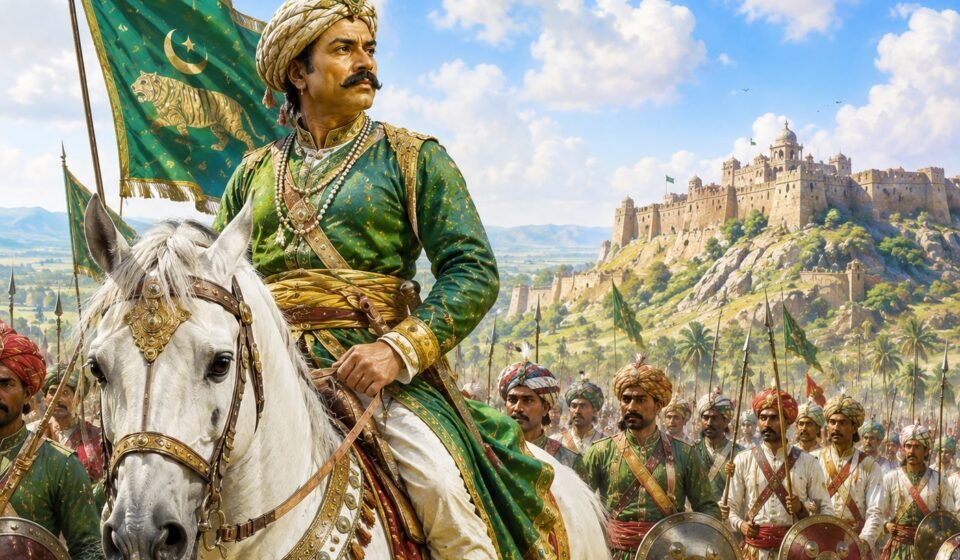
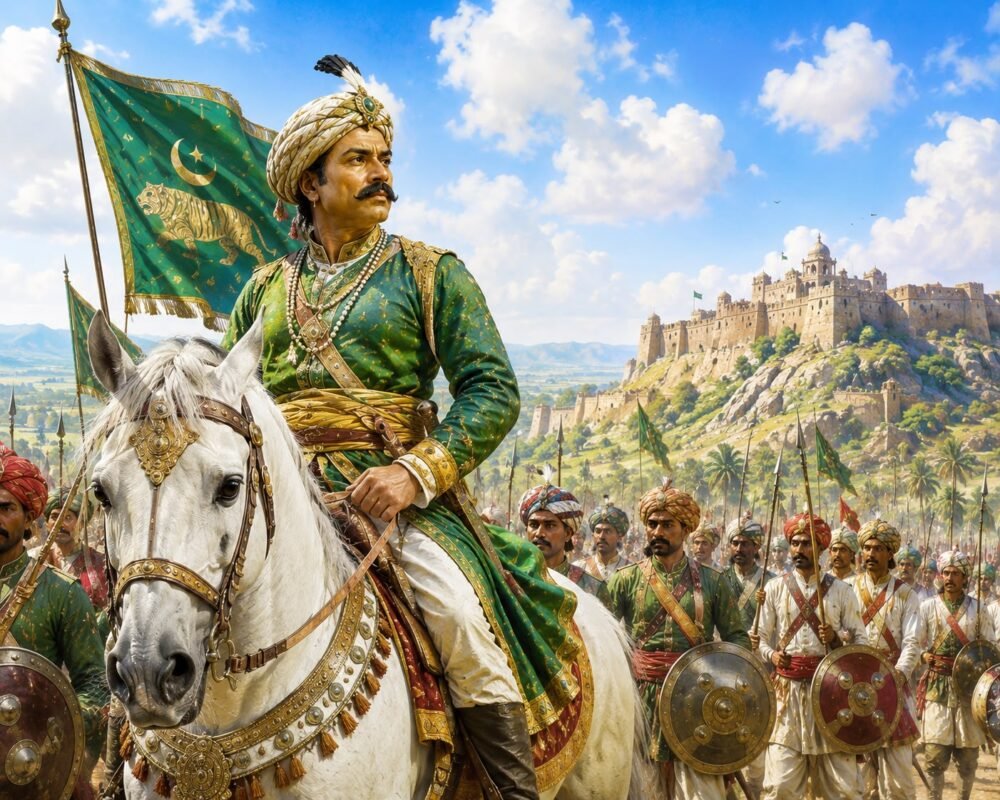
Of all the Indian rulers who fought the East India Company in the eighteenth century, only one ever dictated peace beneath the walls of a presidency capital. Haidar Ali of Mysore, a soldier of fortune who could neither read nor write, built from a middling Deccan kingdom a military state that twice humbled British India, and left his son a war, an army and an example.
His rise was the eighteenth century in miniature. Born around 1720 into a family of soldiers of Punjabi descent in Mysore service, he made his name as a cavalry commander, studied with professional attention the French troops he saw at Pondicherry, and grasped earlier than any Indian contemporary the meaning of European infantry and artillery. Through the 1750s he rose in the faction ridden court of the Wodeyar Rajas until, by 1761, he had displaced the minister Nanjaraja and become the effective ruler of Mysore, keeping the Raja as a maintained and honoured cipher. He then set about building the instrument of his ambitions, a disciplined standing army with European trained sepoy battalions, a powerful artillery, French officers and workshops, and, in time, the rocket corps that became Mysore’s signature on the battlefield. His revenue administration was centralised and searching, for he understood the first equation of the age, that war was money.
Expansion brought collision. His conquests along the Malabar coast and his pressure upon the poligars alarmed Madras, and in 1767 the Company contrived with the Nizam and the Marathas a triple alliance to partition Mysore. Haidar detached the Nizam by diplomacy, neutralised the Marathas by payment, and fought the British alone in the First Anglo Mysore War with a mobility they could not answer. In 1769, after two years of inconclusive campaigning, he appeared with his cavalry before the gates of Madras itself, and the government there, its capital hostage, signed peace on his terms, a treaty of mutual restitution and, crucially, mutual defence. When the Marathas attacked Mysore soon after, the Company evaded its obligation, and Haidar drew the conclusion that governed the rest of his life, that the English word was worthless and the English power must one day be broken.
The reckoning came in 1780. Provoked by British seizure of the French port of Mahe, which lay under his protection, and fortified by an understanding with the Nizam and the Marathas, Haidar descended into the Carnatic with the greatest army southern India had seen, perhaps eighty thousand men, burning to the outskirts of Madras. At Pollilur in September 1780 his son Tipu destroyed a British detachment under Colonel Baillie, killing or capturing nearly the whole force, the worst defeat the Company had yet suffered in India, commemorated in triumphal murals on the walls of his capital. For a season the British position in the south hung by a thread, saved by the transfusion of money and troops that Warren Hastings poured from Bengal and by the iron generalship of old Eyre Coote, who checked Haidar at Porto Novo in 1781 in battles that bent but never broke him.
Haidar died of cancer in his camp in December 1782, still at war, still unbeaten in the essentials, leaving to Tipu a kingdom under arms and a conflict that ended in 1784 with the status quo treaty of Mangalore, the last peace an Indian power ever signed with the Company as an equal. His memory in British writing became a byword for menace, in Mysore tradition a founder of ordered strength, and among historians the outstanding example of the Indian eighteenth century’s capacity for military and fiscal innovation. He had shown that the Company could be fought with its own weapons, drilled infantry, modern artillery, cash revenue and diplomacy, and fought to a standstill. What he could not bequeath was time. The resources of Bengal, which Hastings had used to save Madras, were the deeper lesson of the war, for the Company could lose armies and buy new ones. Mysore could not. Haidar’s genius had built a state that could win battles against the British. It would take only one lost war to destroy it.
1765 to 1818 - Conquest
Part 6 of 10 in this chapter.