 In 30 Seconds




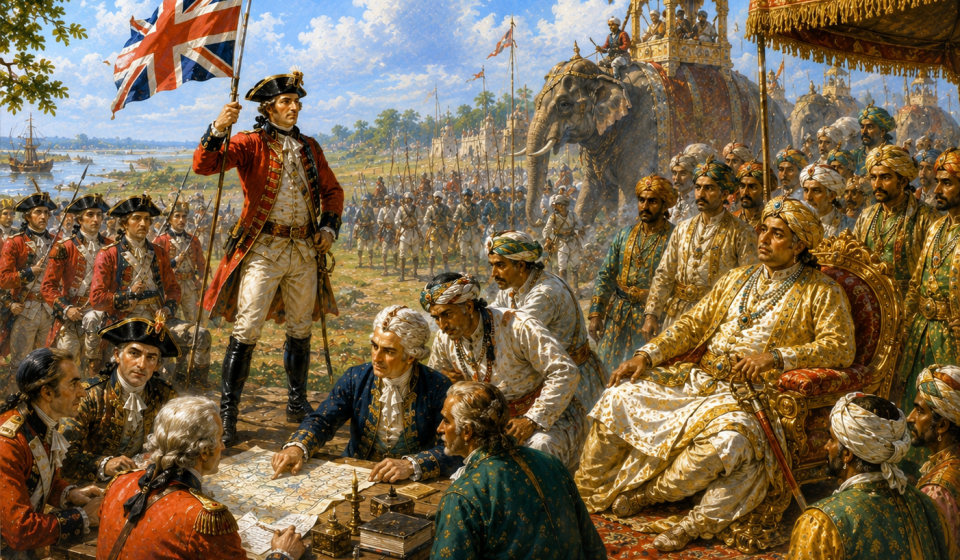
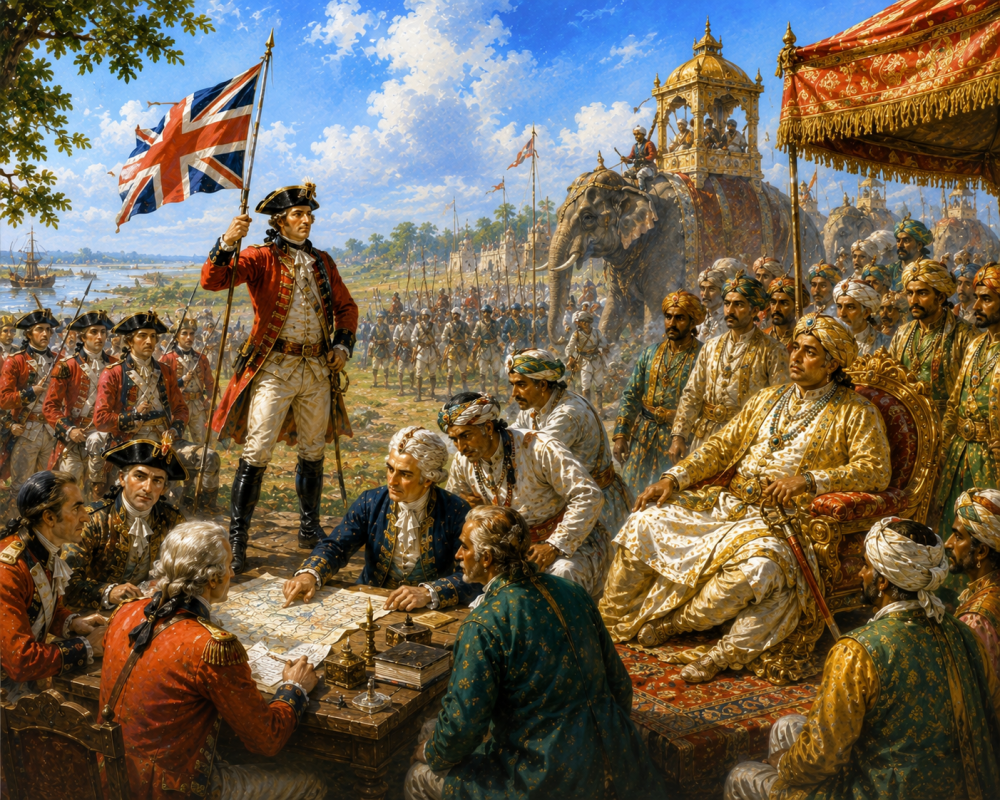
On 23 June 1757, in a mango grove beside the Bhagirathi river at Palashi, an army of the East India Company numbering some three thousand men faced the host of the Nawab of Bengal, perhaps fifty thousand strong. By evening the Nawab’s army had dissolved, the Nawab himself was a fugitive, and Bengal, the richest province of India, lay open to a trading company. Plassey is called a battle. It was, more exactly, a transaction with gunfire attached, and it is the true founding date of British power in India.
The transaction had been negotiated over the preceding months in the shadows of Murshidabad. Siraj ud Daulah had alienated the pillars of his own state, and the pillars had found each other. Mir Jafar, the army’s senior general and a relation of the ruling house, would take the throne. The bankers of the house of Jagat Seth, whom the Nawab had insulted and threatened, would arrange the finances. Rai Durlabh, a chief minister, and the merchant magnate Omichund were among the intermediaries. The English committee in Calcutta, with Clive at its centre, negotiated the terms, a treaty promising the conspirators the throne and the Company enormous compensation, private donations and territorial revenue. When Omichund threatened betrayal unless guaranteed a colossal commission, Clive resorted to a device that even his admirers have struggled to dress in honour, two versions of the treaty, one genuine, one fictitious bearing the promise and a forged signature, the false one for Omichund. The merchant learned the truth only after the victory, and by the accounts of the age, his mind gave way.
Clive marched from Chandernagore in June with about eight hundred Europeans and over two thousand sepoys, and crossed the river to Plassey on the strength of a correspondence with Mir Jafar whose assurances remained maddeningly ambiguous to the last hour. At the council of war on the march, a majority including Clive first voted against risking battle, and Clive, after a solitary hour of reflection in the grove, reversed himself and ordered the advance, the most consequential change of mind in the Company’s history.
The engagement itself was decided by weather, treachery and one death. The Nawab’s artillery opened a cannonade that the smaller English force endured behind embankments. At midday a monsoon downpour drenched the field. The English covered their powder with tarpaulins, and the Nawab’s gunners, less careful, found their powder soaked. Believing the English guns equally silenced, Mir Madan, the one general wholeheartedly loyal to Siraj, led the Nawab’s best cavalry in a charge, and was cut down by grapeshot from guns that had stayed dry. His death was the hinge. Siraj, unnerved, summoned Mir Jafar and begged his fidelity, and Mir Jafar, commanding the largest division of the army, advised retreat and continued to stand motionless with his troops, as he had stood all day. On such advice the Nawab ordered his army back to its camp, the withdrawal became a rout under English pressure, and by nightfall it was over. English casualties were about seventy. The conspirators’ divisions, more than half the Nawab’s army, never engaged at all.
The aftermath completed the transaction. Siraj fled Murshidabad, was captured within days, and was murdered in captivity by order of Mir Jafar’s son Miran. Mir Jafar was installed as Nawab, and the treasury of Bengal was opened to the victors. The Company received its compensation and the revenue of the twenty four parganas near Calcutta. The private presents to the committee and to Clive were immense, Clive’s own share making him at a stroke one of the richest men in Britain, with a Mughal jagir worth twenty seven thousand pounds a year besides. Asked years later by a parliamentary committee about the plunder, Clive replied that considering the treasure vaults thrown open to him, he stood astonished at his own moderation.
The deeper meaning took years to unfold. Bengal’s new Nawab reigned but did not rule, for the power that made him could unmake him, and did. The revenues of the province began their long diversion into the Company’s investment, its wars and its dividends. Plassey was not the conquest of India, but it was the acquisition of the treasury with which India would be conquered. The mango grove transaction had bought, for a few hours of cannon fire and a forged signature, the future of a subcontinent.
1707 to 1765 - The Empire Cracks, the Company Rises
Part 9 of 10 in this chapter.