
Browse Category
Company Rule
4 Chapters
40 Articles
Read this category as an ordered editorial path. Choose a chapter, then follow the articles in sequence.
Chapter 1
10 Articles
1600 to 1720 - The Arrival
-
1
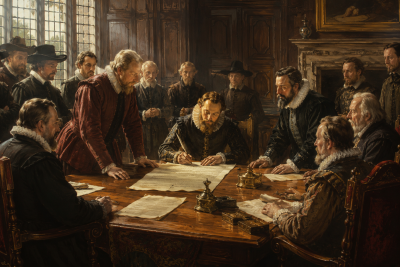 The Charter of 1600: The Day a Company Was Born
On 31 December 1600 Elizabeth I chartered a company of London merchants to buy pepper. The document carried,…
4 Min Read
The Charter of 1600: The Day a Company Was Born
On 31 December 1600 Elizabeth I chartered a company of London merchants to buy pepper. The document carried,…
4 Min Read
-
2
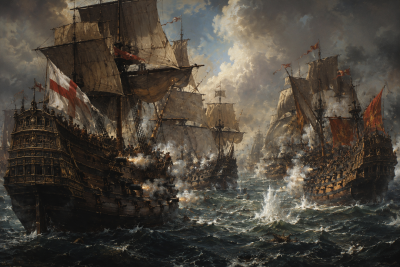 Swally 1612: The Sea Battle That Opened Surat to the English
Two English ships beat a Portuguese fleet off Suvali in 1612 while Mughal officials watched from the shore.…
4 Min Read
Swally 1612: The Sea Battle That Opened Surat to the English
Two English ships beat a Portuguese fleet off Suvali in 1612 while Mughal officials watched from the shore.…
4 Min Read
-
3
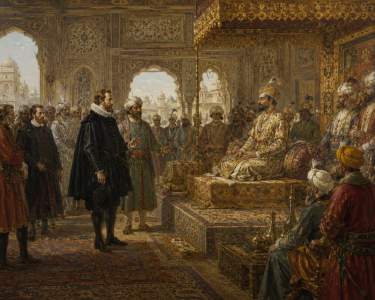 Sir Thomas Roe at the Court of Jahangir: An Ambassador Among Emperors
For four years Sir Thomas Roe followed Jahangir's court seeking a treaty the Mughals saw no reason to…
4 Min Read
Sir Thomas Roe at the Court of Jahangir: An Ambassador Among Emperors
For four years Sir Thomas Roe followed Jahangir's court seeking a treaty the Mughals saw no reason to…
4 Min Read
-
4
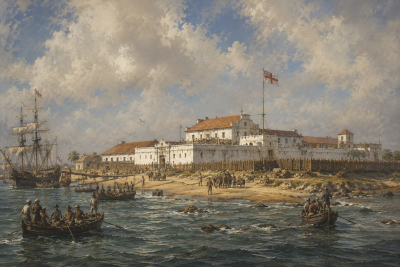 Madras 1639: A Strip of Sand That Became Fort St George
Francis Day's 1639 bargain for a strip of Coromandel beach gave the Company Fort St George, its first…
4 Min Read
Madras 1639: A Strip of Sand That Became Fort St George
Francis Day's 1639 bargain for a strip of Coromandel beach gave the Company Fort St George, its first…
4 Min Read
-
5
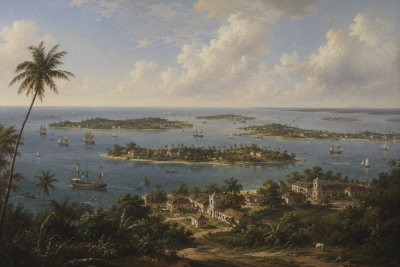 Bombay: The Islands That Came as a Dowry
Bombay came to England as part of a Portuguese princess's dowry and was leased to the Company for…
4 Min Read
Bombay: The Islands That Came as a Dowry
Bombay came to England as part of a Portuguese princess's dowry and was leased to the Company for…
4 Min Read
-
6
 Job Charnock and the Founding of Calcutta
In August 1690 Job Charnock unpacked his goods under a tree at Sutanuti. Within a century the swamp…
4 Min Read
Job Charnock and the Founding of Calcutta
In August 1690 Job Charnock unpacked his goods under a tree at Sutanuti. Within a century the swamp…
4 Min Read
-
7
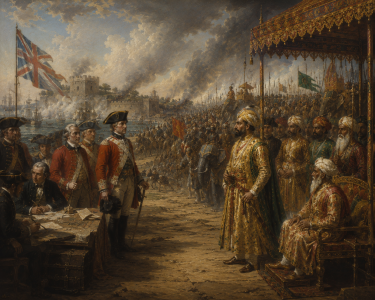 Child’s War: When the Company Fought Aurangzeb and Begged for Pardon
In 1686 the Company declared war on Aurangzeb's empire and was crushed within four years, begging pardon with…
4 Min Read
Child’s War: When the Company Fought Aurangzeb and Begged for Pardon
In 1686 the Company declared war on Aurangzeb's empire and was crushed within four years, begging pardon with…
4 Min Read
-
8
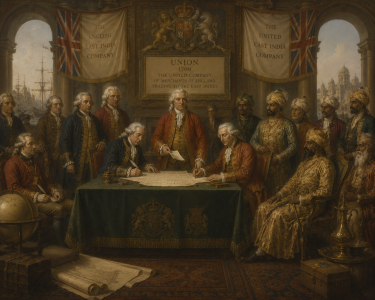 Two Companies, One Empire: The Rivalry and Merger of 1709
For a decade England had two East India Companies at war with each other in Parliament and in…
4 Min Read
Two Companies, One Empire: The Rivalry and Merger of 1709
For a decade England had two East India Companies at war with each other in Parliament and in…
4 Min Read
-
9
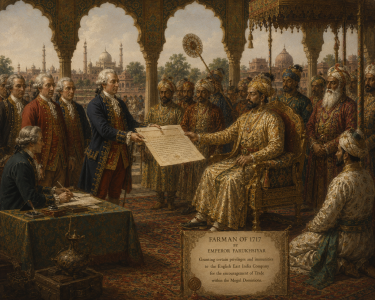 The Farman of 1717: The Emperor’s Gift That Poisoned Bengal
A surgeon's cure won the Company duty free trade in Bengal in 1717. The abuse of that privilege…
4 Min Read
The Farman of 1717: The Emperor’s Gift That Poisoned Bengal
A surgeon's cure won the Company duty free trade in Bengal in 1717. The abuse of that privilege…
4 Min Read
-
10
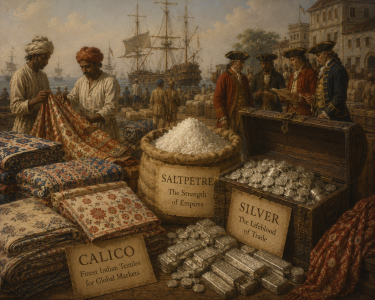 Calico, Saltpetre and Silver: What the Company Actually Traded
Pepper drew the English east, Indian cloth made them rich, saltpetre armed their state and silver paid for…
4 Min Read
Calico, Saltpetre and Silver: What the Company Actually Traded
Pepper drew the English east, Indian cloth made them rich, saltpetre armed their state and silver paid for…
4 Min Read
Chapter 2
10 Articles
1707 to 1765 - The Empire Cracks, the Company Rises
-
1
 The Empire Cracks: India After Aurangzeb
Aurangzeb died in 1707 with his empire vast on the map and hollow at the core. The dissolution…
4 Min Read
The Empire Cracks: India After Aurangzeb
Aurangzeb died in 1707 with his empire vast on the map and hollow at the core. The dissolution…
4 Min Read
-
2
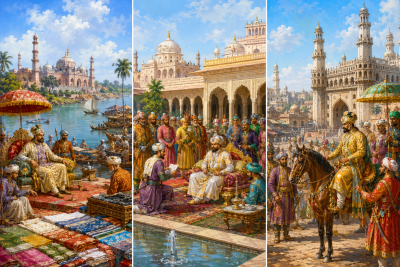 The Successor States: Bengal, Awadh and Hyderabad
Bengal, Awadh and Hyderabad were vigorous kingdoms built from Mughal provinces. Their open succession politics made kingmaking the…
4 Min Read
The Successor States: Bengal, Awadh and Hyderabad
Bengal, Awadh and Hyderabad were vigorous kingdoms built from Mughal provinces. Their open succession politics made kingmaking the…
4 Min Read
-
3
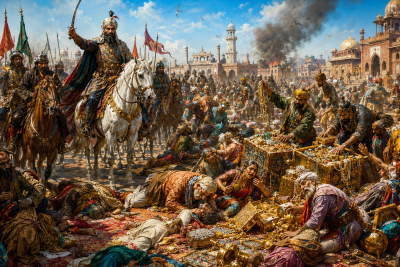 Nadir Shah 1739: The Sack of Delhi and the Broken Spell
Nadir Shah's 1739 invasion shattered the Mughal army at Karnal, drowned Delhi in blood and carried off the…
4 Min Read
Nadir Shah 1739: The Sack of Delhi and the Broken Spell
Nadir Shah's 1739 invasion shattered the Mughal army at Karnal, drowned Delhi in blood and carried off the…
4 Min Read
-
4
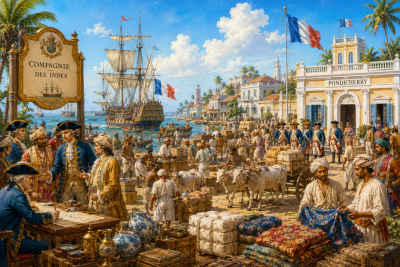 The French Arrive: Pondicherry and the Compagnie des Indes
France's Compagnie des Indes built Pondicherry into the finest European town in India and pioneered every device of…
4 Min Read
The French Arrive: Pondicherry and the Compagnie des Indes
France's Compagnie des Indes built Pondicherry into the finest European town in India and pioneered every device of…
4 Min Read
-
5
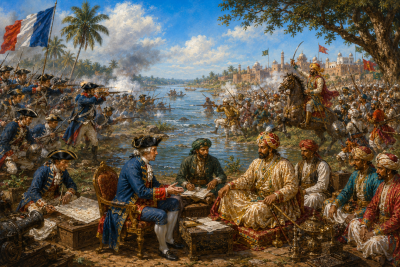 The First Carnatic War and the Revelation at the Adyar River
At the Adyar river in 1746 a thousand French led muskets broke ten thousand of the Nawab's horsemen…
4 Min Read
The First Carnatic War and the Revelation at the Adyar River
At the Adyar river in 1746 a thousand French led muskets broke ten thousand of the Nawab's horsemen…
4 Min Read
-
6
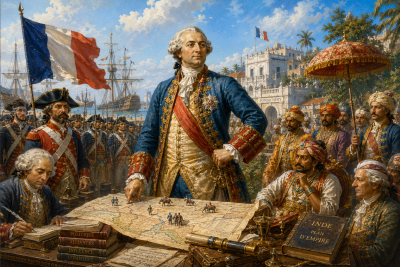 Dupleix: The Frenchman Who Wrote the Playbook of Empire
Sepoy armies, puppet rulers, subsidiary alliances: Dupleix invented every device of European empire in India, and the British…
3 Min Read
Dupleix: The Frenchman Who Wrote the Playbook of Empire
Sepoy armies, puppet rulers, subsidiary alliances: Dupleix invented every device of European empire in India, and the British…
3 Min Read
-
7
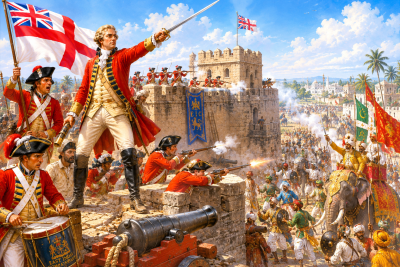 Clive at Arcot: Fifty Days That Made a Reputation
With five hundred men and three guns, a twenty six year old former clerk seized and held Chanda…
4 Min Read
Clive at Arcot: Fifty Days That Made a Reputation
With five hundred men and three guns, a twenty six year old former clerk seized and held Chanda…
4 Min Read
-
8
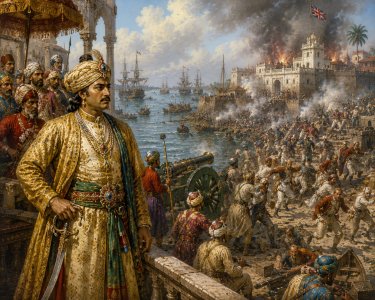 Siraj ud Daulah and the Fall of Calcutta
Siraj ud Daulah's grievances against Calcutta were largely just. Asserting them cost the young Nawab his capital's dignity,…
4 Min Read
Siraj ud Daulah and the Fall of Calcutta
Siraj ud Daulah's grievances against Calcutta were largely just. Asserting them cost the young Nawab his capital's dignity,…
4 Min Read
-
9
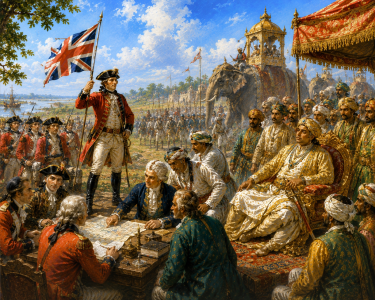 Plassey 1757: The Conspiracy That Won an Empire
Plassey was a transaction with gunfire attached: a conspiracy of generals and bankers, a rain soaked cannonade, and…
4 Min Read
Plassey 1757: The Conspiracy That Won an Empire
Plassey was a transaction with gunfire attached: a conspiracy of generals and bankers, a rain soaked cannonade, and…
4 Min Read
-
10
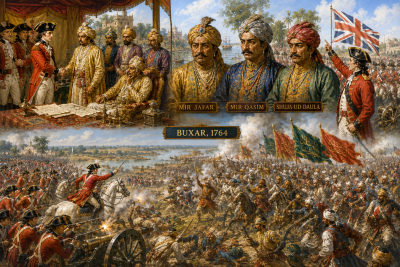 From Mir Jafar to Buxar: The Battle That Truly Decided India
Buxar in 1764 broke a Nawab, a Wazir and the Mughal emperor together, and the Diwani of 1765…
4 Min Read
From Mir Jafar to Buxar: The Battle That Truly Decided India
Buxar in 1764 broke a Nawab, a Wazir and the Mughal emperor together, and the Diwani of 1765…
4 Min Read
Chapter 3
10 Articles
1765 to 1818 - Conquest
-
1
 The Diwani Years: How the Company Bled Bengal
After 1765 the Company bought Bengal's goods with Bengal's own taxes while private fortunes sailed home. The province…
4 Min Read
The Diwani Years: How the Company Bled Bengal
After 1765 the Company bought Bengal's goods with Bengal's own taxes while private fortunes sailed home. The province…
4 Min Read
-
2
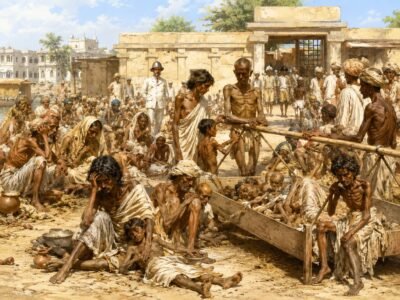 The Great Bengal Famine of 1770
The rains failed in 1769 and Bengal died by the million while the revenue was violently kept up.…
4 Min Read
The Great Bengal Famine of 1770
The rains failed in 1769 and Bengal died by the million while the revenue was violently kept up.…
4 Min Read
-
3
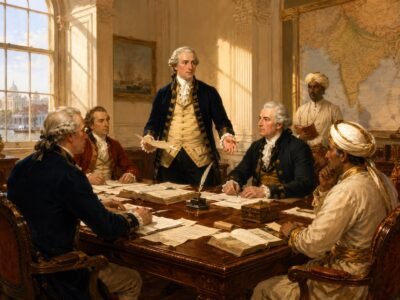 The Regulating Act of 1773 and the Age of Warren Hastings
Bankruptcy brought the state into India in 1773, and Warren Hastings built the skeleton of British administration amid…
4 Min Read
The Regulating Act of 1773 and the Age of Warren Hastings
Bankruptcy brought the state into India in 1773, and Warren Hastings built the skeleton of British administration amid…
4 Min Read
-
4
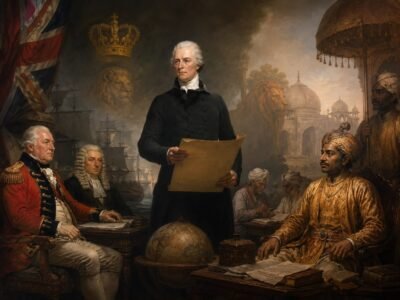 Pitt’s India Act 1784: The Empire Gets Two Masters
Pitt's India Act of 1784 gave the empire two masters, a Board of Control above the Company, and…
4 Min Read
Pitt’s India Act 1784: The Empire Gets Two Masters
Pitt's India Act of 1784 gave the empire two masters, a Board of Control above the Company, and…
4 Min Read
-
5
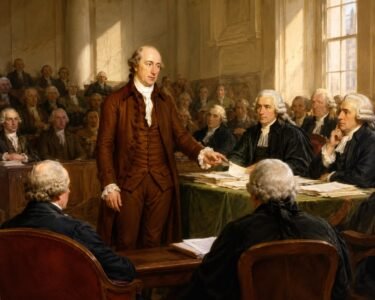 The Trial of Warren Hastings: An Empire in the Dock
For seven years Burke arraigned Warren Hastings before the Lords in the name of the people of India.…
4 Min Read
The Trial of Warren Hastings: An Empire in the Dock
For seven years Burke arraigned Warren Hastings before the Lords in the name of the people of India.…
4 Min Read
-
6
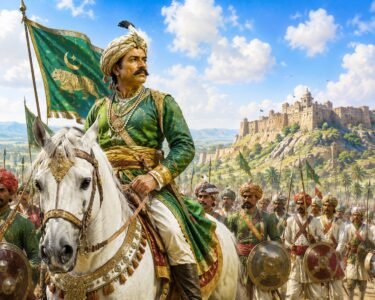 Haidar Ali: The Soldier Who Made the Company Tremble
Haidar Ali built Mysore into a military state that dictated peace at the gates of Madras and destroyed…
4 Min Read
Haidar Ali: The Soldier Who Made the Company Tremble
Haidar Ali built Mysore into a military state that dictated peace at the gates of Madras and destroyed…
4 Min Read
-
7
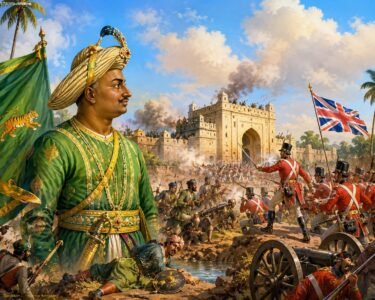 Tipu Sultan and the Fall of Srirangapatna
Modernizer, hard master and unyielding enemy of the Company, Tipu Sultan chose the breach at Srirangapatna in 1799…
4 Min Read
Tipu Sultan and the Fall of Srirangapatna
Modernizer, hard master and unyielding enemy of the Company, Tipu Sultan chose the breach at Srirangapatna in 1799…
4 Min Read
-
8
 Wellesley and the Subsidiary Alliance: Empire by Contract
Wellesley's subsidiary alliance made Indian states pay for the armies that subjected them, an empire acquired by contract,…
4 Min Read
Wellesley and the Subsidiary Alliance: Empire by Contract
Wellesley's subsidiary alliance made Indian states pay for the armies that subjected them, an empire acquired by contract,…
4 Min Read
-
9
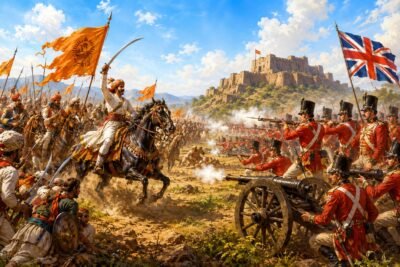 The Anglo Maratha Wars: The Fall of the Last Indian Rivals
Three wars over forty three years decided whether Marathas or the Company would inherit the Mughal world. Assaye…
4 Min Read
The Anglo Maratha Wars: The Fall of the Last Indian Rivals
Three wars over forty three years decided whether Marathas or the Company would inherit the Mughal world. Assaye…
4 Min Read
-
10
 1818: The Year the Company Became India’s Master
With the Peshwa's surrender in 1818 the Company stood without rival from the Sutlej to the sea. The…
4 Min Read
1818: The Year the Company Became India’s Master
With the Peshwa's surrender in 1818 the Company stood without rival from the Sutlej to the sea. The…
4 Min Read
Chapter 4
10 Articles
1818 to 1856 - Consolidation and Reform
-
1
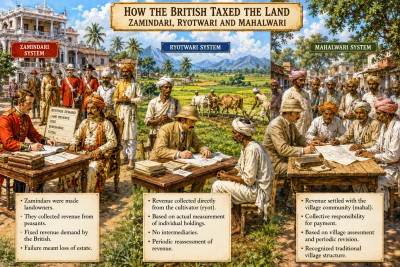 How the British Taxed the Land: Zamindari, Ryotwari and Mahalwari
Zamindari, ryotwari and mahalwari were three philosophies of rule imposed on the Indian village, and their consequences outlived…
4 Min Read
How the British Taxed the Land: Zamindari, Ryotwari and Mahalwari
Zamindari, ryotwari and mahalwari were three philosophies of rule imposed on the Indian village, and their consequences outlived…
4 Min Read
-
2
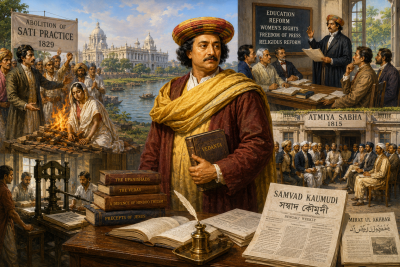 Ram Mohan Roy and the Bengal Renaissance
Scholar of Persian, Sanskrit and English, enemy of sati and censorship, founder of the Brahmo Samaj, Ram Mohan…
4 Min Read
Ram Mohan Roy and the Bengal Renaissance
Scholar of Persian, Sanskrit and English, enemy of sati and censorship, founder of the Brahmo Samaj, Ram Mohan…
4 Min Read
-
3
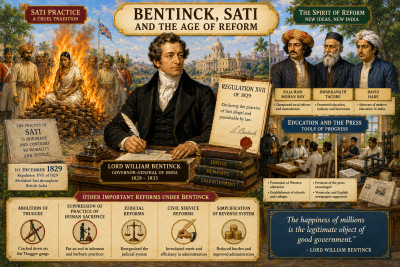 Bentinck, Sati and the Age of Reform
The abolition of sati in 1829 was a deliverance first demanded by Indians themselves, and the founding act…
4 Min Read
Bentinck, Sati and the Age of Reform
The abolition of sati in 1829 was a deliverance first demanded by Indians themselves, and the founding act…
4 Min Read
-
4
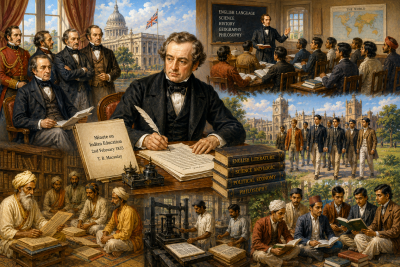 Macaulay’s Minute: English Education and Its Long Shadow
Written to settle a budget quarrel, Macaulay's Minute of 1835 fixed the linguistic destiny of modern India and…
4 Min Read
Macaulay’s Minute: English Education and Its Long Shadow
Written to settle a budget quarrel, Macaulay's Minute of 1835 fixed the linguistic destiny of modern India and…
4 Min Read
-
5
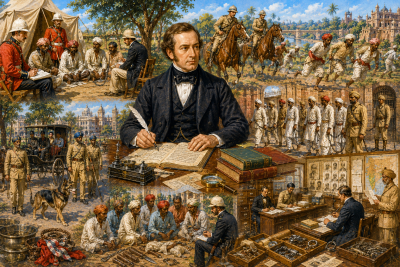 Thuggee, Sleeman and the Machinery of Colonial Policing
The campaign against thuggee made Sleeman famous and the roads safer, and built a machinery of surveillance and…
4 Min Read
Thuggee, Sleeman and the Machinery of Colonial Policing
The campaign against thuggee made Sleeman famous and the roads safer, and built a machinery of surveillance and…
4 Min Read
-
6
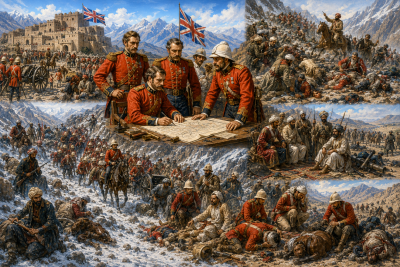 The First Anglo Afghan War: Disaster Beyond the Khyber
Sixteen thousand marched from Kabul and one rider reached Jalalabad. The First Afghan War restored the king it…
4 Min Read
The First Anglo Afghan War: Disaster Beyond the Khyber
Sixteen thousand marched from Kabul and one rider reached Jalalabad. The First Afghan War restored the king it…
4 Min Read
-
7
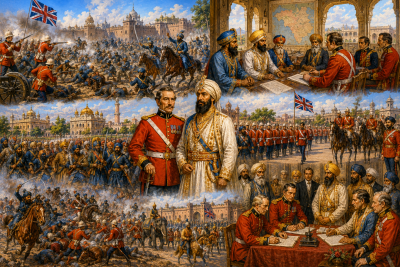 The Anglo Sikh Wars and the Annexation of Punjab
The Khalsa was the one army the Company truly feared. Court treachery, two savage wars and a sold…
4 Min Read
The Anglo Sikh Wars and the Annexation of Punjab
The Khalsa was the one army the Company truly feared. Court treachery, two savage wars and a sold…
4 Min Read
-
8
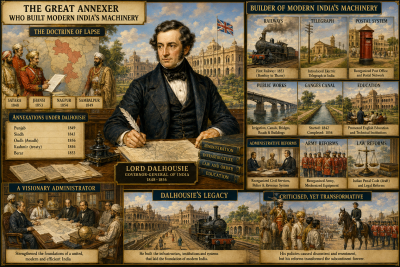 Dalhousie: The Great Annexer Who Built Modern India’s Machinery
Railways, telegraph, post and canals with one hand, Satara, Jhansi, Nagpur and Awadh with the other. Dalhousie built…
4 Min Read
Dalhousie: The Great Annexer Who Built Modern India’s Machinery
Railways, telegraph, post and canals with one hand, Satara, Jhansi, Nagpur and Awadh with the other. Dalhousie built…
4 Min Read
-
9
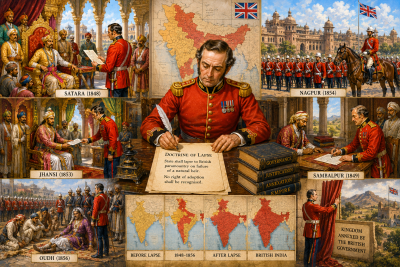 The Doctrine of Lapse: How Kingdoms Were Swallowed
Satara, Jhansi, Nagpur: the Doctrine of Lapse erased dynasties by refusing adopted heirs, and the bill for the…
4 Min Read
The Doctrine of Lapse: How Kingdoms Were Swallowed
Satara, Jhansi, Nagpur: the Doctrine of Lapse erased dynasties by refusing adopted heirs, and the bill for the…
4 Min Read
-
10
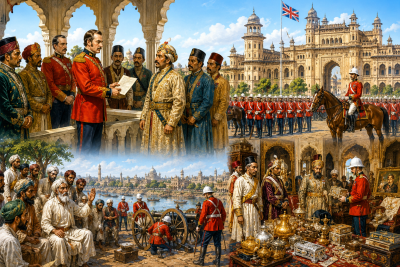 Awadh 1856: The Annexation That Lit the Fuse
The Company deposed its most faithful ally without a battle in February 1856. Within fifteen months Awadh answered,…
4 Min Read
Awadh 1856: The Annexation That Lit the Fuse
The Company deposed its most faithful ally without a battle in February 1856. Within fifteen months Awadh answered,…
4 Min Read