 In 30 Seconds




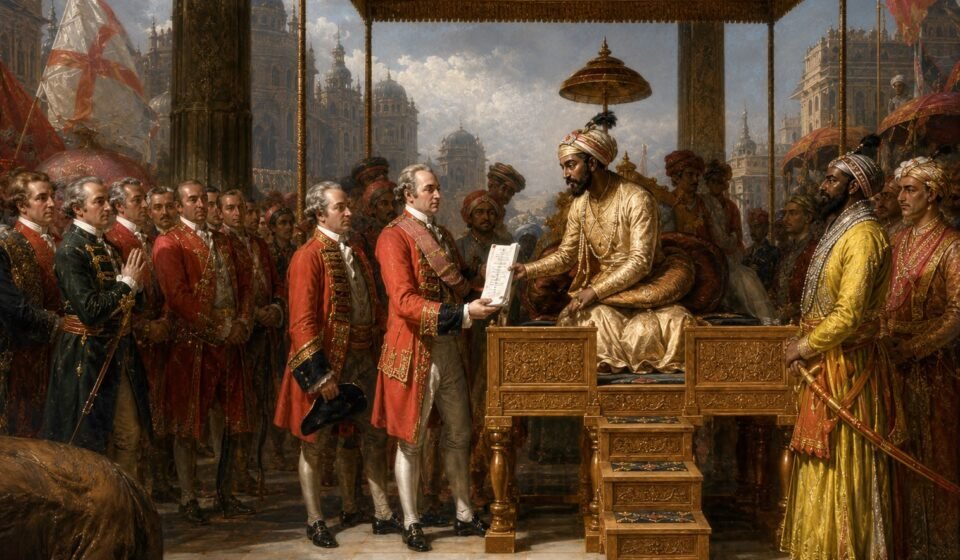
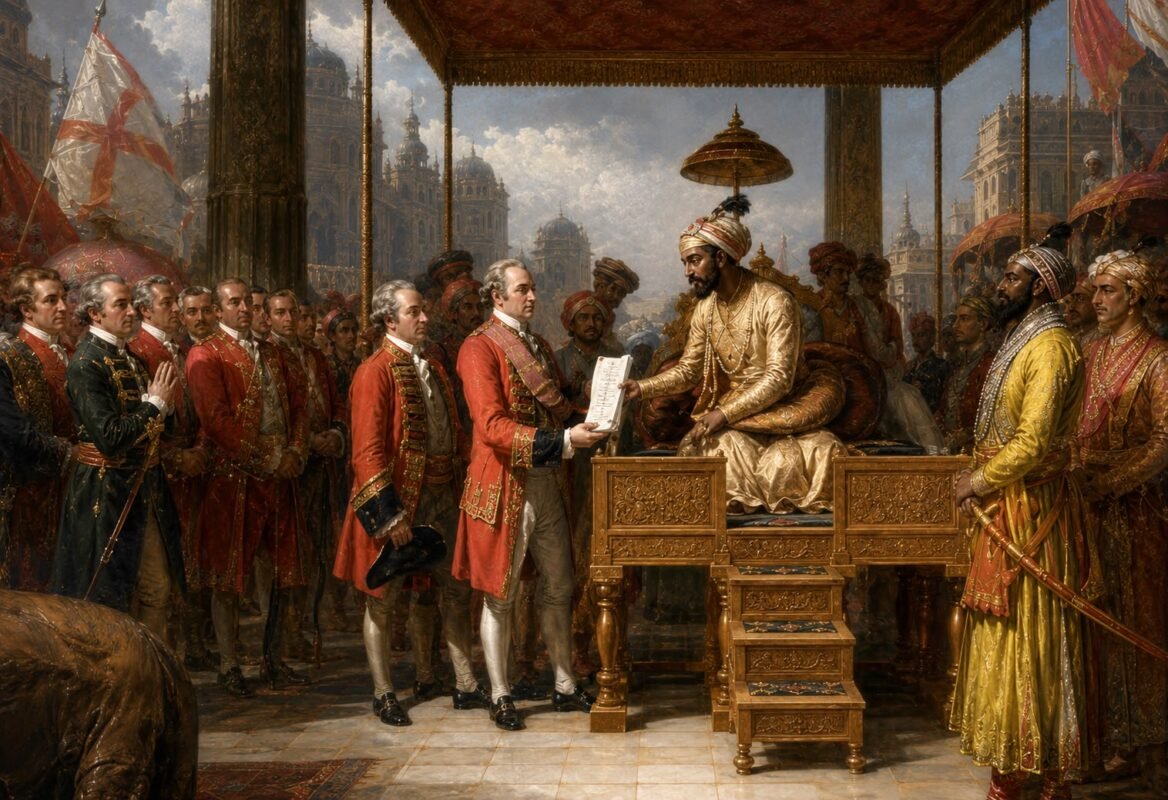
In August 1765 the East India Company became the lawful collector of Bengal’s revenues. What followed over the next decade was described by Englishmen themselves, in Parliament and in print, as a plunder without precedent, and it fixed the pattern of colonial extraction that Indian nationalists would one day give a name, the drain of wealth. The diwani years are the least heroic and most instructive chapter of the Company’s rise.
Clive’s settlement was called the dual system, and its essence was power without responsibility. The Company held the diwani, the right to collect revenue and administer civil justice, but exercised it through Indian deputies, Muhammad Reza Khan in Bengal and Raja Shitab Rai in Bihar, while the Nawab’s shadow government at Murshidabad remained answerable for order, police and criminal justice on a fixed allowance that was steadily cut. The design was deliberate. The Company gathered the harvest while the Nawab bore the blame, and no authority existed anywhere with both the means and the duty to govern well.
The fiscal revolution was immediate. Before Plassey the Company had paid for its Indian cargoes with silver shipped from Europe, the treasure drain about which English critics had complained for a century and from which Bengal had profited. After the diwani the silver ships stopped. The Company now purchased its investment, the cloth and silk and saltpetre sent home each year, out of Bengal’s own land revenue. The province, in effect, bought its own goods for the profit of foreign shareholders, exporting its wealth and receiving nothing in exchange. At the same time the revenue demand itself was driven upward, collections pressed with a rigour the old regime had never sustained, for the Company had a treaty schedule of payments, a war establishment and a dividend to feed.
Above the official extraction ran the private kind. The Company’s servants, paid trifling salaries, made fortunes through the inland trade, now armed with power as well as privilege, through presents from every Indian who needed favour, and through contracts and perquisites of collection. Monopolies in salt, betel nut and tobacco were organised for private benefit, Clive’s own attempt to regularise the abuse through a Society of Trade scandalising London without enriching it. The fortunes went home with their makers, and the nabobs, as returned Company men were called, bought estates and parliamentary boroughs with a lavishness that made them the most resented new men in England. Clive himself, challenged in the Commons in 1772 to account for his wealth, gave the answer that has represented the age ever since, that he stood astonished at his own moderation.
Bengal’s economy bent and then broke under the combination. Contemporary observers, English as well as Indian, recorded the decay of the great commercial houses, the squeezing of the weavers, who now faced a monopoly buyer able to dictate prices and terms, the flight of artisans, and the ruin of old banking networks as the treasure that had circulated through Murshidabad was redirected to Calcutta and the sea. Richard Becher, the Company’s own resident at Murshidabad, wrote in 1769 a sentence that required no nationalist to sharpen it, that since the Company’s accession to the diwani the condition of the people had been worse than before, and that the fine country which flourished under the most despotic and arbitrary government was verging toward ruin.
Becher wrote on the eve of catastrophe. The rains failed in 1768 and collapsed in 1769, and the famine of 1770, which belongs to its own terrible chapter, fell upon a province whose reserves, public and private, had been systematically stripped. Even through the mortality the revenue was collected, and the collections of 1771 exceeded those of the famine year, a fact the Company reported to London without embarrassment.
The system devoured itself within a decade. Bengal’s distress cut the trade on which the Company’s own commerce depended, the wars and establishments consumed the surplus, and in 1772 the Company that held the treasury of the east stood on the edge of bankruptcy, begging a loan from the British state. The loan came with an inquiry, the inquiry with regulation, and the Regulating Act of 1773 began the long process by which the state took charge of the empire the merchants had seized. The diwani years thus ended in the discredit they had earned. But the machine they built, the financing of empire and trade from Indian revenue, outlived every reform, and ran until 1947.
1765 to 1818 - Conquest
Part 1 of 10 in this chapter.