 In 30 Seconds




The East India Company that conquered Bengal in the eighteenth century was not, strictly speaking, the company Elizabeth had chartered. It was the product of a merger, forced by one of the most vicious corporate and political wars in English history, a struggle fought not in India but in Parliament, at court and in the money markets of London during the two decades after the Glorious Revolution of 1688.
The old Company had grown fat and hated. Under Sir Josiah Child it paid magnificent dividends, and its stock was the great speculative counter of the age, but its monopoly excluded a rising class of merchants, the interlopers, who traded to India in defiance of the charter and were hunted by the Company’s ships and lawyers. Child had secured the monopoly by systematic bribery of the court of Charles II and James II, and when James fell in 1688, the Company’s political foundations fell with him. Its enemies, wealthy Whig merchants, scented the kill. The 1690s brought scandal after scandal, including a parliamentary investigation that found enormous sums spent on bribes reaching to the highest levels of government.
The killing stroke was financial. In 1698 the new English government, desperate for money to fight France, in effect auctioned the India trade. A syndicate of the old Company’s rivals offered the state a loan of two million pounds at eight percent in exchange for a charter, and Parliament created the English Company Trading to the East Indies, the New Company, granting it the trade and giving the old London Company three years of grace. The old Company, in a manoeuvre of genius, subscribed a large sum to the new loan itself, thereby buying a substantial share in its rival and the right to continue trading in its own name. England now possessed two chartered East India companies at open war.
The war was fought on every front. In Parliament and in the boroughs the two companies bought elections against each other, corruption on a scale that shocked even that unsqueamish age. In India their rivalry was still more damaging, for each company’s agents denounced the other to Indian courts as impostors. The New Company sent Sir William Norris as ambassador to Aurangzeb, an embassy of great expense and greater futility, while at Surat and Masulipatnam the servants of the two companies intrigued, litigated and occasionally brawled, to the bewilderment and profit of Mughal officials, who raised their demands on both. Freight rates, cloth prices and bribes all moved against the English interest as the companies bid against each other for goods and favour.
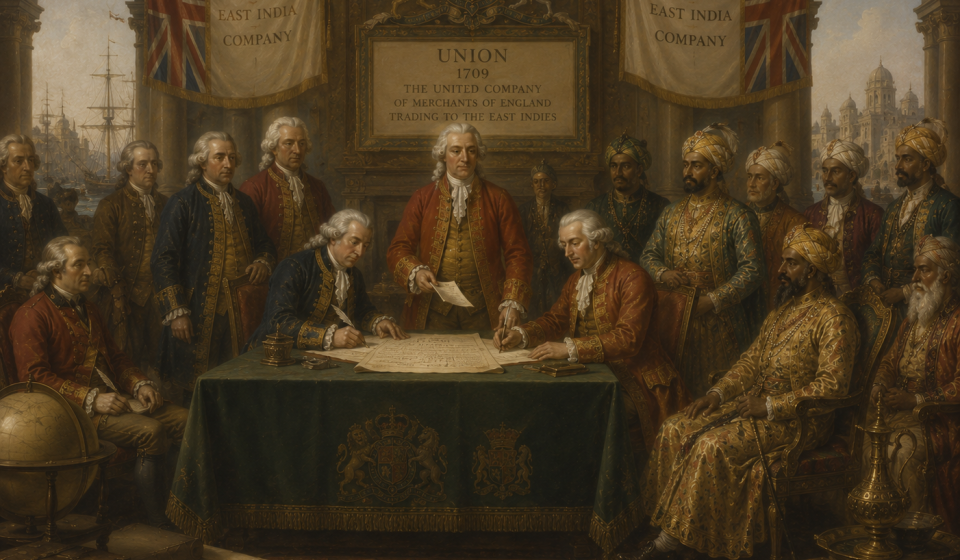
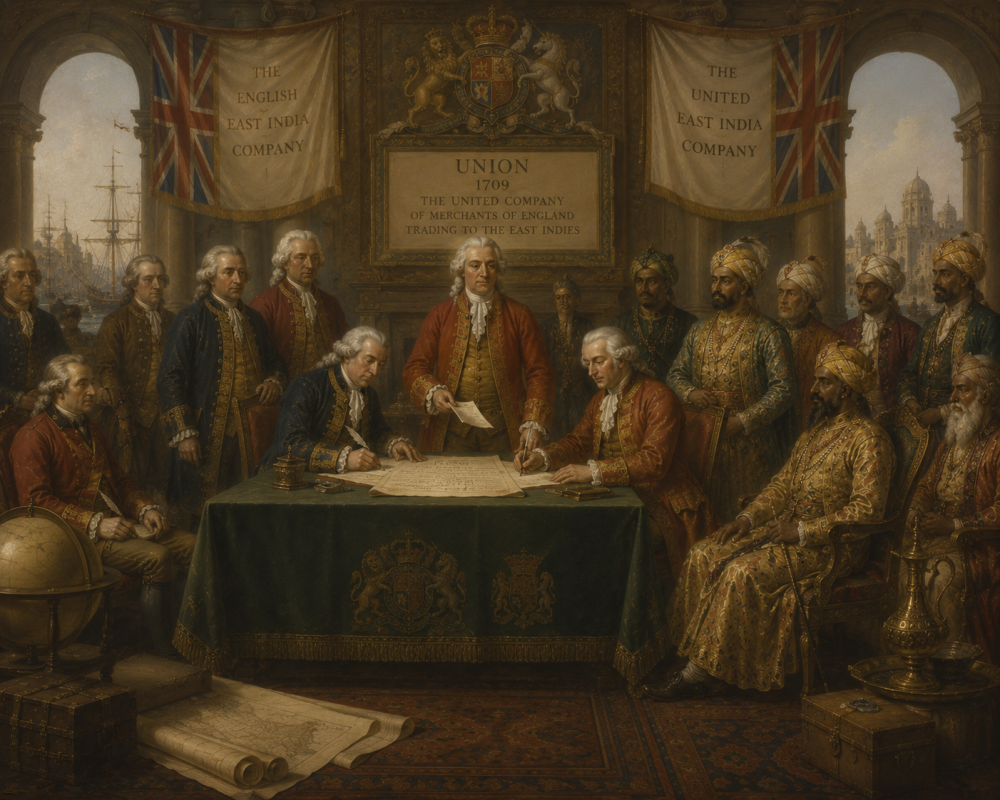
Sanity arrived through exhaustion and statecraft. Both companies were damaging themselves, the state wanted its loans secure and the trade orderly, and the leading men on both sides began to interlock through mutual shareholding. Under pressure from the Crown, and with Sidney Godolphin, the Lord Treasurer, acting as arbiter of the final terms, the two corporations negotiated a union. In 1702 they agreed to trade jointly, and in 1709 the merger was completed, creating the United Company of Merchants of England Trading to the East Indies. It was this United Company, with its capital enlarged, its loans to the state binding it to the national interest, and its court of twenty four directors in Leadenhall Street, that history knows simply as the East India Company for the remainder of its existence.
The merger settled the constitutional character of the enterprise. The Company was now wedded to Parliament rather than to the Crown alone, its monopoly renewed by statute in exchange for loans, its affairs debated publicly, its stock a pillar of the national credit alongside the Bank of England. This entanglement of company and state, born of the wars of the 1690s, meant that when the Company later stumbled into ruling provinces, the British state was already its creditor, guarantor and silent partner, and could not stand aside. The regulation, supervision and ultimate takeover of the Company by the state in the following century all descend from the bargain of 1709. In uniting the two companies, England had, without intending it, incorporated its future Indian empire.
1600 to 1720 - The Arrival
Part 8 of 10 in this chapter.