 In 30 Seconds




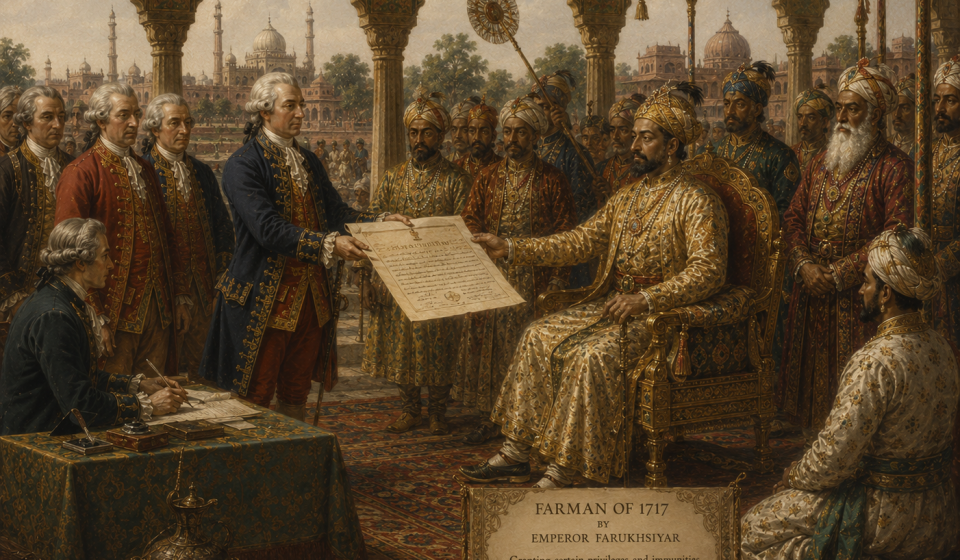
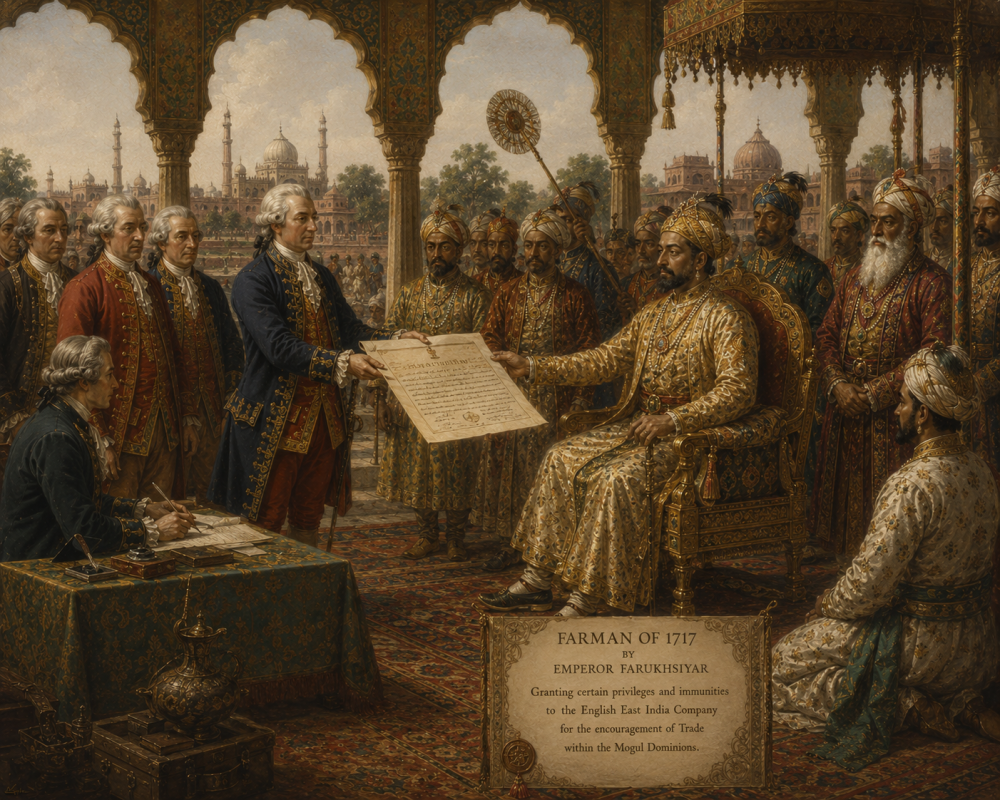
The story begins, improbably, with a surgeon. In 1715 the East India Company sent an embassy from Calcutta to the court of the Mughal emperor Farrukhsiyar at Delhi, led by John Surman and guided by the Armenian merchant diplomat Khwaja Sarhad. In its train travelled William Hamilton, a Scottish surgeon, and it was Hamilton’s fortune to cure the emperor of a painful ailment at the moment when Farrukhsiyar wished to marry. The grateful emperor invited the English to ask their reward. After two years of negotiation, gifts and patience, the embassy carried away in 1717 a set of imperial farmans that the Company would come to regard as its Magna Carta in India.
The privileges were extraordinary. In Bengal, the richest province of the empire, the Company was exempted from all customs duties on its trade in exchange for a fixed annual payment of a mere three thousand rupees. Its goods, moving under passes called dastaks issued by the president of Calcutta, were to travel free of tolls and search. The Company received the right to rent additional territory around Calcutta, its coins struck at the Bombay mint were to circulate as currency of the empire, and its servants gained valuable liberties at Surat and Madras besides. No other European nation held anything comparable. On paper, the English had become the most favoured merchants of the Mughal world.
Paper, however, met power at the border of Bengal. The province was governed by Murshid Quli Khan, the formidable administrator who had made Bengal’s revenues the marvel of the empire and who was, in all but name, an independent ruler as imperial authority decayed after Aurangzeb’s death. He regarded the farman as an act of imperial folly that gave away his province’s customs revenue, and he simply declined to implement its most damaging clauses. The additional villages were never yielded, and the exemptions were policed narrowly. His successors as Nawabs of Bengal, Shuja ud din, Alivardi Khan, maintained the same posture, honouring the Company’s basic trade while refusing to let a foreign corporation dismantle the fiscal machinery of the state.
Between the paper and the refusal grew a poisonous quarrel that lasted forty years. The heart of it was the dastak. The farman exempted the Company’s trade, meaning its export and import trade by sea. It said nothing about the private inland trade of the Company’s servants, who dealt on their own account in salt, betel nut, tobacco and grain, the taxed commodities of the interior. Yet Calcutta’s presidents issued dastaks to cover this private trade, and the passes were sold and lent to Indian merchants as well, so that a growing share of Bengal’s internal commerce claimed exemption from the duties every other trader paid. The Nawabs saw plain fraud draining their treasury and undermining their own merchants. The English saw chartered rights vexatiously obstructed. Both were describing the same facts.
Alivardi Khan managed the tension with a strong hand and rough equity, squeezing the Company for contributions when he needed them, as during the Maratha invasions, but keeping the trade alive, for Bengal profited by it. He is said to have compared the Europeans to bees, of whose honey a ruler might taste, but who would sting him to death if the hive were disturbed. His grandson Siraj ud Daulah inherited the quarrel in 1756 with less patience and less power, and within eighteen months the disputes over dastaks, fortifications and the sheltering of the Nawab’s enemies in Calcutta had spiralled into the storming of the city, the retaliation of the Company, and the conspiracy of Plassey.
The farman of 1717 thus stands at the hinge of the Company’s Indian history. It was the last great gift of the Mughal empire to the English and the first great cause of their empire over it. A privilege granted by a weak emperor, resisted by strong governors and abused by private greed became the legal grievance and the financial engine of conquest. When the Company’s armies later ruled Bengal, they ruled, in part, to make good a piece of paper won at Delhi by a surgeon’s lancet.
1600 to 1720 - The Arrival
Part 9 of 10 in this chapter.