 In 30 Seconds




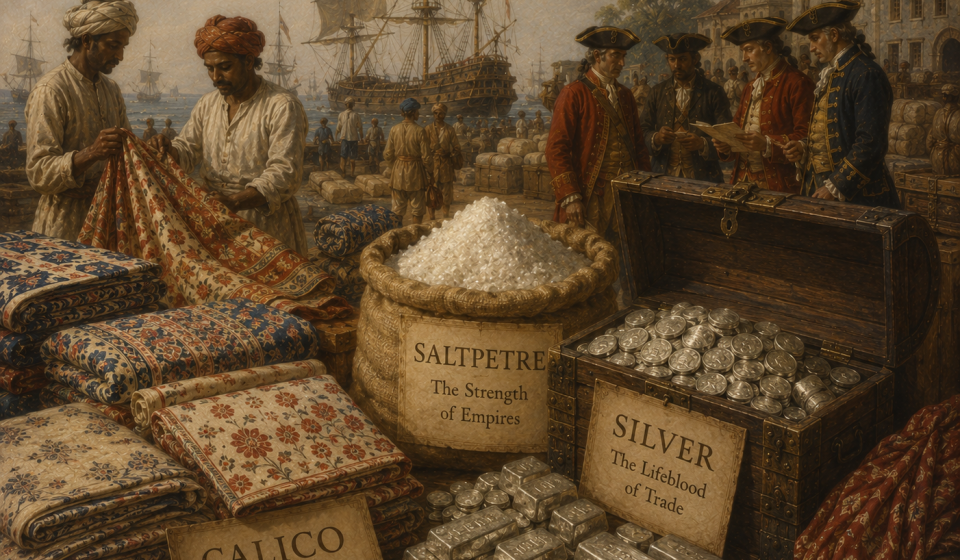
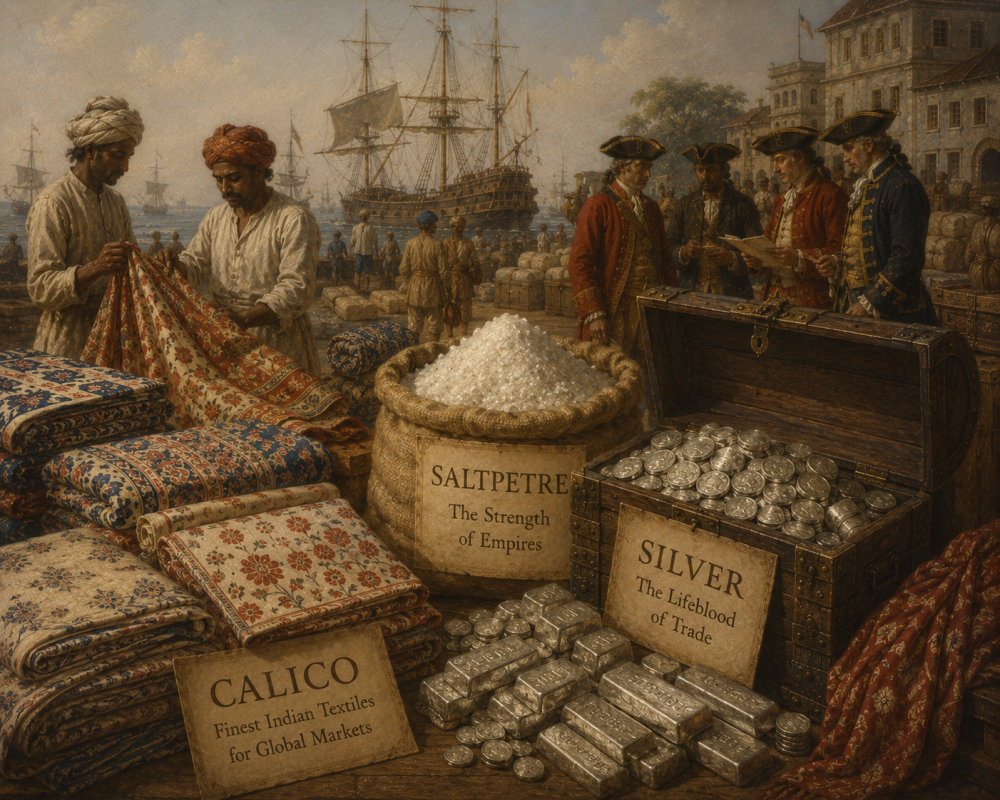
Empires are built on cargo manifests before they are built on battlefields, and the manifest of the East India Company explains its history better than any battle. The Company came east for spices, stayed for cloth, financed itself with saltpetre and paid for everything with silver, and each of those commodities pulled it deeper into India.
The founding dream was pepper, and for its first decades the Company’s profits swung with the markets of Sumatra, Java and the Malabar coast. But the Dutch, richer, more numerous and more ruthless, made the spice islands their fortress, and the massacre of English merchants at Amboyna in 1623 announced that the archipelago belonged to Amsterdam. Excluded from the richest spice grounds, the English fell back upon India, and there they discovered a trade greater than spices had ever been.
That trade was cotton cloth. India in the seventeenth century was the workshop of the world in textiles, its weavers producing fabrics of a fineness, colourfastness and cheapness no other region could approach. The Company shipped calicoes and chintzes from Gujarat and the Coromandel coast, muslins from Bengal, first as currency for the spice trade and then, in growing volume, for England itself. In the second half of the century, printed Indian cottons conquered the English consumer with a speed that alarmed moralists and terrified the domestic wool and silk industries. Ladies of fashion and their maids alike dressed in chintz, houses were hung with palampores, and the woollen interest thundered in Parliament that England’s ancient manufacture was being destroyed by heathen fabrics. The result was protection. Acts of 1701 and 1721 prohibited first the import of printed calicoes for domestic use and then the wearing of most cotton fabrics altogether. The Company adjusted, re exporting Indian cloth to Europe, Africa and the Americas, where calicoes became a staple currency of the Atlantic slave trade, a dark thread in the fabric that is too often left out of the pattern.
Beneath the glamour of cloth lay the grimmer utility of saltpetre, the essential ingredient of gunpowder, of which Bengal and Bihar around Patna were the world’s great source. Saltpetre served the Company doubly, as ballast for its ships and as a commodity of which the English state was a hungry customer in every war. The trade tied the Company to the government as a strategic supplier and tied its fortunes ever more firmly to Bengal, where the best petre lay. Indigo for dyeing, raw silk, sugar, and later tea from China, purchased largely with Indian goods and Indian revenues, completed the list.
The awkward secret of the whole system was that England produced almost nothing India wanted. English woollens sat unsold in tropical warehouses, and the trade balanced only through treasure. Decade after decade the Company shipped silver bullion east, Spanish American silver earned by English trade elsewhere, and its critics at home denounced the export of treasure as national bleeding. The Company’s apologists, including the economist Thomas Mun, replied with early free trade arguments that re exports more than recovered the silver. The debate was never settled in theory. In practice it was settled at Plassey, after which the revenues of Bengal paid for the Company’s cargoes and the silver stream reversed. The change was celebrated in London as the end of the drain of treasure. Indian economists a century later would give the new arrangement its lasting name, the drain of wealth, flowing the other way.
There is a final irony worth recording. The calico acts, designed to protect wool, instead created a sheltered space in which English manufacturers learned to imitate Indian cottons, and the machines of Lancashire eventually did what Parliament could not, undercutting the Indian weaver in his own markets. The trade that had drawn England to India ended by devastating the very industry that had made India worth the voyage. The cargo manifests of the seventeenth century thus contain, in miniature, the entire economic history of the colonial encounter, the attraction, the dependence, the reversal and the ruin.
1600 to 1720 - The Arrival
Part 10 of 10 in this chapter.