 In 30 Seconds




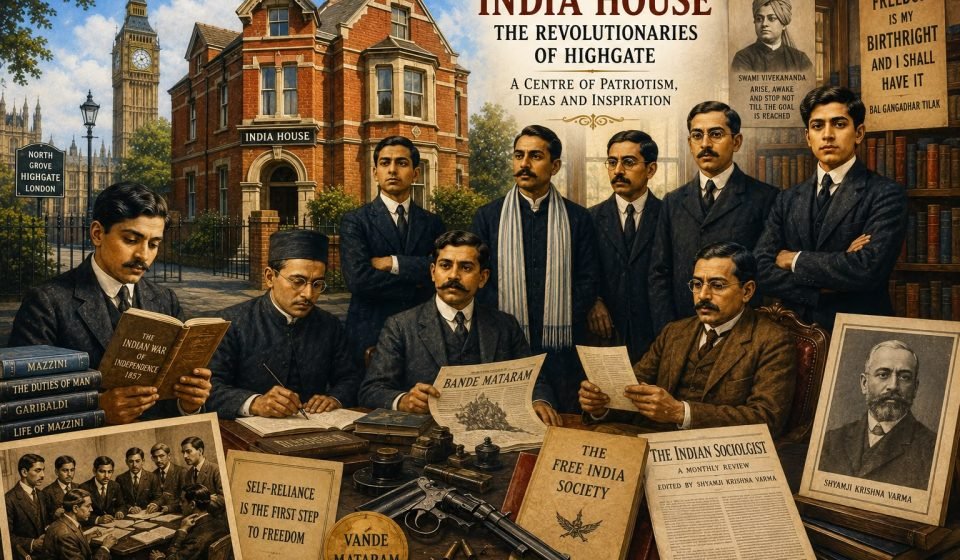
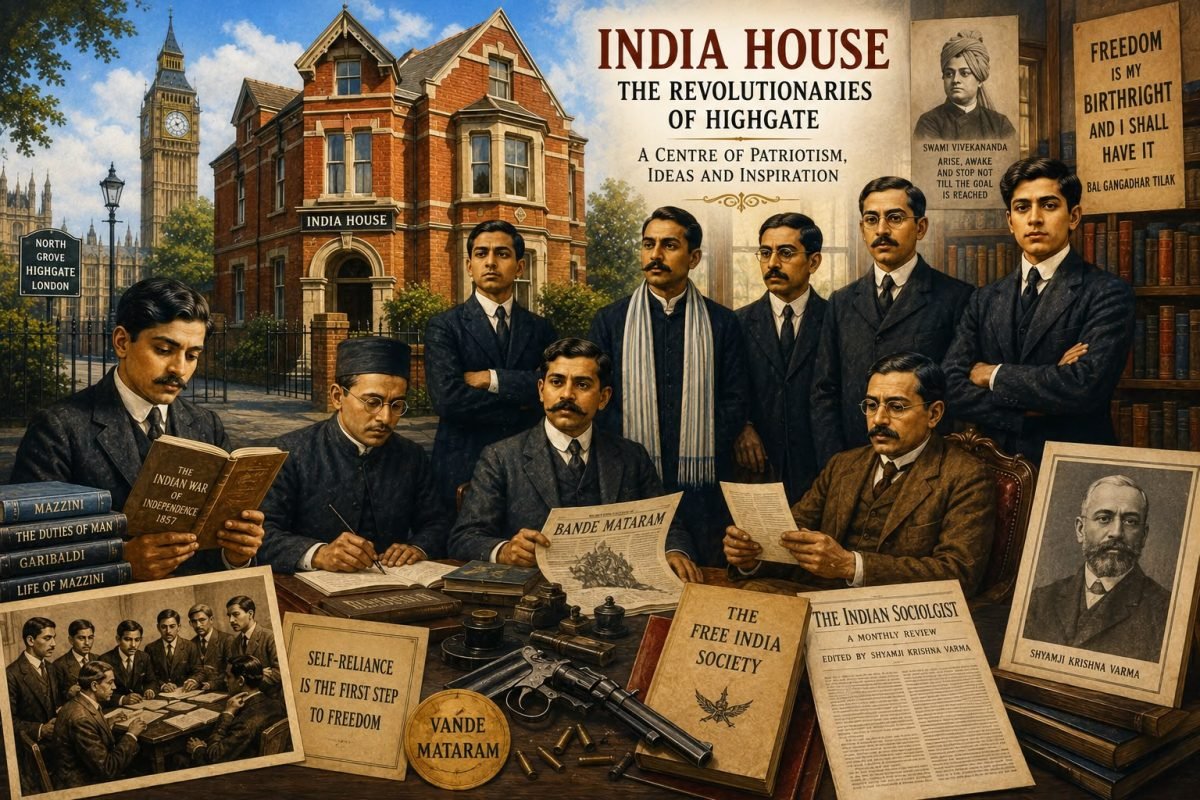
For five years the most watched address in the British Empire was a student hostel in the London suburb of Highgate. India House, opened in 1905 at 65 Cromwell Avenue, was conceived as a residence for Indian students and became the headquarters of Indian revolution abroad, the place where the empire’s capital hosted, fed and educated the young men sworn to destroy it, until an assassination a mile from Buckingham Palace brought the experiment down.
Its founder was a self made scholar of improbable trajectory. Shyamji Krishna Varma, born in a small Kutch trading family in 1857, had risen as a Sanskritist praised by Oxford’s Monier Williams, the first Indian called to lecture at Oxford while taking his own degree there, then served and quarrelled as diwan in princely states before settling in London with a fortune and a conviction, drawn from Herbert Spencer’s individualism, that British rule in India was an organised violation of natural rights. In January 1905 he launched the Indian Sociologist, a penny monthly whose masthead preached resistance to aggression as not simply justifiable but imperative, founded the Indian Home Rule Society, and endowed the lectureships and travelling fellowships, several named for Spencer and for the Rana of the house he had served, that brought picked young Indians to Britain free of the loyalty oaths government scholarships required. India House was the boarding establishment of this counter university, and its Sunday meetings drew everyone from Dadabhai Naoroji’s respectable circle to anarchist Europe, with Madame Bhikaiji Cama, the movement’s flag bearing matriarch in Paris, and the young Gandhi, visiting in 1906 and 1909, among those who argued under its roof, Gandhi’s Hind Swaraj being written, in large part, as an answer to the doctrines he heard there.
The doctrines soon outran the founder. Krishna Varma, harried by threats of prosecution, moved to Paris in 1907, and leadership at Highgate passed to his fiercest fellowship holder, Vinayak Damodar Savarkar, a Poona law student in his mid twenties who had founded the secret Abhinav Bharat society at home and now made India House its foreign arsenal. Under Savarkar the establishment translated Mazzini into Marathi, celebrated the martyrs of 1857 at demonstrative anniversaries, and produced the book the Raj feared enough to ban before publication, The Indian War of Independence 1857, printed in Holland, smuggled worldwide in false covers, which renamed the Mutiny for the movement forever. Less literary cargo moved too, a bomb manual copied from Russian exiles in Paris and cyclostyled for India, and Browning pistols smuggled in a false bottomed box, one of which reached Anant Kanhere, who shot the district magistrate Jackson at Nasik in December 1909.
The blow that ended it fell first in London. On 1 July 1909, at an Imperial Institute reception, Madan Lal Dhingra, an India House resident, shot dead Sir William Curzon Wyllie, political aide to the Secretary of State for India, the first political assassination by an Indian on British soil, whose story belongs to its own chapter. The reaction closed around Highgate, residents scattered, and India House was sold within the year. Savarkar, arrested in 1910 on warrants from the Nasik case, made the escape attempt that sealed his legend, slipping through a porthole of the steamer Morea at Marseilles and swimming ashore to a France that returned him, an extradition wrangle the Hague tribunal later blessed, and the two life sentences that followed sent him to the Cellular Jail and, in time, toward the later career, and the later controversies, that made him the ideologue of Hindutva. Krishna Varma died in Geneva in 1930, still publishing, his ashes waiting seventy three years for a free India to bring them home to Kutch in 2003.
The network itself did not die with the House. It migrated, to Cama’s Paris, to Berlin’s wartime committee, to the Ghadar movement gathering among Punjabi emigrants on America’s Pacific coast, the next chapter of revolution abroad. India House had lasted five years and schooled a generation, proving, in the heart of the imperial capital, the proposition its founder had taken from Spencer, that ideas respect no frontier, and that an empire which educated its subjects would be argued with, and shot at, in its own language.
1905 to 1911 - Swadeshi, Revolutionaries and Reform
Part 8 of 10 in this chapter.