 In 30 Seconds




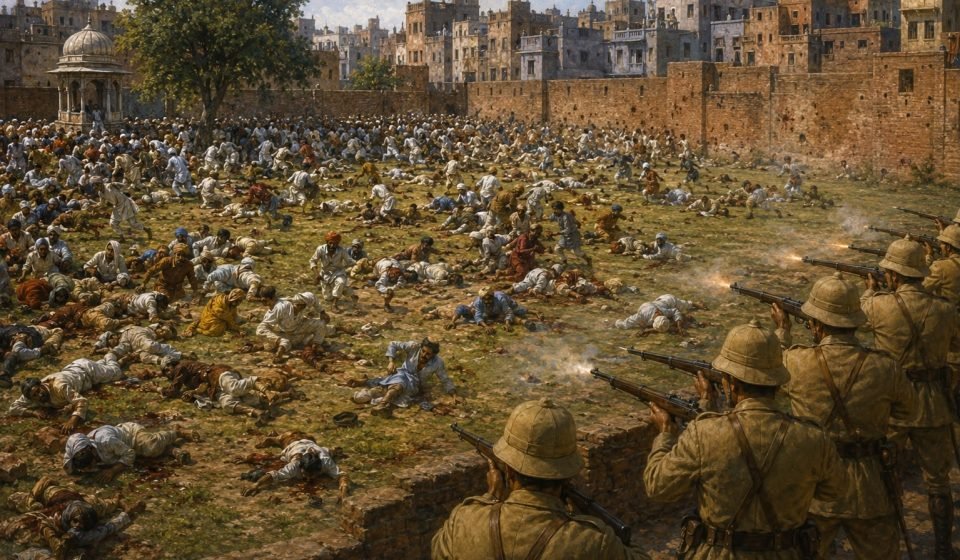
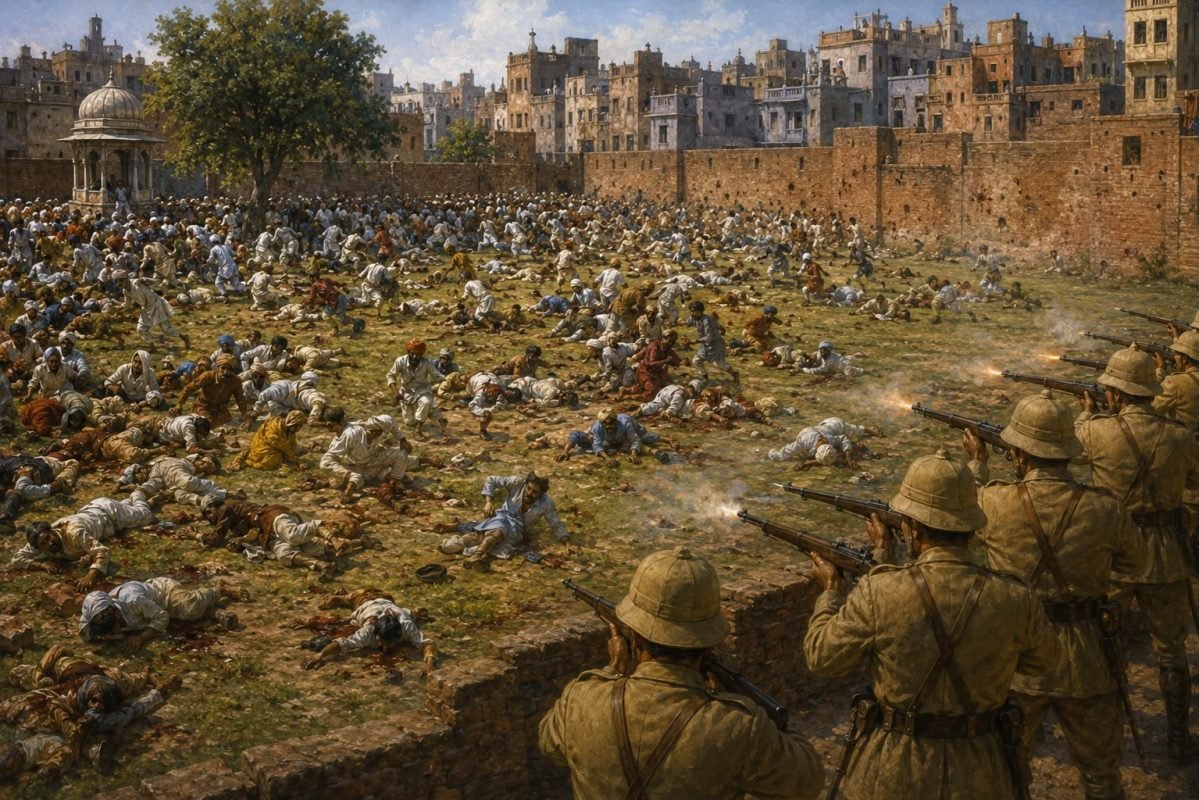
On the afternoon of 13 April 1919, Baisakhi day, some fifteen to twenty thousand people were gathered in the Jallianwala Bagh in Amritsar, a walled waste ground of six or seven acres near the Golden Temple, villagers in for the festival and its horse fair mingled with townsfolk attending a protest meeting against the Rowlatt arrests, in defiance of a proclamation many had never heard. Toward a quarter past five, Brigadier General Reginald Dyer entered the Bagh’s main passage with fifty rifles of Gurkha, Baluch and Pathan troops, deployed them on the raised ground inside without a word of warning, and ordered fire into the thickest of the crowd. The firing lasted about ten minutes and consumed one thousand six hundred and fifty rounds, the troops directed to where the fleeing masses were densest, at the walls too high to climb and the single working exits, until the ammunition ran low. Dyer then withdrew, making no provision for the wounded, who lay through the night of the martial law curfew among the dead. The official Hunter Committee count of the dead was three hundred and seventy nine, the Congress inquiry placed it near a thousand, and the well in the Bagh’s corner, from which over a hundred bodies were recovered, remains the dispute’s silent witness.
The road into the garden ran through the panic of the Punjab’s rulers. The Rowlatt hartals had shaken a province rubbed raw by war recruitment, influenza and prices, and in Amritsar on 10 April the deportation of Drs Satyapal and Kitchlew had brought crowds against police firing and then mob violence in which five Europeans were killed and a mission schoolteacher, Marcella Sherwood, was beaten and left for dead. Sir Michael O’Dwyer’s government, convinced it faced 1857 reborn, handed the city to the army, and Dyer, commanding at Jalandhar, arrived on the eleventh persuaded that the Punjab required not policing but a demonstration. His own words, to the Hunter Committee, removed the massacre from the category of tragic error. He had not been confronted by a mob he could not otherwise disperse, he testified, he had made up his mind on the march that if the meeting were held he would fire, and fire until the crowd dispersed, to produce a moral effect throughout the Punjab, and he would have used the machine guns of his armoured cars had the entrance admitted them. In the weeks of martial law that followed, the Punjab tasted the moral effect’s full curriculum, public floggings, aircraft bombing crowds at Gujranwala, and in the Amritsar lane where Miss Sherwood had fallen, the crawling order, every Indian passing compelled to go on his belly, the empire’s discipline arranged as racial theatre.
Britain’s reckoning split along the fault the massacre had exposed. The Hunter Committee censured Dyer, the government relieved him of command, and Montagu and Churchill in the Commons condemned the doctrine of frightfulness in words that still read well, the Commons sustaining the censure. The Lords voted the other way, approving Dyer’s conduct, and the Morning Post’s public subscription for the wronged general raised twenty six thousand pounds and a jewelled sword of honour, the guardian of the Punjab retired in comfort upon the gratitude of imperial England. India drew the comparison and the conclusion together. Tagore returned his knighthood in a letter asking to stand shorn of distinctions beside his degraded countrymen. Gandhi, who had begun 1919 recruiting for the empire’s army, ended it convinced that the government was satanic and cooperation with it sin, and Non Cooperation followed within the year. Twenty one years later, in London, Udham Singh, who carried the Bagh in his memory from boyhood, shot Sir Michael O’Dwyer dead at Caxton Hall and went to the gallows completing, as he declared, an old account.
The Bagh itself was purchased by national subscription and stands today as the movement’s most sacred wound, its walls still holding the bullet scars, its well preserved, its flame burning among the names. Empires govern, in the last resort, by a claim of guardianship, and claims of guardianship do not survive machine calculation of massacre. What died in the garden on Baisakhi of 1919, beside the hundreds in the dust, was the moral title of British rule, and every Indian of that generation, whatever their politics, dated the empire’s death sentence from that afternoon.
1913 to 1919 - Ghadar, War and Gandhi Arrives
Part 10 of 10 in this chapter.