 In 30 Seconds




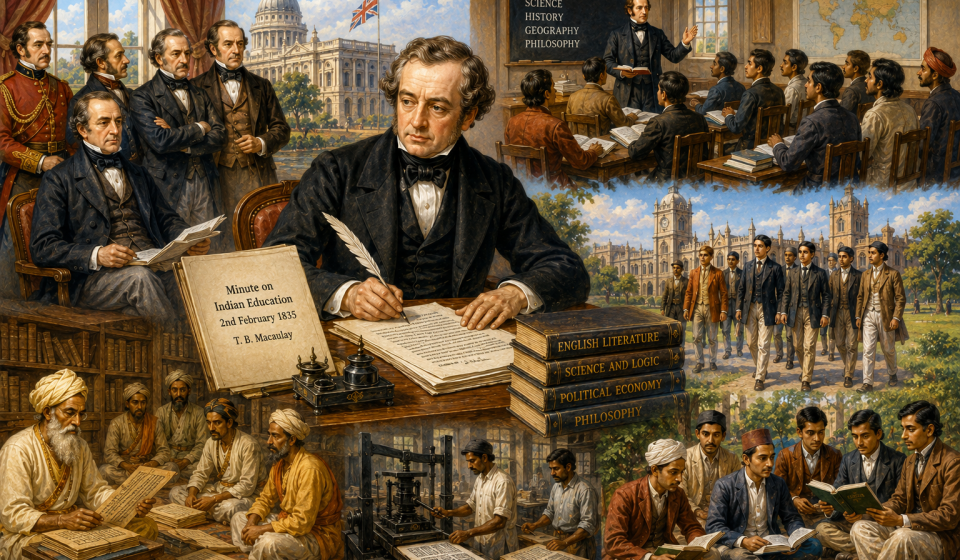
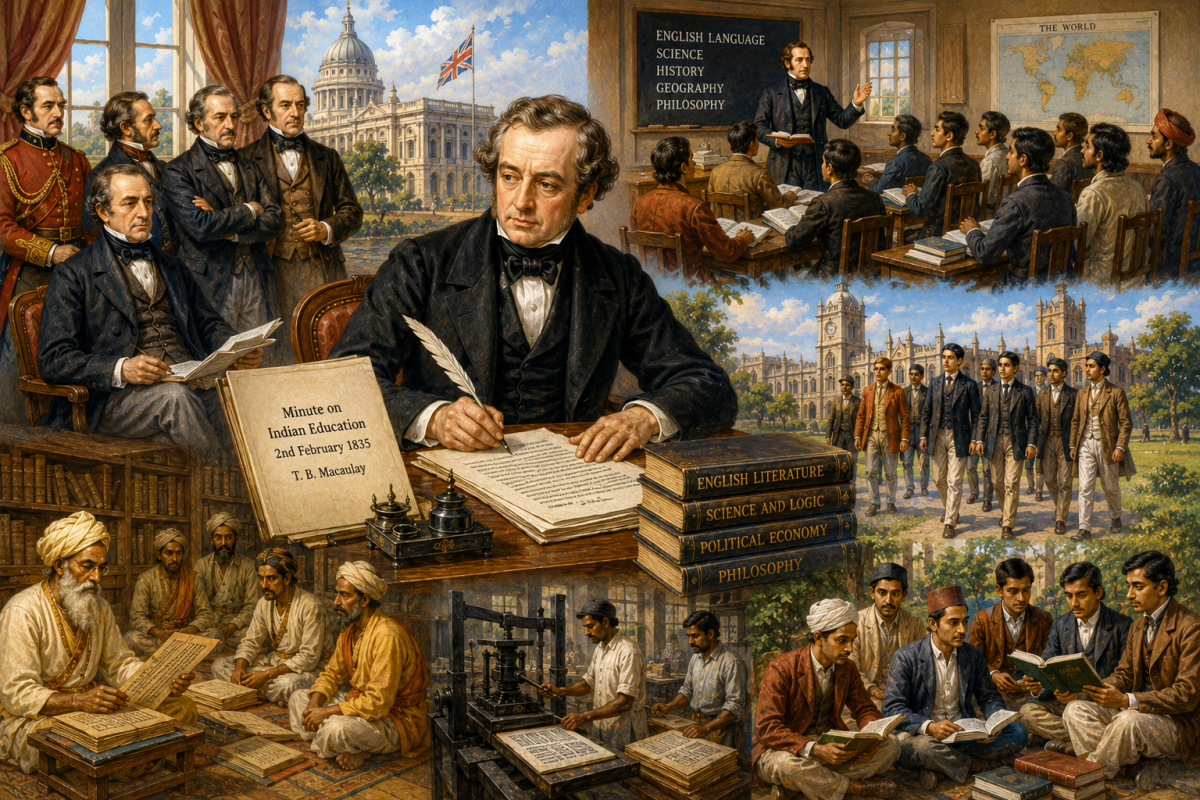
Few government memoranda have cast a longer shadow than the Minute on Indian Education that Thomas Babington Macaulay, law member of the Governor General’s council, composed in February 1835. Written to settle a bureaucratic dispute over a modest education budget, it announced a civilisational verdict, dictated the linguistic destiny of modern India, and created, exactly as it intended, a class of persons who would transform the country in ways its author never imagined, including the way that ended British rule.
The dispute was between the Orientalists and the Anglicists. Since Warren Hastings the Company had patronised Sanskrit and Arabic learning, and a committee administered the small fund that the charter of 1813 had set aside for education. One party held that government should continue reviving classical Indian learning, with English grafted on. The other, strengthened by the demand of Indian families themselves for English schooling, the example of Ram Mohan Roy’s campaigns and the visible market value of the language, argued for English as the medium of state supported higher education. Macaulay, arriving in India with the confidence of a man who had read everything European and nothing Indian, settled the matter with an essay whose brilliance and whose arrogance have never been separable. He confessed no knowledge of Sanskrit or Arabic, but declared that he had never found an Orientalist who could deny that a single shelf of a good European library was worth the whole native literature of India and Arabia, a sentence that Indian memory has never filed away. Since government could not educate the millions, he proposed to form a class who may be interpreters between us and the millions whom we govern, a class of persons Indian in blood and colour, but English in taste, in opinions, in morals and in intellect, who would in turn refine the vernaculars and diffuse knowledge downward, the theory later called downward filtration.
Bentinck’s resolution of March 1835 adopted the Anglicist position, directing the education funds to English medium instruction in European literature and science. The decision fell on prepared ground, for Indian initiative had led where policy followed, Roy’s protests, the Hindu College founded by Calcutta citizens in 1817, and the schools of missionaries and reformers had created the demand the state now organised. Wood’s Despatch of 1854 completed the structure with a system of universities, established at Calcutta, Bombay and Madras in 1857, grants in aid, and at least a paper commitment to vernacular mass education that remained, throughout British rule, the system’s starved and broken limb. The pyramid Macaulay designed stood on its point, a narrow apex of English higher education above a base of village illiteracy that the Raj never seriously financed, and at independence roughly one Indian in six could read.
The consequences of the Minute exceeded every intention. The English educated class duly appeared, filled the clerkships and the professions, and became the despised and indispensable babu of Anglo Indian mockery. But languages carry cargo. With English grammar came Milton and Mill, Burke and Bentham, the vocabulary of rights, nations and liberty, and the new class read it all with growing personal application. The interpreters between the rulers and the millions discovered they could interpret in both directions, and the men who founded the Indian National Congress, argued before the Privy Council, and eventually wrote the Constitution of India were Macaulay’s children to a man, using the coloniser’s tongue as the one language in which Madras could conspire with Bengal. English became, and remains, India’s language of law, science, administration and elite advantage, a unifier of the nation and a wall within it, dividing those who possess it from those who do not.
The cost was real and is still being audited. State patronage turned away from India’s classical learning for a century, the vernaculars were left to private devotion, and generations grew up trained to measure their own civilisation by foreign rulers, an inner colonisation slower to end than the outer one. Macaulay had predicted, in the most quoted of his prophecies, that educated India would one day demand European institutions, and called such a day the proudest in English history. The day came in forms he did not foresee, argued in his language, against his empire, by the class he created. The Minute won its argument in 1835 and has been arguing with India ever since.
1818 to 1856 - Consolidation and Reform
Part 4 of 10 in this chapter.