
 In 30 Seconds




In February 1707, in a military camp in the Deccan, the emperor Aurangzeb died in his eighty ninth year, still at war with the Marathas he had spent a quarter of a century trying to crush. He left behind an empire larger on the map than any his ancestors had ruled and weaker in its bones than any of them would have recognised. Within half a century of his death, the Mughal empire that had awed the world was a ghost, its emperors puppets, its provinces kingdoms in all but name, and its capital twice sacked by invaders. Into the vacuum thus created stepped, among others, a company of English merchants.
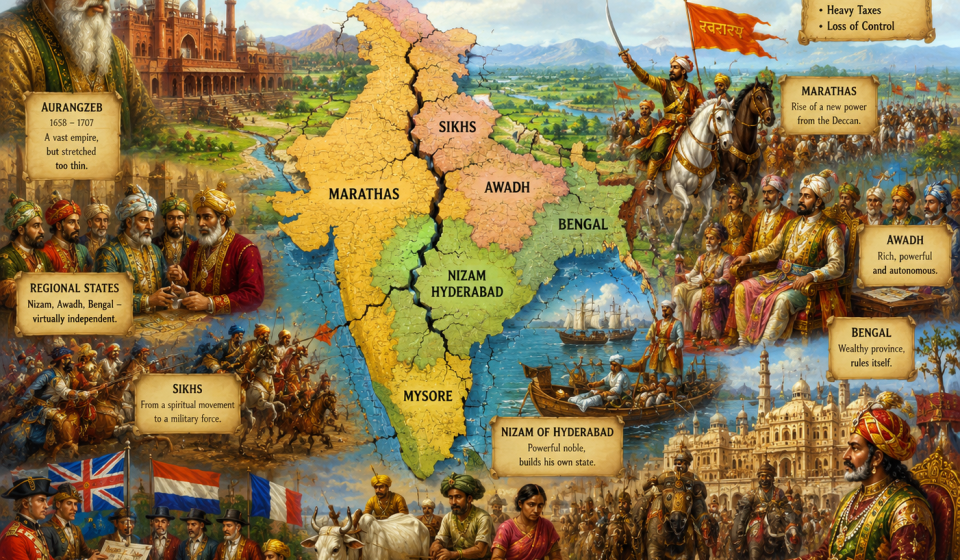
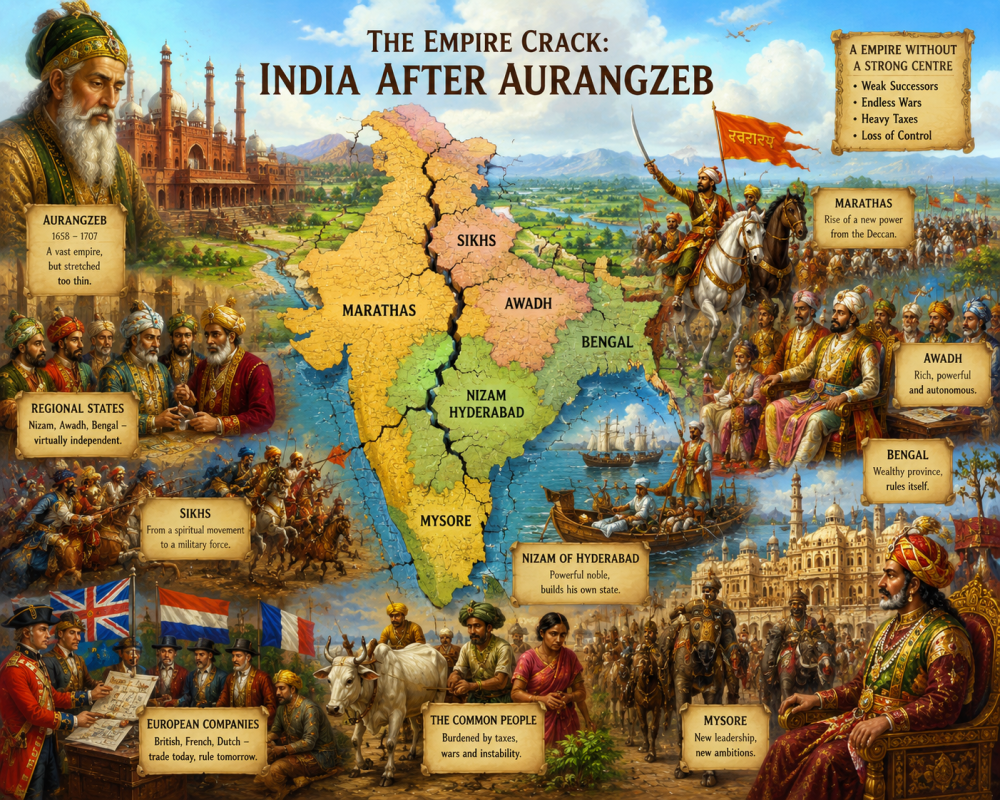
The rot had many roots, and historians still argue over their relative weight. Aurangzeb’s endless Deccan wars had drained the treasury, worn out the army and kept the emperor a thousand miles from the north Indian heartland for decades. The mansabdari system, the machinery of rank and revenue assignment that paid the nobility, buckled under its own success, for the empire had recruited more nobles than it had productive jagirs to assign them, and the scramble for revenue turned administrators into extractors. Peasant rebellions, of the Jats around Agra, the Satnamis, and the Sikhs in Punjab under the banner of their martyred Gurus, gnawed at the core provinces. And the Marathas, whom Aurangzeb could defeat in battle but never in war, emerged from his death stronger than ever, their horsemen soon collecting chauth, a tribute of one fourth, from provinces the emperor still claimed to rule.
The succession itself completed the damage. Mughal custom had always settled the throne by war among princes, a brutal filter that had at least produced able rulers. Now the wars continued but the filter failed. Bahadur Shah I, victorious in 1707, was already old and reigned five years. After him the throne became a prize passed between factions of nobles, and the emperors became instruments. The Sayyid brothers, Abdullah Khan and Husain Ali, kingmakers of the 1710s, raised and destroyed emperors at pleasure, deposing and killing Farrukhsiyar, the very monarch who had granted the English their great farman, in 1719. That single year saw four emperors on the throne of Delhi. When Muhammad Shah, called Rangila, the pleasure lover, settled into a long reign from 1719 to 1748, stability of a kind returned to the court, but it was the stability of resignation.
The ablest men in the empire drew the obvious conclusion. If the centre could not protect or reward them, they would build their own centres. Nizam ul Mulk, the most powerful noble of his generation, abandoned the poisoned politics of Delhi and planted himself in the Deccan. Murshid Quli Khan in Bengal and Saadat Khan in Awadh turned their governorships into inheritances. None of them declared independence, for the Mughal name retained an authority that outlived Mughal power, and every usurper in eighteenth century India, including eventually the English, found it convenient to rule in the emperor’s name. The fiction was maintained precisely because it was useful.
What did this mean for the foreign merchants on the coast? Everything. The Mughal peace, which had made Child’s War so hopeless in the 1680s, was dissolving. In its place came a system of competing regional powers, each in need of revenue, soldiers and allies, each willing to bargain with armed Europeans, and none commanding the overwhelming force that Aurangzeb had wielded. The military balance shifted too. The European wars of the age were forcing rapid innovation in drill, artillery and infantry tactics, while Indian armies, though vast and often brave, remained cavalry centred hosts bound to the politics of their paymasters. A few thousand drilled sepoys under European officers would soon prove worth many times their number.
None of this made conquest inevitable in 1707. The successor states were vigorous, the Marathas were formidable, and the Europeans were still merchants clinging to the shore. But the essential condition of empire had been created, which is the absence of a paramount power. India after Aurangzeb was a subcontinent in search of a new master. It would spend the eighteenth century auditioning candidates, Maratha, Afghan, Persian and European, and the least likely of them would win.
1707 to 1765 - The Empire Cracks, the Company Rises
Part 1 of 10 in this chapter.