
 In 30 Seconds




Story
Most sacred places commemorate an event. Naimisharanya commemorates a telling. In the tradition’s own account, this forest on the Gomti river in what is now Sitapur district is where the great narratives of Hinduism were recited into permanence, where the sage Suta, arriving among an assembly of rishis engaged in a sacrificial session of vast length, was asked to relate everything he had heard, and answered with the Puranas and the Mahabharata itself. The stories that furnish the Hindu imagination, of the churning of the ocean, of the avatars, of the dynasties of the sun and moon, all carry, in their own framing verses, the same return address. This was spoken in Naimisharanya. The forest is, in effect, the recording studio of Hindu civilisation.
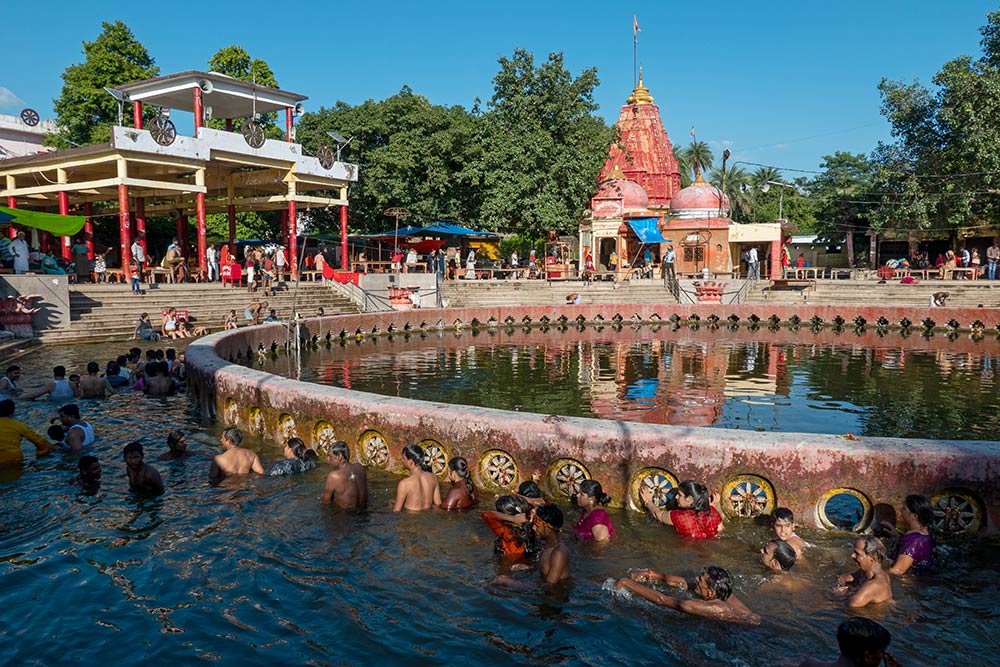
The name and the founding legend arrive together. Seeking a place fit for their long sacrifice, safe from the disorders of the approaching dark age, the sages asked Brahma, who released a wheel, a chakra, and told them that where its rim broke apart, there they should settle. The wheel rolled across the world and shattered here, and the spot became the Chakra tirtha, the circular pool at the heart of the site whose waters, fed by springs the devout call bottomless, remain the pilgrimage’s central bath. Around it, the tradition says, dwelt the eighty eight thousand rishis of the assembly, a number that has become the shorthand for the place itself, and the forest took the name Naimisha, glossed variously as the spot where the wheel’s rim, nemi, broke, or where the demons were destroyed in a nimisha, the blink of an eye.
The claim of the framing verses is worth taking seriously as cultural history even where the historian must stay silent on the legend. The Puranas were composed and compiled across many centuries, and their editors chose, again and again, to set the act of narration in this specific forest on the Gomti, which tells us that by early in the common era Naimisharanya already possessed an authority worth borrowing, a reputation as the place where sacred speech was at its purest. The Mahabharata opens here. The Bhagavata Purana, the scripture at the heart of Krishna devotion, unfolds here as Suta’s answer to Shaunaka, the chief of the assembled sages. Even the Ramcharitmanas of Tulsidas, a millennium and a half later, honours the site’s convening power. When Hindu tradition wanted to certify a text, it convened the eighty eight thousand and had it spoken in Naimisha.
The living pilgrimage gathered its own geography around the legend. Beside the Chakra tirtha stand the temple of Lalita Devi, counted among the shakti pithas and the presiding goddess of the site, the shrine of Vyasa at the Vyasa gaddi where the compiler of the Vedas is said to have taught, and Hanuman garhi with its colossal image. The Gomti’s ghats receive the ash immersions and ancestral rites of the surrounding districts, and the site anchors the eighty four kosi parikrama, the great circular pilgrimage of roughly a fortnight that circuits the sacred landscape each spring, one of the oldest walking traditions of Awadh. The Sita Samahit and Dadhichi legends attach to the wider circuit, for tradition places here the hermitage of Dadhichi, the sage who gave his own bones so the gods could forge the thunderbolt, the archetype of sacrifice for the common good.
History has passed through more quietly than at Kashi or Ayodhya, which is part of the site’s character. Naimisharanya was never a capital or a battlefield prize, merely a forest that generations kept walking to, its continuity carried by pandas, akharas, and the annual rhythm of the parikrama rather than by dynasties. The modern state has lately noticed it, with a development authority constituted in the 2020s to build the corridors and facilities of a major destination, folding the forest of the rishis into the same pilgrimage infrastructure economy this series tracks across the sacred cities.
What Naimisharanya offers this series is a reminder about the nature of UP’s sanctity. The state’s holy places are not only sites of birth, death, and divine residence. They include this, a place holy because stories were told well there, an entire tirtha resting on the authority of narration. In the state that would later produce the epics of Hindi literature, the printing houses of the nationalist press, and the story factories of the modern screen, the oldest shrine of all belongs to the storyteller.