
 In 30 Seconds




The Regulating Act of 1773 had put one hand of the British state upon India. Pitt’s India Act of 1784 closed the grip, and the system it created, an empire with two masters, Company and Crown, governed India for the next seventy four years, until the revolt of 1857 swept it away.
The road to the Act ran through one of the great political convulsions of British history. India had become the scandal and the obsession of the age. The American colonies were lost, the nabobs flaunted fortunes of suspect origin, the Company lurched between dividend and bankruptcy, and its wars against the Marathas and Mysore appeared to threaten ruin. Reports of parliamentary committees, with Edmund Burke’s pen at their most savage, laid out a chronicle of rapacity in Bengal and the Carnatic. Reform was certain. Its shape brought down a government.
In 1783 the coalition ministry of Fox and North introduced a bill that would have transferred the government of India to commissioners named in Parliament, in effect handing the vast patronage of the East to the politicians then in office. The Company fought for its life, the opposition cried that Fox was making himself a king of Bengal, and King George III, who detested the coalition, destroyed the bill by having it made known that any peer who voted for it would be counted his enemy. The Lords obediently rejected it, the King dismissed the ministry, and the young William Pitt became First Minister at twenty four. India had unmade one British government before ever Britain fully made a government for India.
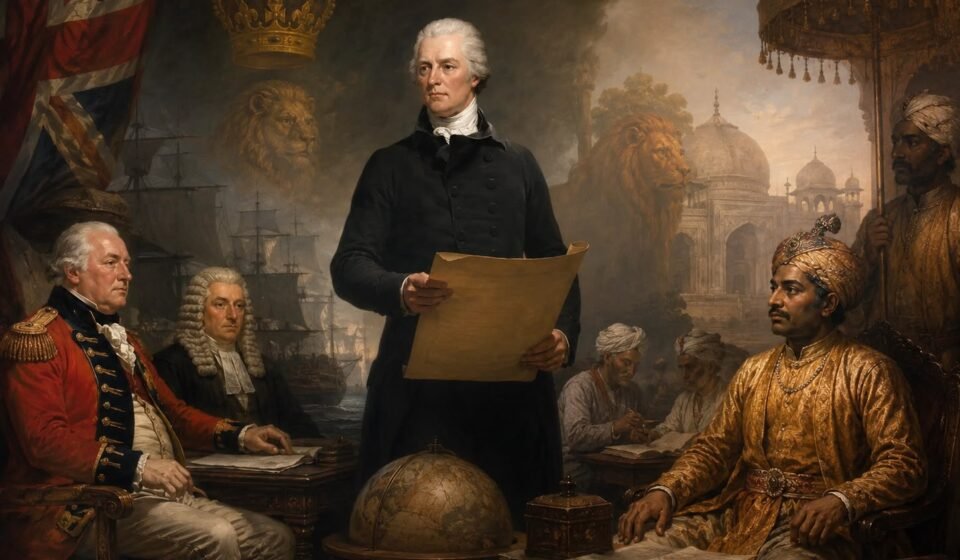
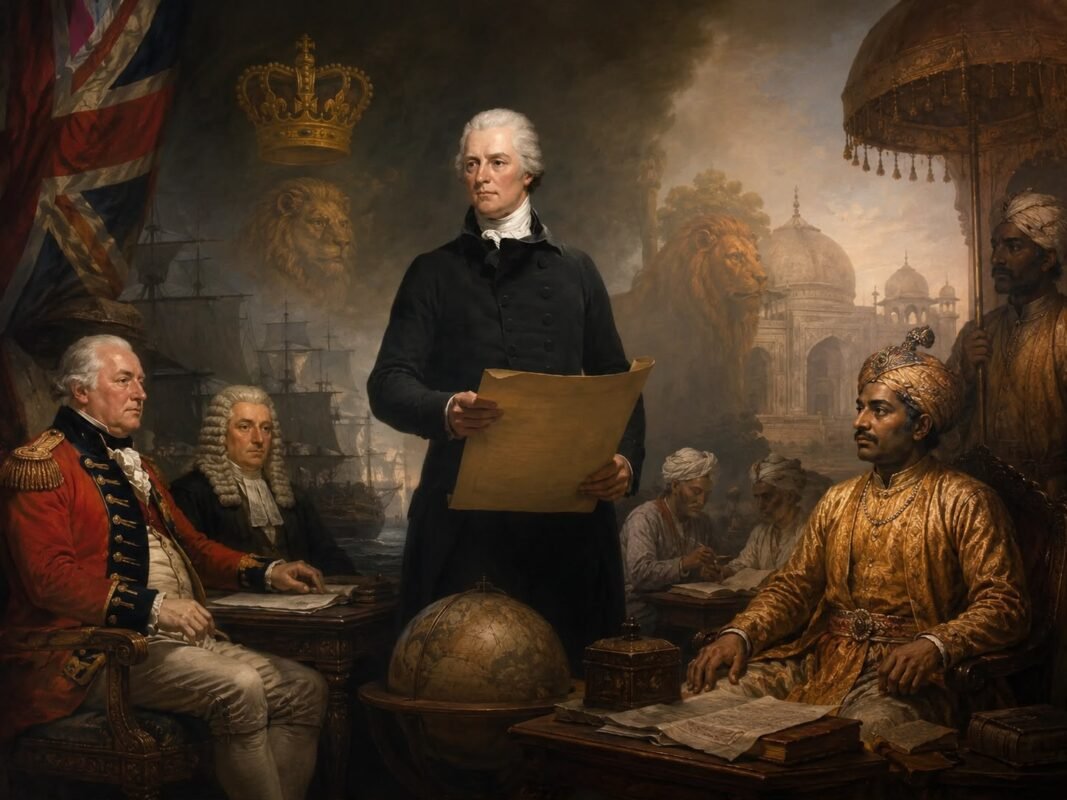
Pitt’s own Act, passed in 1784 after his election triumph, was built on a shrewder compromise. The Company kept its trade, its patronage, the appointment of its servants, and the formal government of its territories. But above the Court of Directors the Act placed a Board of Control, six privy councillors headed in practice by a president who became, in all but name, a cabinet minister for India. The Board could inspect all correspondence, approve, amend or veto every dispatch, and through a secret committee of directors could send its own orders on matters of war, peace and diplomacy directly to India, in the Company’s name but without the Company’s consent. Political power had passed to the ministry while commercial administration and patronage stayed in Leadenhall Street, an arrangement mocked then and since as a system of double government, but one that endured because it suited both partners, the state ruling without the cost, the Company profiting without the responsibility of final power.
In India the Act strengthened the Governor General against his council in external affairs and subordinated Madras and Bombay decisively to Calcutta. Two years later, to secure Lord Cornwallis for the post, Parliament added the power to override the council altogether, completing the office that would rule India, in one form, into the twentieth century. The Act also delivered, in a clause Indian history would remember with irony, a solemn self denying ordinance, declaring that schemes of conquest and extension of dominion in India were measures repugnant to the wish, the honour and the policy of the British nation. Under governments bound by that clause the Company conquered Mysore, the Marathas, Sindh and Punjab. Each conquest was reported as defensive.
Hastings, reading the new dispensation from Calcutta, resigned and sailed home in 1785 into the arms of his prosecutors. The men who followed him governed under the new system, servants of two masters who were increasingly one. Cornwallis, an English aristocrat with no Company past, symbolised the change, sent out to be incorruptible, to purify the services with high salaries and closed doors against Indians, and to settle the revenues of Bengal in the great experiment of 1793.
Pitt’s Act ended the age in which India was governed as the private business of a corporation, and began the age in which a British ministry answered, however thinly, for the fate of millions of Indians it never saw. The line from the Board of Control of 1784 runs straight to the Secretary of State of 1858 and thence to the India Office that negotiated with Gandhi. Constitutions, once planted, grow longer roots than empires expect.
1765 to 1818 - Conquest
Part 4 of 10 in this chapter.