 In 30 Seconds




In March 1919, four months after the armistice for which India had given a million men, the Government of India enacted into peacetime law the emergency powers of its wartime state, and the country answered with the first truly national agitation in its history. The Rowlatt Act, remembered in every Indian language as the Black Act, was the match of 1919, the law that brought Gandhi into all India politics, put the nation into the streets, and led, through the fear and fury it kindled in the Punjab, to the garden in Amritsar.
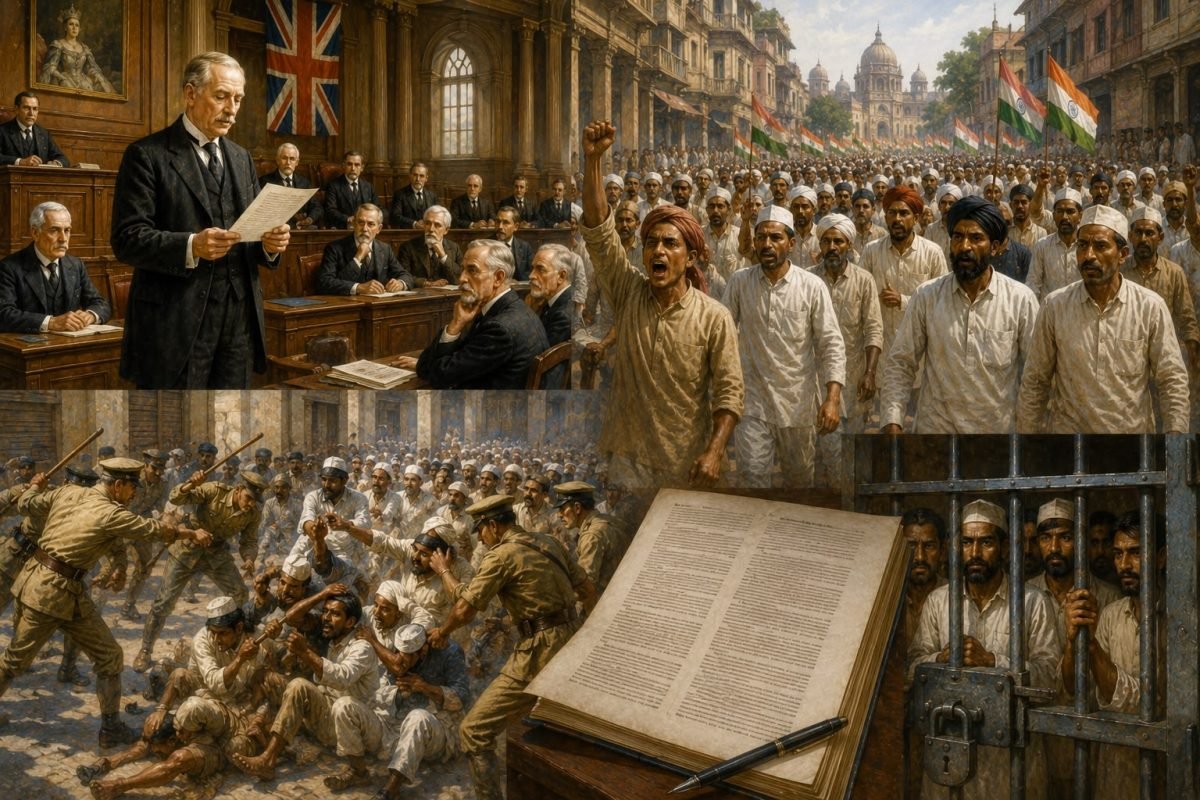
The Act descended from a committee. Justice Sidney Rowlatt’s sedition committee, appointed in 1917 to survey revolutionary conspiracy from the Chapekars to Ghadar, reported in 1918 that the danger persisted and recommended that the special instruments of the wartime Defence of India Act, then expiring, be kept ready in permanent form. The legislation of February and March 1919 followed the report, providing for the trial of scheduled political offences by special courts of three judges, sitting without jury, admitting evidence inadmissible under ordinary law, and allowing no appeal, and, in its preventive part, for the detention of suspects without trial, demand of securities, and restriction of movement, renewable indefinitely. The government pleaded the powers would be reserved for anarchical crime and used sparingly, and in the event never once invoked the Act. The plea missed what every Indian saw, that a state which had promised responsible government as the war’s reward had delivered, as its first peacetime measure, the permanent architecture of rule by suspicion, na vakil, na daleel, na appeal, as the streets abbreviated it, no lawyer, no argument, no appeal.
The Act achieved instantly what a generation of nationalists had not, unanimity. Every elected Indian member of the Imperial Legislative Council opposed it, veterans of loyalism among them, and when the government certified it into law over their votes, the demonstration of the councils’ impotence was complete. Jinnah resigned his seat in a letter that named the moment, telling the Viceroy that a government which passed such laws in such a manner forfeited its claim to be called civilised. And from his sickbed in Gujarat, Gandhi, till then the government’s wartime recruiting ally, concluded that the Act was the symptom of a deeper disease and prescribed, for the first time on the national scale, his own medicine. The Satyagraha Sabha’s pledge, drafted in February, bound its signatories to refuse civil obedience to the Act and such other laws as a committee should direct, and the instrument he announced for the nation was the hartal, a day of fasting, prayer and total suspension of business, self purification as general strike.
The hartal, observed on 30 March in Delhi by confusion of dates and on 6 April 1919 across the country, revealed an India no one, Gandhi included, had measured. From Karachi to Calcutta the cities closed, Hindu and Muslim marched and prayed together, Swami Shraddhanand of the Arya Samaj preached from the pulpit of the Jama Masjid in Delhi, where police firing on the crowds of the thirtieth had already given the movement its first dead. Then the wave broke on the state’s response. Gandhi, travelling toward Delhi and the Punjab, was arrested at Palwal on 9 April and turned back, and the news of his arrest ignited Bombay and his own Ahmedabad, where mobs burned government buildings and the Mahatma, aghast at the violence answering his name, suspended satyagraha, confessing a Himalayan miscalculation, that he had summoned to civil disobedience a people not yet schooled in its discipline. In the Punjab, where war recruitment and influenza had rubbed the province raw, the government of Sir Michael O’Dwyer met the agitation as rebellion in the making, and in Amritsar on 10 April the deportation of the local leaders, Satyapal and Kitchlew, brought crowds against gunfire, mobs against banks and Europeans, and the city to the edge of the abyss into which, three days later, Dyer marched it.
The Act itself died unused, repealed with the rest of its family in 1922 on the recommendation of the Raj’s own repressive laws committee, the empire conceding the argument after collecting its cost. Its historical work was done in its first month, and it was the opposite of its intention. Drafted to disarm sedition, the Rowlatt Act created the mass movement, handed that movement to Gandhi, and fused, for a season, the nation it had presumed to police.
1913 to 1919 - Ghadar, War and Gandhi Arrives
Part 9 of 10 in this chapter.