 In 30 Seconds




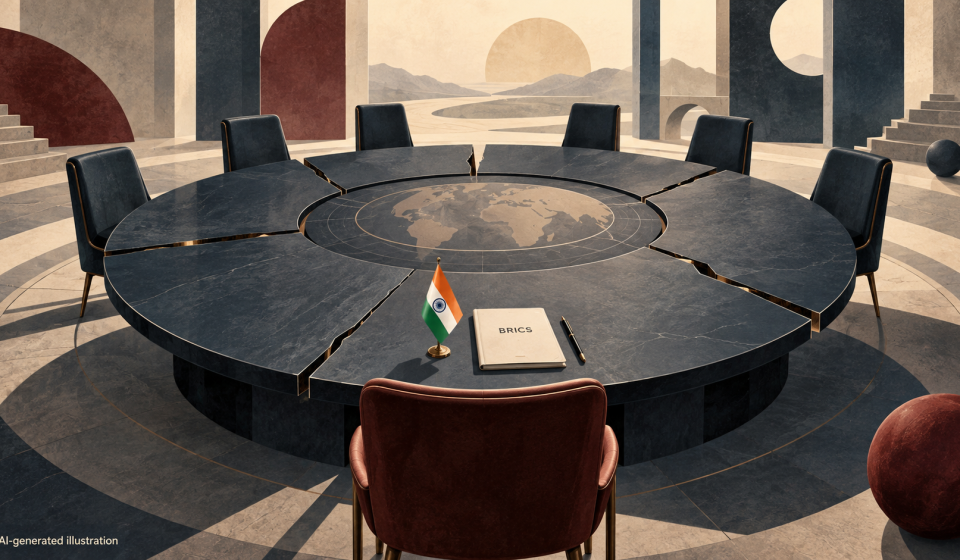
India assumed the BRICS chairmanship on January 1, 2026, at a moment when the grouping’s structural rationale has arguably never been stronger and its internal coherence has arguably never been weaker. The bloc’s post-2023 enlargement, bringing in Egypt, Ethiopia, Iran, Indonesia, Saudi Arabia and the UAE alongside the founding five, has given it a demographic and resource footprint that is difficult for the G7 to dismiss as marginal. Yet that same enlargement has imported the fault lines of the regions it now represents. The clearest evidence came within months of India taking the chair: BRICS foreign ministers meeting under the shadow of the Iran-Israel war could not agree on a joint communiqué and had to settle for a chair’s summary instead, a diplomatic euphemism for failure to reach consensus. That single episode does more to explain the strategic environment India inherited than any communiqué ever could: it is chairing a coalition whose members are, in one instance, literally at war with each other.
This is the paradox worth taking seriously. A grouping that speaks for a more multipolar order is host, this year, to the most acute demonstration yet of its own fragmentation. And the country holding the gavel is one whose foreign policy identity, that is “strategic autonomy,” reformulated for 2026 as a chairmanship theme of resilience, innovation, cooperation and sustainability, is built explicitly on not choosing sides. The question this essay pursues is not whether India’s caution is diplomatically comprehensible (it plainly is) but whether that caution is compatible with the kind of institutional leadership BRICS now needs to remain more than a rhetorical vehicle.
“Ouster” is not the real risk, agenda capture is
The idea that BRICS might formally expel India is not a serious institutional possibility, and treating it as one obscures the real risk. India is a founding member, the bloc’s second-largest economy, and structurally indispensable to any claim BRICS makes to represent both Asia’s demographic weight and a democratic counterpoint to Chinese dominance within the grouping. No consensus-based institution ousts a member of that stature; more to the point, none of the other members has an incentive to do so, since India’s presence is precisely what keeps BRICS from reading as a China-Russia-led anti-Western axis.
The real risk is agenda capture, not expulsion. If India spends its chairmanship managing perceptions rather than producing outcomes, the practical effect is that other members, China through the sheer scale of its capital and manufacturing offer, Russia through its appetite for confrontation with Western institutions, and a widening circle of Gulf and African members with their own regional priorities, increasingly set the terms of what BRICS actually does, while India retains ceremonial primacy without substantive authorship. This is a more insidious outcome than expulsion, because it allows India to keep the title of leadership while losing the content of it.
The dedollarisation trap, examined empirically
The clearest illustration of this dynamic is the currency question, and it is worth being precise about what is actually being asked. India’s own parliamentary Standing Committee on External Affairs has pressed the government on whether it will advance a de-dollarisation agenda at the September 2026 summit, a question that exposes the tension between financial-sovereignty ambitions and the risk of provoking retaliation from Washington, particularly at a moment of live trade friction between India and the United States. New Delhi’s posture, reported consistently across the 2026 chairmanship cycle, has been to frame BRICS as a platform for reform rather than confrontation, resisting the language of an anti-Western bloc even as it makes room for financial diversification.
This is a defensible position, not merely a timid one. A common BRICS currency remains a technical improbability: the bloc’s members have incompatible capital-account regimes, wildly divergent inflation and exchange-rate management practices, and no shared central banking architecture: a common currency would require exactly the kind of fiscal and monetary pooling that took the eurozone decades to build among far more converged economies. India’s scepticism of that project is analytically sound.
But the empirical failure is not scepticism about a currency union, it is the absence of a substitute agenda at the level of infrastructure. India possesses, in its Unified Payments Interface, one of the only digital payment rails in the world that has been proven at national scale (tens of billions of transactions processed monthly) and has already been extended, bilaterally, to a handful of partner countries. That is precisely the kind of asset a chairmanship could turn into a multilateral public good: a BRICS-wide interoperability standard for instant payments, local-currency settlement corridors, or shared central-bank-digital-currency protocols that reduce transaction costs for small and medium exporters across the Global South without touching the reserve-currency question at all. The distance between “we will not attack the dollar” and “we have nothing to offer instead” is where India’s 2026 chairmanship is currently sitting, and it is a distance of choice, not necessity.
The New Development Bank as an underused instrument
The same gap between rhetoric and instrument shows up in the New Development Bank, the one piece of BRICS institutional architecture with actual balance-sheet capacity. The NDB’s own leadership has stated an ambition to reach roughly USD 30 billion in cumulative approved financing and to extend 30 percent of its lending in local currencies by 2026, a target that, if met, would represent genuine progress toward reducing dollar dependency in project finance without any of the symbolic baggage of a reserve-currency challenge. Yet the Bank’s portfolio remains geographically lopsided toward its founding members and has been slow to scale toward the newer, and often capital-starved, members in Africa and Southeast Asia. India’s chairmanship theme of “resilience” is an obvious opportunity to press for a recapitalisation and a mandate expansion aimed specifically at the enlarged BRICS+ membership, strategically targeting vaccine manufacturing capacity, municipal infrastructure and climate adaptation (both green and transition finance), rather than treating the NDB as a background institution to be mentioned in communiqués.
Health and cities: the tests of “delivered capacity”
India’s prior chairmanship years already demonstrate that the country can generate concrete initiatives when it chooses to: the 2021 presidency produced over 150 meetings and events across the year and set priorities around multilateral reform and digital tools for the Sustainable Development Goals, while subsequent chairmanships produced a Digital Health Summit, an Agricultural Research Platform, and a satellite-constellation agreement. The problem is not a record of zero initiatives. It is that these initiatives have tended to remain at the level of frameworks and summits rather than becoming operational systems that a health ministry in Southeast Asia or a municipal government in East Africa can actually plug into.
Pharmaceutical manufacturing is the sharpest test case. India supplies a substantial share of the generic medicines and vaccine doses used across the developing world, and the COVID-19 period demonstrated, brutally, what happens when vaccine production and intellectual property are concentrated in a handful of jurisdictions. A BRICS chairmanship genuinely oriented toward Global South delivery would use that manufacturing base as the anchor for a shared regulatory-recognition system, joint genomic surveillance network, and pooled emergency stockpiling arrangement among BRICS+ members, reducing the multi-year regulatory lag that currently forces developing countries to wait for Western or WHO approvals before accessing medicines already being produced at scale in India. That is a project India is uniquely positioned to lead and has not yet proposed at the necessary scale.
Urbanisation presents a parallel and, in some ways, larger opportunity. BRICS+ members collectively hold decades of experience in solving analogous problems, notably informal settlement upgrading, municipal digital governance, water and sanitation at scale and climate-resilient transit, independently and redundantly. A BRICS Cities Network, financed through the NDB and built around open technical standards rather than one-off pilot projects, would let a mid-sized African city adopt an Indian digital-governance stack, a Brazilian bus-rapid-transit model, or a Chinese renewable-grid integration approach with financing already attached. No such platform currently exists in any operational form, despite years of BRICS urbanisation working groups.
Why caution is being misread as capitulation
None of this requires India to become anti-American, and this is the analytically important point that is often lost in commentary that frames the debate as balancing versus alignment. India’s relationships with Washington, Brussels and Tokyo are not in tension with an ambitious BRICS agenda; they are, if anything, the source of the credibility India could bring to it, since India is the one major BRICS member that cannot plausibly be accused of running the bloc as a proxy for a single external power. The risk is not that India’s Western ties compromise its BRICS leadership. The risk is that an accumulated pattern of blocking or slow-walking initiatives, on dedollarisation, on technology-sharing frameworks, on language perceived as anti-Western, produces the appearance of a de facto veto, even when each individual decision is defensible on its own terms. Perception accumulates into reputation, and reputation among BRICS+ partners is now a scarcer resource for India than it was a decade ago, precisely because the bloc has more members who did not need India to found the institution and feel no particular loyalty to its founding logic.
What a results-oriented chairmanship would look like
A more exacting standard for India’s 2026 presidency would rest on a small number of deliverables that survive the summit rather than a long list of thematic pillars that do not: an interoperable digital-payments framework built on UPI’s operational experience; a pharmaceutical and vaccine manufacturing network with mutual regulatory recognition; a BRICS Cities and Climate Resilience programme financed through a recapitalised NDB; and a standing mechanism for coordinating Global South positions ahead of IMF and World Bank governance reviews. None of these requires a shared currency. None requires hostility to Washington. None requires India to underwrite Chinese or Russian geopolitical objectives. All of them would convert BRICS from a platform that produces communiqués into one that produces things developing countries can use.
Conclusion: the irony India should want to avoid
The scenario worth worrying about is not India’s expulsion from BRICS, an institutionally implausible outcome, but a slower and more consequential drift in which BRICS becomes more relevant to global governance debates precisely as India becomes less central to shaping what BRICS actually does with that relevance. Strategic autonomy was never meant to be a synonym for institutional passivity. If India’s 2026 chairmanship produces working payment corridors, a functioning vaccine-manufacturing network, and a recapitalised development bank with a genuine Global South mandate, its balancing act will read, in retrospect, as leadership. If it produces another cycle of thematic pillars and unresolved communiqués, the balancing act will read as exactly what its critics already suspect it to be: caution mistaken for strategy.