
 In 30 Seconds




AI export controls news: This news analysis explains AI export controls news for readers searching for clear, current and useful context from an India-focused global news outlet.
AI export controls news: key context for readers
The reason AI export controls news matters is that it connects headline developments with policy choices, markets, technology, diplomacy and the way India is understood by audiences in the West. This article keeps the search intent simple: what happened, why it matters, and what readers should watch next.
In focus: AI export controls. This analysis explains why AI export controls matters for readers in India and the West, and how it connects to policy, markets, technology or diplomacy.
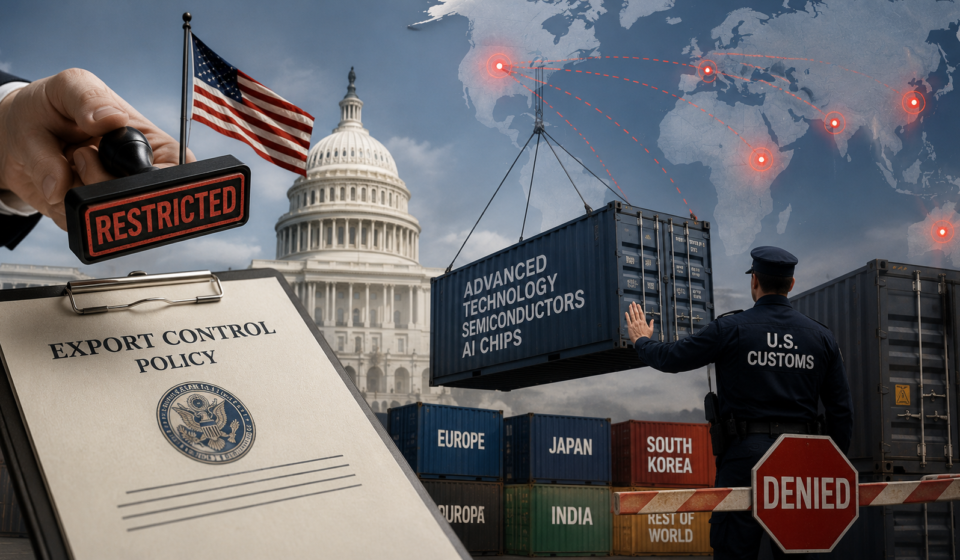
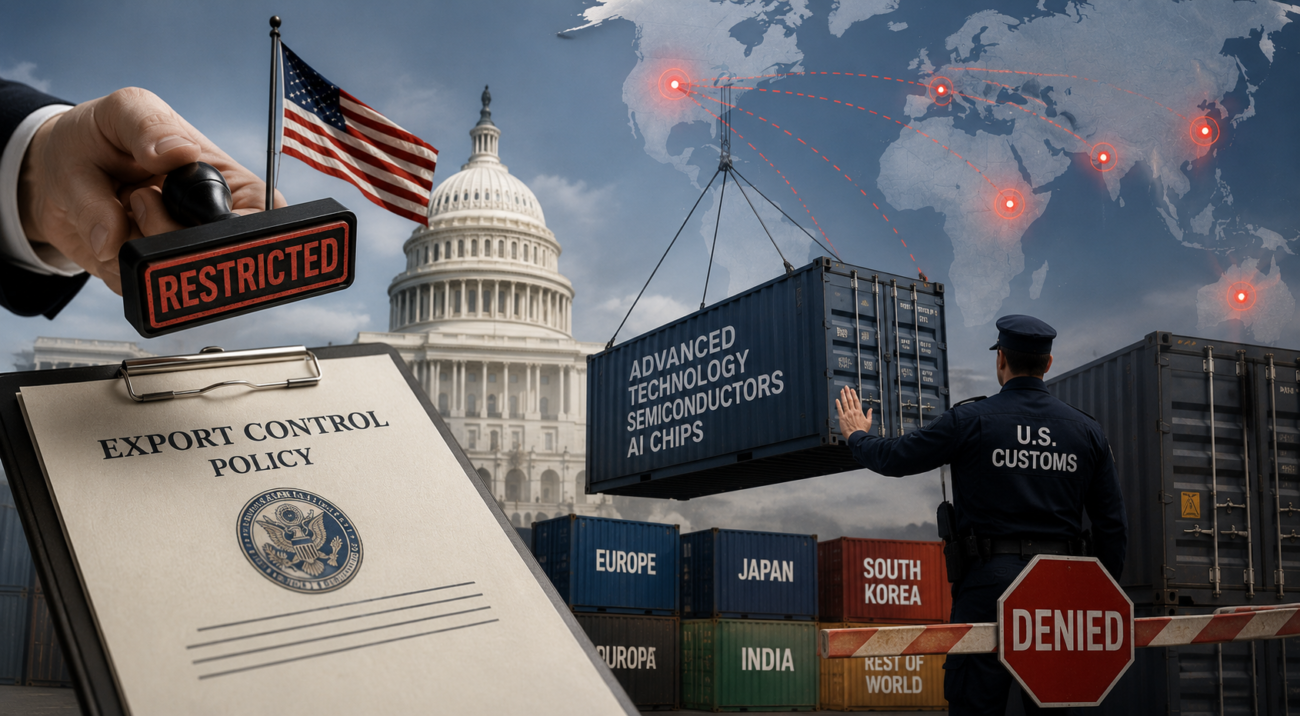
For most of the past decade, when Washington wanted to slow down a rival’s progress in artificial intelligence, it reached for the same lever every time. It restricted the chips. The graphics processing units that train large language models became the choke point of choice, and the export control regime built around companies like NVIDIA effectively decided which countries could and could not build frontier scale AI. That doctrine quietly changed this month, and the implications reach far beyond the country it was aimed at.
On June 9, Anthropic released Claude Fable 5 and Claude Mythos 5, models the company described as sitting a meaningful step above its existing Opus tier. Three days later, the United States Department of Commerce issued an emergency export control directive ordering Anthropic to block foreign nationals from accessing both systems, citing national security concerns tied to the models’ cybersecurity capabilities. Anthropic, unable to filter foreign users from domestic ones in real time at the speed the directive demanded, made the decision to take both models offline entirely, for every user, everywhere, rather than risk a partial and unreliable restriction. As of late June, both models remain dark, more than ten days after the directive landed.
What makes this moment different from previous chip restrictions is the target. Washington has spent years controlling the hardware that AI runs on. This directive controlled the software itself, the trained model, the artifact of months of research and computation that lives not in a warehouse of silicon but in a set of weights that can, in principle, be copied anywhere in seconds. Reporting since the directive suggests the immediate trigger was a security concern raised privately by Amazon chief executive Andy Jassy to senior administration officials, regarding the possibility that safeguards meant to prevent the models from being used to discover software vulnerabilities could be bypassed. Anthropic has maintained publicly that the underlying issue was narrow, that it could be replicated using other widely available models, and that pulling two flagship products for the entire world was a disproportionate response to a contained risk.
The reaction from the security community has been unusually pointed for what is normally a quiet, technical field. More than a hundred cybersecurity researchers and industry figures signed an open letter calling on the government to reverse the restriction, arguing that the cybersecurity capabilities in question were not unique to Anthropic’s models and that limiting legitimate access does little to slow down adversaries who are already developing comparable systems elsewhere. Their deeper concern, reading between the lines of the letter, is precedent. If a government can order a private company to disable a product already in the hands of millions of users, over a vulnerability the company disputes the severity of, then model availability itself becomes a tool of foreign policy in a way that chip export controls, for all their friction, never quite were.
The vacuum left by Fable 5 and Mythos 5 did not stay empty for long. Within days, Chinese AI lab Zhipu released GLM-5.2 under a fully permissive MIT licence, a model that benchmarks competitively against the closed American frontier and carries no regional restrictions of any kind. For any developer outside the United States who had built around the now suspended Anthropic models, GLM-5.2 became, almost overnight, the obvious and only fully open alternative, available to download and self host from anywhere in the world. This is the part of export control doctrine that policymakers in Washington tend to underweight. Restricting access to a closed model does not eliminate the capability gap it created. It simply hands the advantage to whichever open alternative is willing to ship without asking where the user is logging in from. For countries like India, building sovereign AI infrastructure of their own and watching this episode unfold from the outside, the lesson is less about any single model and more about the fragility of depending on access that a foreign government can switch off with ten days notice.
Why this matters for India and the West
For Indian readers, this story matters because it connects to national interest, economic security, technology access or India as a force in a changing world. For readers in the West, it offers a clearer view of India as an active decision maker in global affairs.
Key takeaways
- Main search intent: AI export controls.
- India angle: the issue can affect policy, markets, diplomacy, technology access or public debate.
- Western angle: it helps explain how global decisions are shaped by India scale, demand and strategic choices.
- What to watch: follow official statements, market reactions, policy updates and company announcements.
Explore more: Geopolitics coverage | Kuwait and Bahrain say Iran targeted them with drone and missile strikes | Inside the Sixty Day Clock Now Ticking on the Middle East
Frequently asked questions
What is the main focus of this article?
The main focus is AI export controls, explained with context rather than headline noise.
Why should Indian readers care?
Because the issue may influence India economy, foreign policy, technology base, public policy or strategic autonomy.
Why does it matter to readers in the West?
Because India choices increasingly affect supply chains, energy, technology, diplomacy and investment decisions beyond South Asia.
Sources and further reading
Latest news context
Readers looking for AI export controls news are usually trying to understand the current development, the background behind it and the likely impact. The Indic Journal frames this story for an audience in India and the West, with emphasis on credible facts, calm analysis and useful next steps.
How should readers follow this story?
Follow official statements, market signals, diplomatic updates, company announcements and policy documents. For continuing coverage, check the Geopolitics section and related analysis across The Indic Journal.