 In 30 Seconds




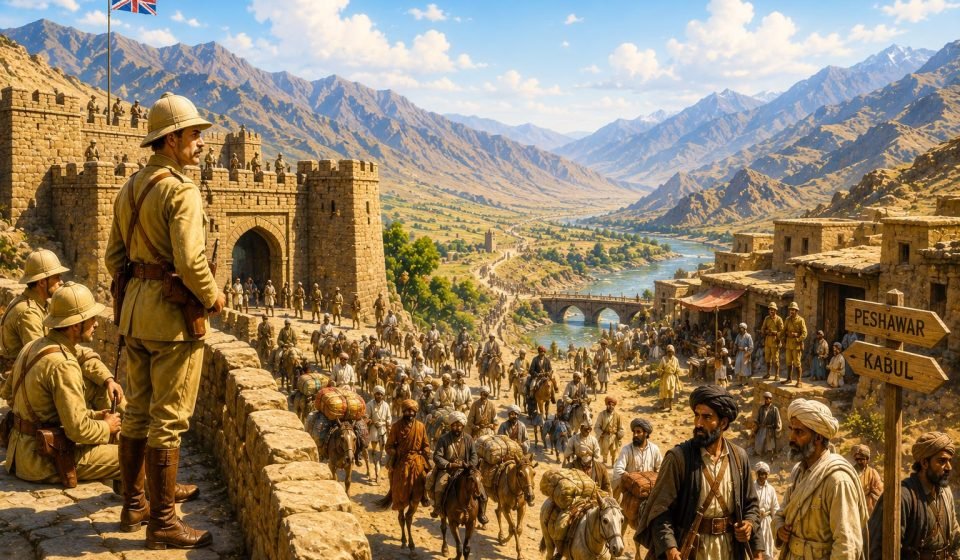
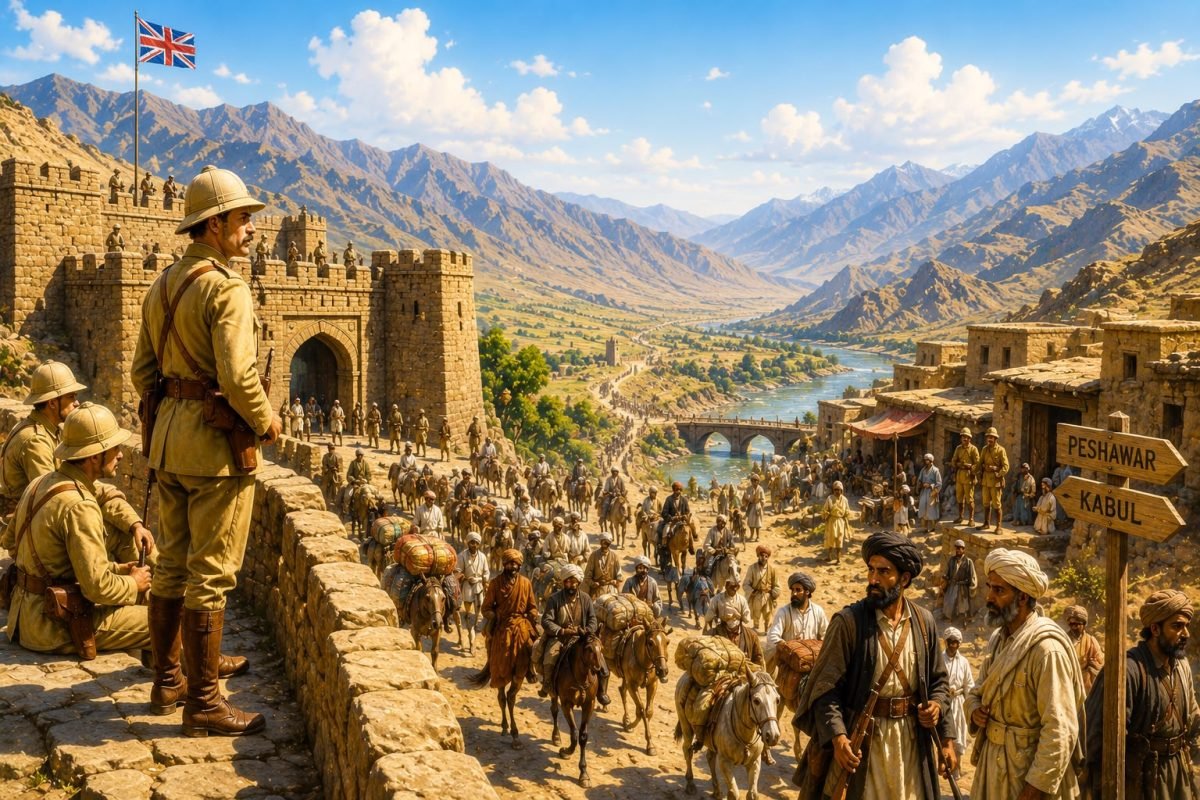
For a hundred years the British in India looked over their shoulder at Russia, and the shadow match the two empires played across the mountains and khanates of Central Asia, christened the Great Game by an officer who died playing it and immortalised under that name by Kipling, governed the Raj’s armies, budgets and nightmares. Its Indian theatre was the North West Frontier, the belt of tribal mountains between the Punjab plains and Afghanistan, where the empire fought its longest war, a century of expeditions against the Pashtun tribes whom it never subdued and never ceased to admire.
The Game’s logic was distance shrinking. Early in the nineteenth century two thousand miles of desert and khanate separated the Russian and Indian frontiers, and the alarmists were laughed at. By the 1870s, with Tashkent, Bukhara and Khiva absorbed, the gap had closed to a few hundred, and the laughter stopped. British policy oscillated between two schools, masterly inactivity, which held the Indus and let Afghanistan be, and the Forward school, which demanded outposts, agents and influence up to the Hindu Kush. The First Afghan War of 1839, the catastrophe that opened the contest, was the Forward school’s first bill, and the Second, launched by Lytton in 1878 after Kabul received a Russian mission and rebuffed a British one, ran the same course in compressed form, victory, occupation, the massacre of the Kabul embassy under Cavagnari, Roberts’s punitive campaigns, the disaster of Maiwand, and withdrawal in 1881 behind a settlement of genuine cunning, Abdur Rahman, the Iron Amir, installed with a subsidy and control of his foreign policy, Afghanistan converted into what it remained for a century, the buffer state par excellence, sealed against both empires.
The frontier of that buffer was drawn in 1893, when Mortimer Durand negotiated with the Amir the line that bears his name, running the boundary of spheres straight through the Pashtun peoples, assigning Swat, Bajaur, the Khyber and Waziristan to the British side of the map and to no one’s control on the ground. The tribes announced their opinion of cartography in the great rising of 1897, when the frontier burned from Malakand, where a young correspondent named Churchill got his first book, to the Khyber, and the Tirah campaign that answered it cost more British Indian casualties than many a formal war. Out of the fire came Curzon’s settlement of 1901, the North West Frontier Province carved from the Punjab, regular troops pulled back from the hills, tribal militias and political agents pushed forward, and the tribal territory left, by design, as an unadministered buffer within the buffer, governed under the Frontier Crimes Regulation’s collective punishments, a legal exceptionalism whose descendants endured into the twenty first century.
The Game’s last moves were played beyond the passes. Younghusband’s mission to Lhasa in 1904, Curzon’s riposte to imagined Russian influence in Tibet, shot its way to the holy city through medieval armies and extracted a treaty London promptly diluted in embarrassment. Then the rise of Germany rearranged the board, and the Anglo Russian Convention of 1907 divided Persia into spheres, closed the file on Tibet and Afghanistan, and formally ended the century’s match, though the players never quite believed it, and the file reopened, under new management, within living memory.
The Game’s price was paid in India and by India. The war scares, the Afghan adventures and the frontier’s permanent garrison consumed the military budget that swallowed between a third and half of Indian revenues, the standing grievance of every nationalist economist from Naoroji onward, who observed that India was charged for the defence of an empire’s anxieties. Its cultural deposit was equally lasting, the romance of the frontier officer, the Kiplingesque cult of the Pathan enemy worthy of love and rifle fire, and the strategic habit of viewing the northwest as India’s destiny and dread. The Raj bequeathed the line, the tribes and the habit to its successors in 1947, and the Durand Line, drawn by an empire that vanished, remains among the most consequential and contested borders on earth, the Great Game’s longest running legacy.
1885 to 1905 - Moderates and Awakening
Part 10 of 10 in this chapter.