 In 30 Seconds




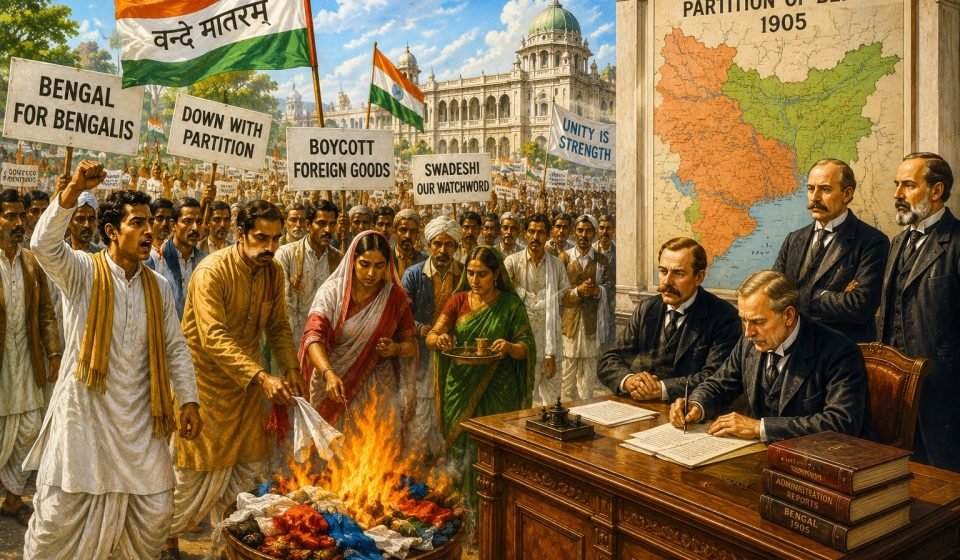
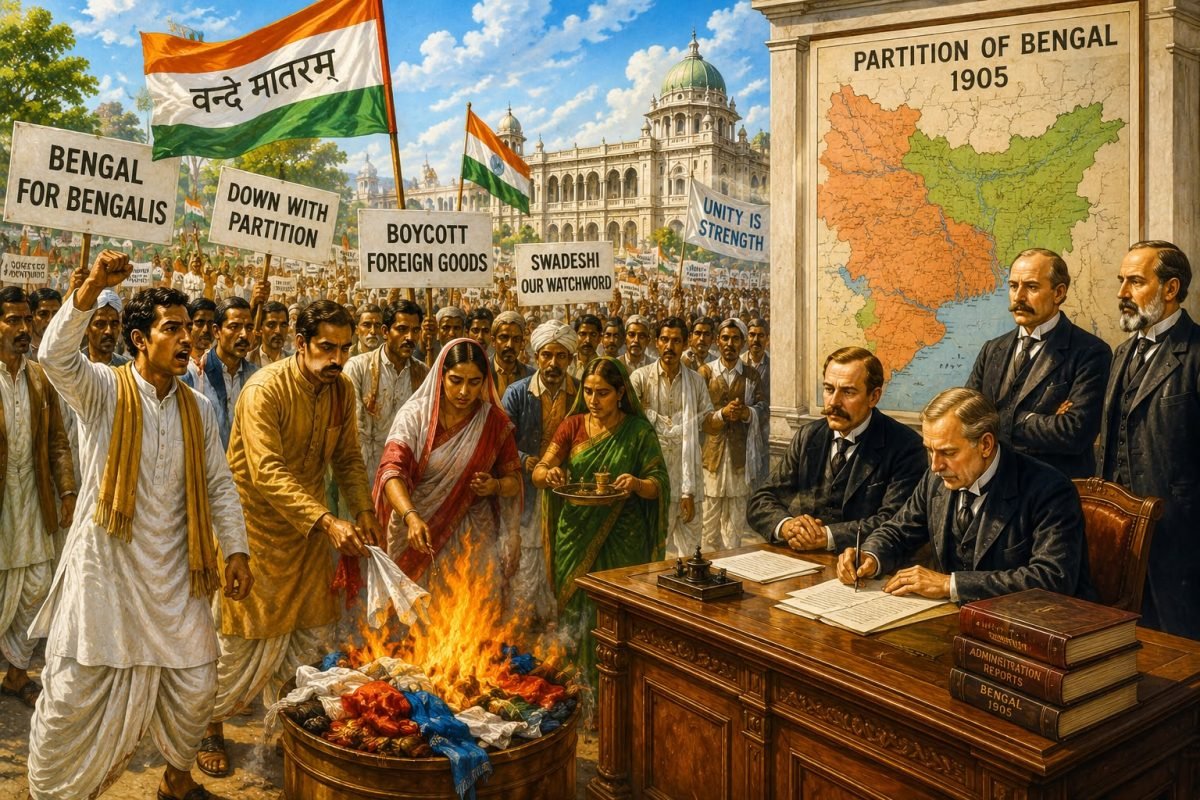
On 16 October 1905 the province of Bengal was cut in two, and Bengal answered with a day the like of which British India had never seen. Shops closed, hearths went unlit, the ghats of the Ganga filled with bathing multitudes, and through Calcutta moved vast processions singing Bande Mataram while Hindus and Muslims tied rakhis on one another’s wrists in Rabindranath Tagore’s gesture of unbreakable kinship. The partition of Bengal, conceived by Lord Curzon’s government as an administrative stroke and a political one, instead detonated the swadeshi movement, transformed the Congress from a debating society into the seed of a mass force, and taught the empire that the map of India could no longer be redrawn over the heads of Indians.
The official case was administration. Bengal as then constituted was an unwieldy giant of some seventy eight million people, embracing Bihar and Orissa besides Bengal proper, admittedly beyond one government’s effective care, and its eastern districts were genuinely underserved. But the scheme chosen, out of many possible, was the one that split the Bengali speaking people themselves, creating a new province of Eastern Bengal and Assam with its capital at Dacca, Muslim in majority, and leaving a western rump in which Bengalis were outnumbered by Biharis and Oriyas. The government’s own papers betrayed the deeper design. Home Secretary Risley minuted with memorable candour that Bengal united was a power and Bengal divided would pull several different ways, and that one of the merits of the scheme was precisely the weakening of the Calcutta centred opposition that led political India. Curzon toured East Bengal assuring Muslim audiences that the new province would give them a unity they had not enjoyed since the days of the old Nawabs. Divide and rule was not a nationalist slogan first. It was an administrative method, and 1905 was its masterpiece.
Bengal had been warned by rumour and fought the proposal for two years by every constitutional means, meetings by the hundred, petitions bearing tens of thousands of signatures, the pleading of Surendranath Banerjee’s Bengalee and the entire moderate machinery. Its total failure was itself the lesson. At the Town Hall meeting of August 1905 the leadership crossed the line it had never crossed, resolving to boycott British goods until the partition was undone, and boycott, joined to swadeshi, the vow to use only Indian made things, gave the protest a weapon that reached from the professor to the peasant woman choosing cloth. On the day of partition itself Calcutta observed mourning and defiance together, foundation of the Federation Hall to proclaim Bengal one, the rakhi bandhan on a scale that made the ritual political, and the singing everywhere of the new anthems, among them a song Tagore had just written, Amar Sonar Bangla, my golden Bengal, whose destiny no one present could have imagined, the future national anthem of a sovereign Bangladesh.
The storm did not pass, as Calcutta officialdom predicted, in a season. It widened for years, into the national education movement and the samitis, the songs and the secret societies, the trials and deportations, the story of the chapters that follow. It split the Congress at Surat over how far to carry it, called the Muslim League into being at Dacca in part to defend the new province’s promised advantages, and drew from the government both the batons of repression and, in 1909, the concessions of Morley Minto. Bengal itself paid the movement’s price in leaders jailed and youths on the gallows, and the province’s politics acquired the revolutionary edge it never afterward lost.
The end confessed everything. In December 1911, at the Delhi Durbar, the King Emperor announced the annulment of the partition, Bengali speaking Bengal reunited under a governor, Bihar and Orissa separated on the lines language had always suggested, and the capital of India removed from turbulent Calcutta to Delhi. The retreat was dressed in imperial ceremony, but India read it plainly. Sustained agitation had forced the Raj, for the first time, to undo a settled act of state. The partition of Bengal was meant to weaken Indian nationalism by dividing its strongest province. It ended by giving the movement its first victory, its first martyrs, its first mass methods and its first songs, and the six years of struggle between the stroke and its surrender changed Indian politics beyond any restoration of the map.
1905 to 1911 - Swadeshi, Revolutionaries and Reform
Part 1 of 10 in this chapter.