
 In 30 Seconds




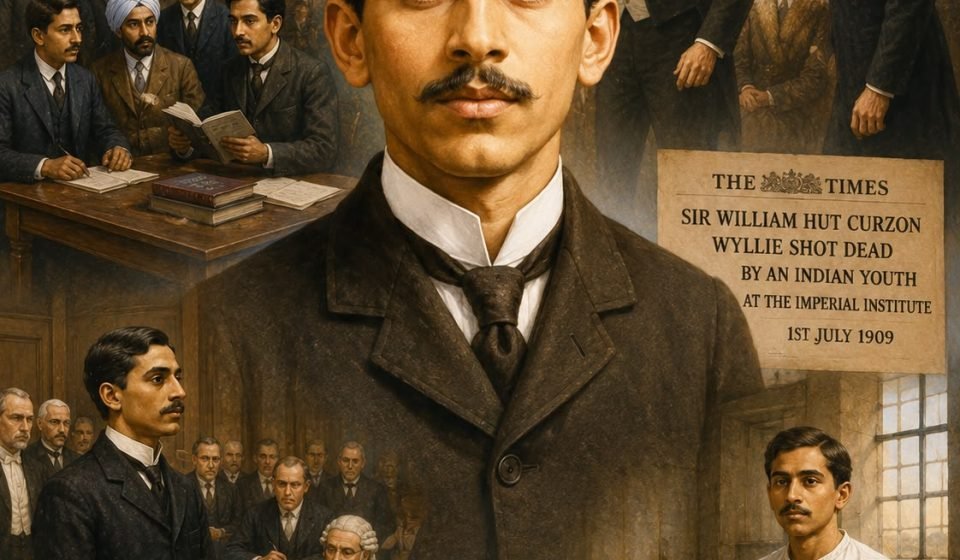
On the evening of 1 July 1909 the National Indian Association held its annual reception at the Imperial Institute in South Kensington, the empire entertaining its Indian students amid the polite machinery of imperial goodwill. As the gathering thinned toward eleven, a Punjabi engineering student named Madan Lal Dhingra approached Sir William Hutt Curzon Wyllie, political aide de camp to the Secretary of State for India and the India Office’s chief watcher of Indian students, and fired five shots into his face at point blank range, killing also, with a shot gone wide, Dr Cawas Lalcaca, a Parsi physician who threw himself between. Dhingra attempted to shoot himself, was overpowered, and stood the next month in the dock of the Old Bailey, the first Indian political assassin to strike on British soil.
He was twenty five, son of a wealthy and conspicuously loyal civil surgeon of Amritsar, a family so aligned with the Raj that it publicly disowned him within days. In London since 1906 studying engineering, he had found his way to India House in Highgate, into the orbit of Savarkar and the doctrines of Abhinav Bharat, and out of the drawing room nationalism of his class into the conviction, hardened by the executions and transportations then filling the Indian news, that the occupation of India was a standing war in which the occupied were entitled to soldiers. Curzon Wyllie, courteous, well meaning and personally kind to Indian students, was chosen precisely as the system’s face among them, the supervising eye of the India Office, and the choice announced the underground’s doctrine that the quarrel was with the machine and every hand that worked it.
The trial lasted a single day. Dhingra declined counsel, disputed the court’s jurisdiction over a member of a subject nation, and offered no defence of fact, only of war, that the killing of Indians by his government entitled Indians to reply in kind, and that a nation held down by foreign bayonets was in a perpetual state of war. Sentenced to death, he answered that he was proud to lay down his life for his country. The statement he had prepared, suppressed at trial and published by the movement abroad, gave the revolutionary generation one of its texts, declaring that a nation outraged in its dignity must worship God with blood… its closing sentence, the wish to be reborn of the same mother and to die again in the same sacred cause until the cause succeeded, entering the anthology of Indian martyrdom. He was hanged at Pentonville on 17 August 1909 and buried within the prison, the authorities refusing the body to his sympathisers. Some in England itself were unsettled by the manner of his going, the Irish press saluted him openly, and a private remark attributed to no less than Churchill, ranking the scaffold statement among the finest made in the name of patriotism, has trailed the case through the literature.
The consequences moved on two tracks. The state’s track closed India House within the year, tightened watch on Indian students, and reached through the Nasik case for Savarkar, whose arrest, Marseilles escape and transportation followed in 1910, the metropolitan phase of the revolution ending as its Paris and American phases opened. The movement’s track carried Dhingra into the calendar of martyrs, his portrait in the shrine rooms of Ghadar houses on the Pacific coast, his precedent in the minds of the young men of the Punjab a generation later, Udham Singh above all, who in 1940 avenged Jallianwala Bagh in the same city and asked to be remembered beside him. In 1976 free India brought what were identified as his remains home from Pentonville’s ground, together with Udham Singh’s, and the son whom loyal Amritsar had disowned returned to a country that names streets for him.
Moderate India condemned the deed in 1909, Gandhi with particular force, arguing that India could not be freed by the pistol without becoming the thing it fought, and that debate, between the ethics of the bomb and the ethics of suffering, became the freedom struggle’s longest argument. Both sides of it, ever after, claimed the same thing of the boy at the Old Bailey, that whatever the deed’s wisdom, the courage was the nation’s own.
1905 to 1911 - Swadeshi, Revolutionaries and Reform
Part 9 of 10 in this chapter.