 In 30 Seconds




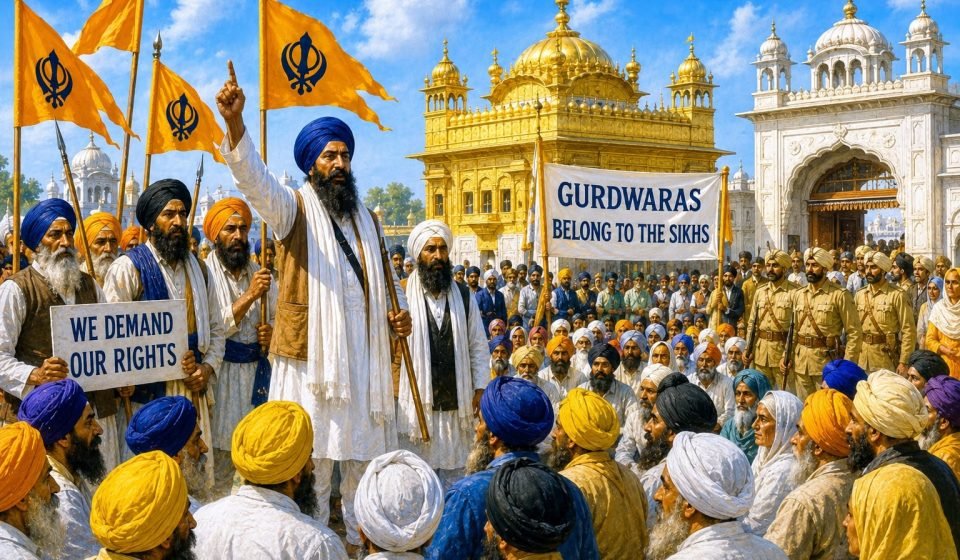
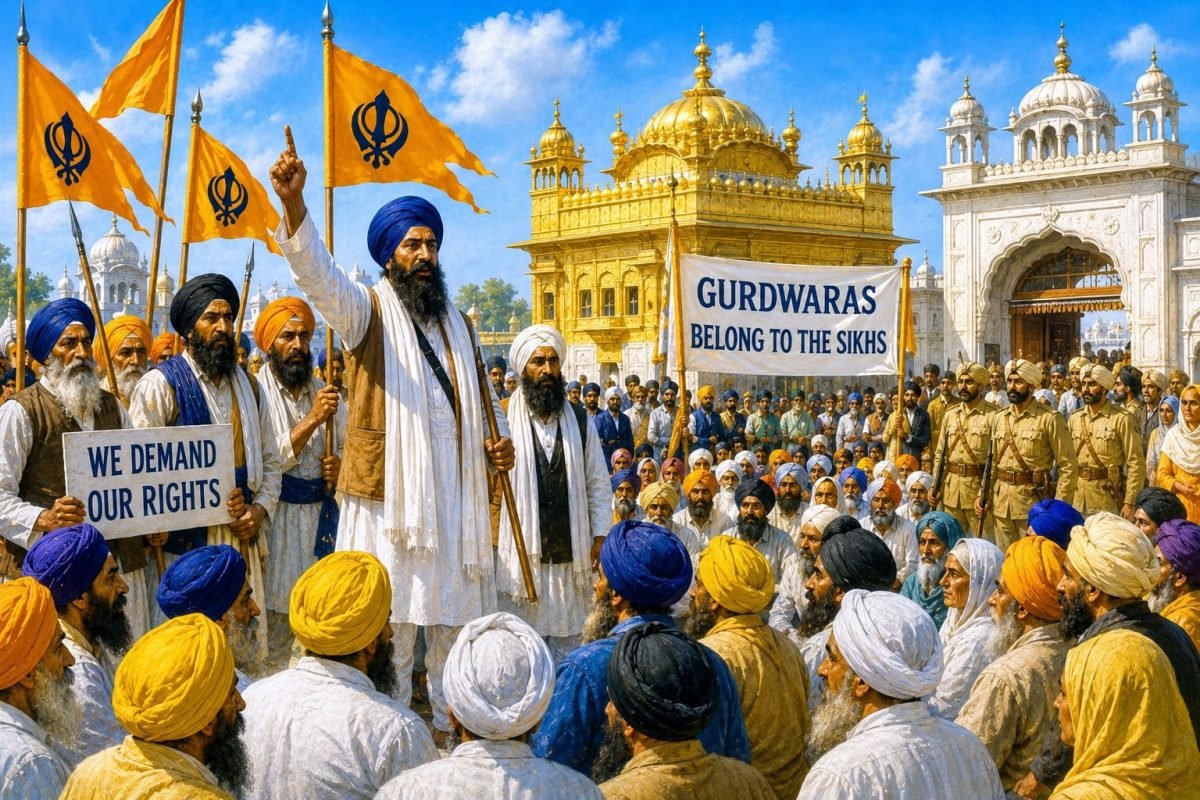
Between 1920 and 1925 the Sikhs of the Punjab fought and won a struggle that belongs equally to religious reform and to the freedom movement, the campaign to wrest the gurdwaras, the community’s shrines, from the hereditary custodians into whose private property they had decayed, and from the colonial state that stood behind those custodians. The Akali movement’s five years of disciplined, suffering nonviolence, praised by Gandhi as India’s teacher in satyagraha, cost the community by its own count some four hundred dead and thousands imprisoned, created in the SGPC and the Akali Dal the two institutions that have governed Sikh public life ever since, and ended in the rarest of colonial documents, a statute conceding the movement’s whole demand.
The grievance had grown for a century. The great shrines, Nankana Sahib where the founder was born, the Darbar Sahib at Amritsar itself, and hundreds besides, with the rich lands endowed upon them, had passed under mahants, custodians originally of the Udasi orders, whom British courts, applying property law to sanctity, had confirmed as effective owners, and whom the administration prized as a loyal interest, managing even the Golden Temple through a government appointed sarbarah. The reformist energy of the Singh Sabha movement, the Tat Khalsa’s press and the returned anger of Sikh soldiers and emigrants, Ghadar’s leaven among them, converged after the war upon the shrines’ condition, mahants living scandalously upon the Guru’s offerings, and upon the collaboration that protected them, the Darbar Sahib’s own custodians having honoured General Dyer after the massacre in his honour’s own city. In the autumn of 1920 the reformers created their twin instruments, the Shiromani Gurdwara Parbandhak Committee to manage the shrines the movement liberated, and the Shiromani Akali Dal to organise the jathas, the sworn bands of volunteers who would liberate them.
The movement’s character was written in blood at its first great station. At Nankana Sahib on 20 February 1921, the mahant Narain Das, forewarned and armed, met the morning’s unarmed jatha with hired gunmen, and some hundred and thirty Akalis were shot, cut down and burned in the shrine’s compound, Lachhman Singh Dharowali’s body bound to a jandi tree and set alight. The massacre, mourned by Gandhi in person at the site, gave the movement its martyrs and its discipline, for the Akali answer was not vengeance but escalation of suffering. Through the keys affair of late 1921, when government seized the Darbar Sahib’s treasury keys and, before mass courting of arrest, surrendered them to the SGPC president, Gandhi’s telegram hailing the first decisive battle of India’s freedom won. Through Guru ka Bagh in 1922, where for weeks jathas of a hundred marched daily to be beaten senseless by police lathis without raising a hand, clergymen and Congress observers watching men fall in rows, the spectacle breaking, at last, the government’s nerve rather than the movement’s. Through the Jaito morcha of 1923 to 1925, in the princely state of Nabha after its Maharaja’s forced abdication, where firing on the jatha at Jaito killed a score and the marches continued for two years, Nehru himself briefly jailed in Nabha for solidarity.
The statute came in July 1925. The Sikh Gurdwaras Act transferred the historic shrines of the province to elected committees under the SGPC, a legal revolution, a colonial legislature vesting the community’s sanctuaries in a body chosen by universal Sikh franchise, women voting included, the mahants pensioned into history. The prisoners’ release followed the Act’s acceptance, and the movement stood down victorious, having, in Punjab’s political arithmetic, also broken the loyalist monopoly upon the community and bound its awakened politics into the national struggle, the Akali jathas of these years supplying the Congress movements of the next decade with their most disciplined contingents.
The inheritance has outrun the empire that conceded it. The SGPC, the community’s elected parliament of the shrines, and the Akali Dal, its political arm, remain the axes of Sikh public life, their elections the community’s general elections, their history since, through the Punjabi suba campaign to the storms of the 1980s, the continuation of the question the movement first posed, of who speaks for the panth. The answer given between 1920 and 1925, written at Nankana Sahib and Guru ka Bagh, was the community itself, organised, suffering and unarmed, and it remains the movement’s, and the province’s, proudest page.
1919 to 1929 - The Gandhian Storm
Part 8 of 10 in this chapter.