
 In 30 Seconds



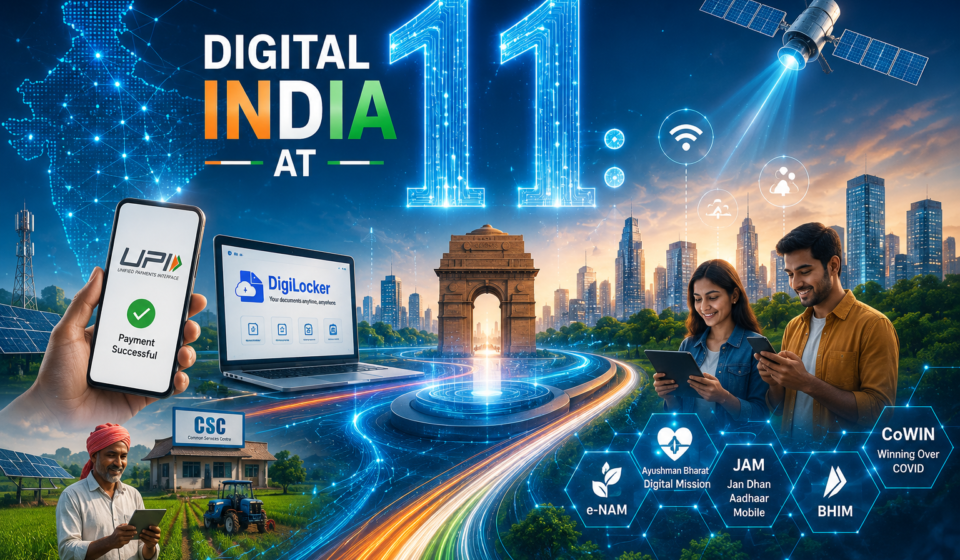
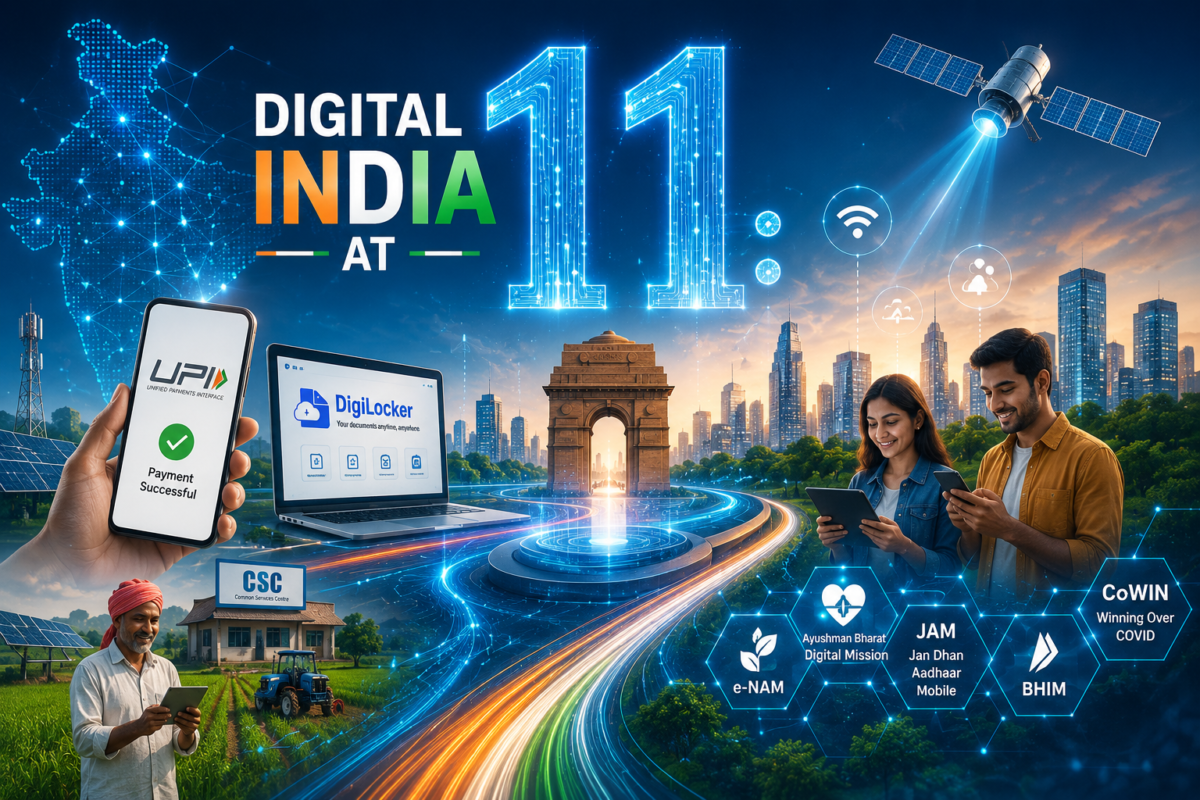
On July 1 2026, the Digital India programme turned eleven years old, and Prime Minister Narendra Modi marked the occasion with a message that captured the scale of what has changed since 2015. He said the initiative had given India a new identity worldwide, and for once the political language was not much of an exaggeration. What began as a plan to fix patchy internet access and reduce government paperwork has quietly become one of the largest digital infrastructure projects any country has ever attempted.
It helps to remember what life looked like before this. Getting a bank account often meant standing in a queue with a bundle of documents that a clerk would examine with visible suspicion. A subsidy meant for a farmer or a widow could vanish somewhere between the treasury and the intended recipient, eaten up by middlemen who existed only on paper. A birth certificate, a caste certificate, a driving licence, each one required its own visit to its own office, its own set of photocopies, its own wait. Digital India set out to change that plumbing, and over a decade it mostly has.
The Numbers Behind The Claim
Aadhaar sits at the centre of the story. Enrolments crossed 144 crore by March 2026, making it the largest biometric identity system anywhere in the world. It now underpins authentication for more than 3,100 welfare schemes and over 360 public services, which means a single fingerprint or iris scan can unlock everything from a cooking gas subsidy to a pension payment. Paired with Jan Dhan bank accounts, which grew from just under 15 crore in 2015 to nearly 58 crore by early 2026, and with the spread of cheap mobile data, this JAM combination of Jan Dhan, Aadhaar and mobile connectivity has allowed the government to send money directly into people's accounts rather than through layers of intermediaries. By June 2026, direct benefit transfers worth more than 51 lakh crore rupees had moved through this pipeline.
Then there is UPI, the payments system that most Indians now use without thinking twice about it. India accounts for nearly 49 percent of all real time digital payment transactions on earth, an extraordinary figure for a country that was still largely a cash economy a decade ago. UPI has also started travelling beyond India's borders, now live in countries including the UAE, Singapore, France, Mauritius and Sri Lanka, giving Indian tourists and workers abroad a taste of home in the form of a familiar payment screen.
DigiLocker deserves its own mention too. More than 70 crore people have signed up, and over 850 crore documents have been issued through it, meaning a driving licence or a degree certificate can now sit safely on a phone instead of in a plastic folder that gets damaged in the monsoon. For students there is APAAR, a permanent academic identity that had generated more than 33 crore IDs by June 2026, and for farmers there is a Farmer ID system that had crossed 9 crore registrations by March.
Why Other Countries Are Watching
What makes this moment interesting for The Indic Journal's readers is not just the domestic scale but the export potential. India has signed cooperation agreements with 24 countries on what is called India Stack, essentially offering the underlying technology of Aadhaar and UPI as a template other nations can adapt for their own digital identity and payment systems. Trinidad and Tobago is exploring a credentialing system built on this model. Several African and Southeast Asian governments have sent delegations to study how India pulled off enrolment at this scale without the kind of chaos that similar projects have produced elsewhere.
None of this means the story is free of problems. Digital exclusion remains real in remote and older populations who struggle with smartphones and shaky connectivity. Data protection concerns have followed Aadhaar since its earliest days, and the sheer size of these databases makes them an obvious target for both hackers and future political misuse. Critics also point out that measuring success purely in enrolment numbers can mask uneven quality of service on the ground, where a digital record does not always translate into a faster or fairer outcome for the person standing in front of an official counter.
Still, eleven years on, the direction of travel is hard to argue with. India moved from a country where a poor citizen had to prove their existence to bureaucracy again and again, to one where a fingerprint can do much of that work in seconds. As the country looks toward its Viksit Bharat 2047 goals, the digital rails built over the last decade are likely to carry an even larger share of the weight, for better and, its critics would add, for worse.
Related Reading
- Iran Rejects Trump’s ‘One Shot’ Threat Amid Funeral Rites
- Chandrima Bhattacharya Resigns from TMC Posts in West Bengal
- Open Channels FM: Open Source as Foundation, Not Final Answer
Official context: Readers can compare this story with public information from Election Commission of India.