 In 30 Seconds




Among the causes that men in 1857 gave for taking up arms, one legal formula recurs from Jhansi to Kanpur, the Doctrine of Lapse, the principle by which the Company refused to recognise adopted heirs to dependent thrones and took the escheated kingdoms for itself. In eight years the doctrine transferred a group of ancient states to British rule without a shot, and demonstrated, more nakedly than any war, that the paramount power regarded the map of princely India as a temporary arrangement awaiting digestion.
The legal theory was not Dalhousie’s invention, though his hand made it famous. The Company’s lawyers had long distinguished between sovereign allies and dependent or subordinate states, creations or creatures of the paramount power, and had held since the 1830s that while a Hindu ruler’s adoption of an heir was valid in private law, its validity for the succession to a dependent throne required the paramount power’s consent, which might be withheld. In Hindu law and immemorial usage, a son adopted with due rites was a son entire, for purposes sacred and secular alike, and every dynasty in India had renewed itself by adoption time out of mind. The doctrine therefore planted a European feudal concept, escheat to the overlord, in soil where it contradicted the deepest assumptions of the society, and every application of it read, to Indian eyes, as confiscation dressed in Latin.
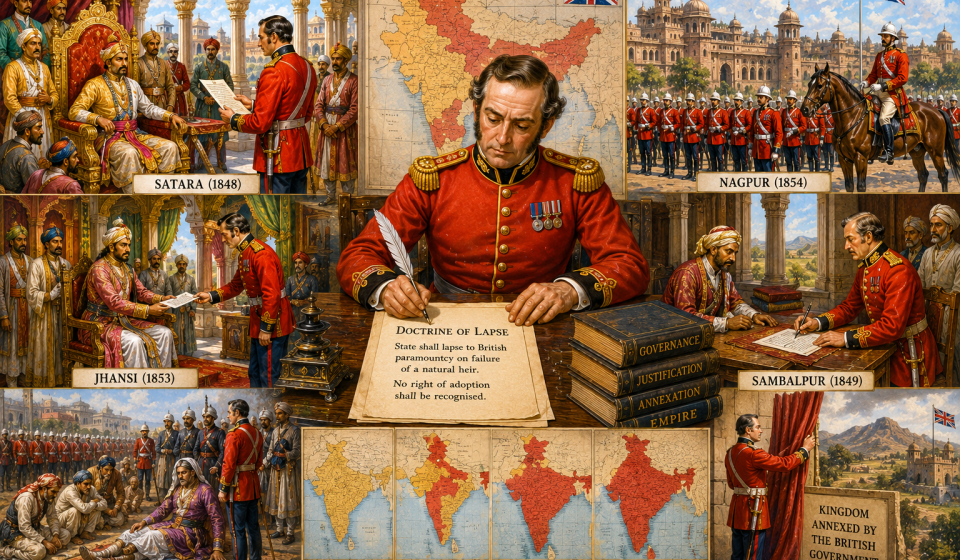
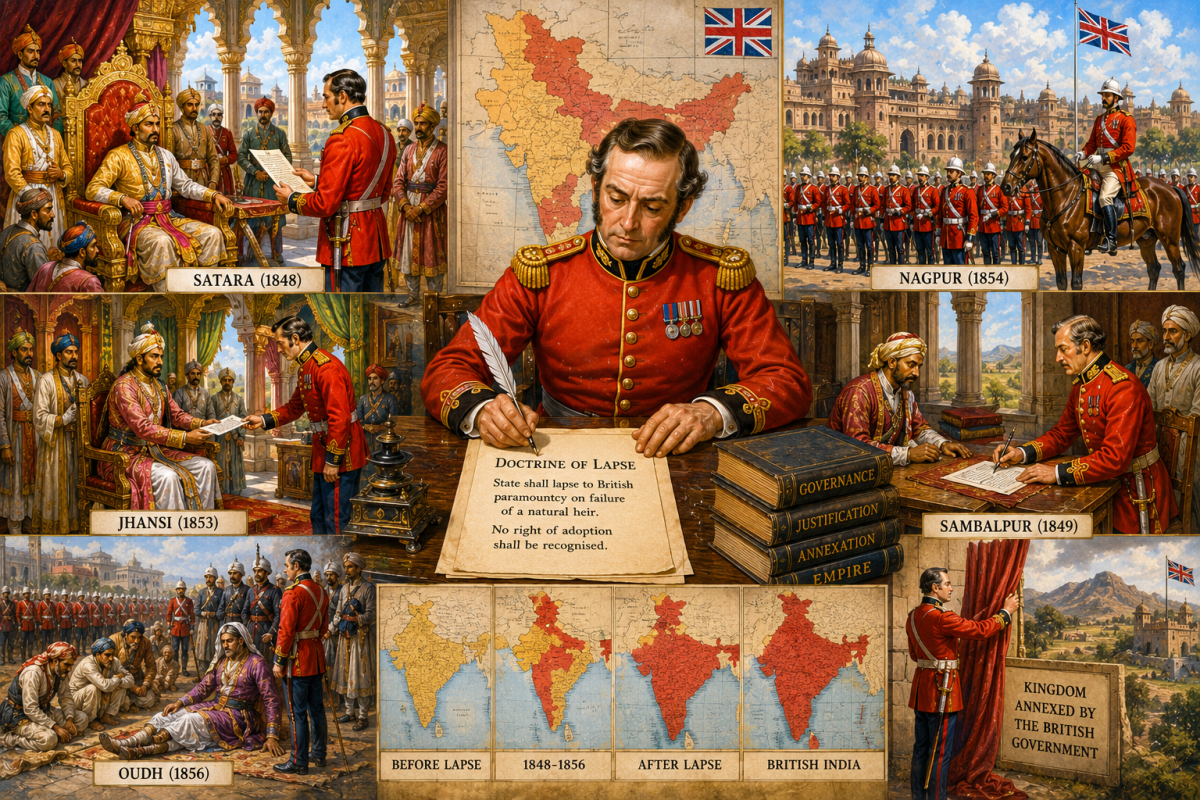
Dalhousie applied it with the regularity of a machine. Satara, the state created by the British themselves in 1818 for the house of Shivaji, lapsed in 1848 when its Raja died leaving an adopted son. Jaitpur and Sambalpur followed in 1849, Baghat and Udaipur of the hills in mid century, Jhansi in 1853, where the Raja’s dying adoption of the child Damodar Rao, made in the presence of British officers, was set aside and the Rani Lakshmibai’s protests, argued through counsel with a cogency the government never answered, were dismissed with a pension. Nagpur, the great Bhonsle state of central India, lapsed in 1854, and the disposal of its palace treasures by public auction, down to the jewels of the ranis, scandalised even Anglo Indian opinion. Alongside the lapses proper ran kindred extinctions, the refusal to continue the ex Peshwa’s pension to his adopted son Nana Saheb in 1851, and the decision, mercifully softened later, to end the imperial title of the Mughals at Bahadur Shah’s death. Awadh in 1856 fell by a different blade, annexation for misgovernment, but to Indian observers the distinction was without a difference. The paramount power took what it wished and found the reason afterward.
Dalhousie’s defence, argued in minutes of great ability, was that the doctrine was law, that its application was policy, and that the extension of British administration was so plainly a blessing that to forgo any rightful opportunity of it would be a dereliction. He was careful, more careful than his legend, declining lapse where he judged the state sovereign rather than dependent, as at Karauli in 1851, when the Court of Directors also drew back. But the careful cases were forgotten and the confiscations remembered, and the cumulative message was heard in every durbar in India, that loyalty purchased nothing, that treaties aged into waste paper, and that the childlessness of one man could erase a dynasty, a court, an army and the ten thousand livelihoods that hung upon them. Each lapse demobilised soldiers, dispossessed officials and pensioned priests, scattering across northern India a class with education, grievance and nothing to lose.
The bill was presented in 1857. Jhansi’s wronged Rani became the revolt’s most celebrated commander, Nana Saheb its figurehead at Kanpur, and the sepoys of the Bengal Army, recruited from the very regions the annexations had unsettled, its instrument. When the Crown took over from the Company in 1858, the Queen’s proclamation pointedly renounced all desire for extension of territory, and Canning’s adoption sanads of 1859 and 1862 guaranteed to every ruler the right of adoption according to his law and custom. The Doctrine of Lapse was buried by name, its lesson underwriting ninety years of alliance between the Raj and the princes it had learned not to swallow. No policy of the Company’s last decade cost so much for so little, and none did more to teach Indians that against the paramount power’s appetite, law was no fence at all.
1818 to 1856 - Consolidation and Reform
Part 9 of 10 in this chapter.