 In 30 Seconds




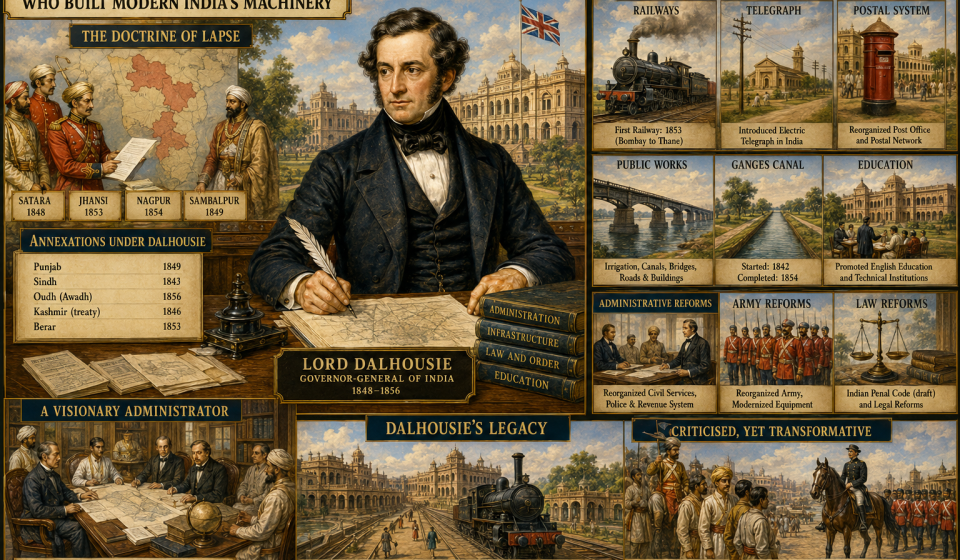
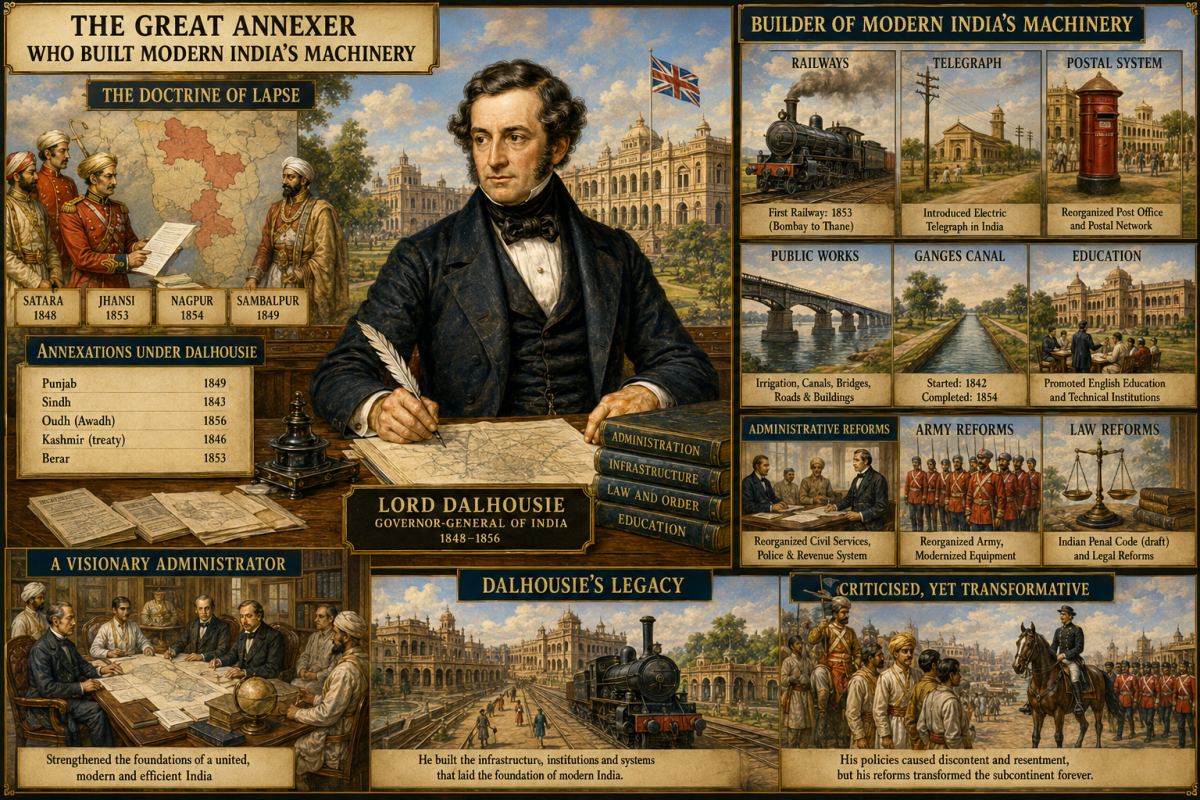
No Governor General changed India more in eight years than James Andrew Broun Ramsay, Marquess of Dalhousie, and none left a more explosive inheritance. Between 1848 and 1856 he annexed more territory than any ruler since Wellesley and laid down, in the same span, the railway, the telegraph, the postage stamp and the public works department, the physical nervous system of modern India. He departed, worn out at forty three, congratulating himself on a peaceful and consolidated empire. Fourteen months later that empire was fighting for its life, and every inquest into 1857 has begun with his name.
Dalhousie arrived the youngest Governor General ever appointed, an aristocrat of the railway age, formed at the Board of Trade in the great years of British railway building, imperious, tireless and utterly certain that British administration was a blessing whose extension needed no further argument. The Second Sikh War met him at the threshold, and his annexation of the Punjab in 1849 set the tone of the decade. Lower Burma followed in 1852 after a war begun over trade grievances. Within India his instrument was the policy remembered as the Doctrine of Lapse, the refusal to recognise adopted heirs to dependent thrones, by which Satara, Jaitpur, Sambalpur, Jhansi and, greatest of all, Nagpur passed to the Company between 1848 and 1854, while pensions and titles, including the purse of the exiled Peshwa’s heir Nana Saheb and the royal style of the Nawabs of the Carnatic, were extinguished as their holders died. Awadh, annexed in 1856 on grounds not of lapse but of misgovernment, completed a decade in which a quarter million square miles changed masters and every remaining prince in India learned to fear the post that brought Calcutta’s letters.
The same will drove the works. Dalhousie’s railway minute of 1853 planned the trunk lines of the subcontinent, and the first trains ran from Bombay in 1853 and from Calcutta in 1854 under the guarantee system he negotiated. The electric telegraph, built under his personal pressure, linked Calcutta with Agra, Bombay, Madras and Peshawar in barely two years, and in 1857 it would, in the phrase of the rebels’ own lament, hang them, carrying warning of the rising faster than any horseman. The Post Office Act of 1854 created the uniform half anna post, opening correspondence to the millions. The Public Works Department, the Ganges Canal, opened in 1854 as the greatest irrigation work on earth, the widening of the Grand Trunk Road, and Wood’s education despatch of 1854, whose universities were chartered in the year of the revolt, completed a program that Indian modernity still inhabits. Even his social legislation cut deep, the Religious Disabilities Act of 1850 protecting the inheritance rights of converts, and the groundwork of the Widow Remarriage Act that passed under his successor in 1856.
That the same hand built the railway and lit the fuse is the paradox only if the two are separated. To Dalhousie annexation and improvement were one policy, the replacement of what he saw as effete misrule by efficient administration, and he pursued both with the same contempt for Indian sentiment. The deposed courts scattered aggrieved claimants across northern India, Nana Saheb at Bithur and the Rani of Jhansi among them. Annexed Awadh put the Bengal Army’s own homeland under new revenue screws. The disarmed aristocracies, the resumed rent free tenures, the missionary confidence and the general acceleration convinced ruler and ruled alike that everything old was marked for demolition. The Bengal sepoy, watching his world annexed, taxed and preached at, needed only the cartridge.
Dalhousie sailed home in 1856, his health destroyed by work, and lived just long enough to see the storm break and to be blamed for it, dying in 1860 with his defence unwritten. History’s verdict has settled into an equipoise he would have disliked. The infrastructure he drove into existence unified India as no conqueror had, and became the skeleton of the nation that expelled his successors. The annexations that seemed to him mere tidiness supplied the revolt of 1857 with half its leaders and much of its fury. The empire’s greatest builder was also the principal architect of its greatest crisis, and both achievements were the same man, working at the same desk, in the same tearing hurry.
1818 to 1856 - Consolidation and Reform
Part 8 of 10 in this chapter.