 In 30 Seconds




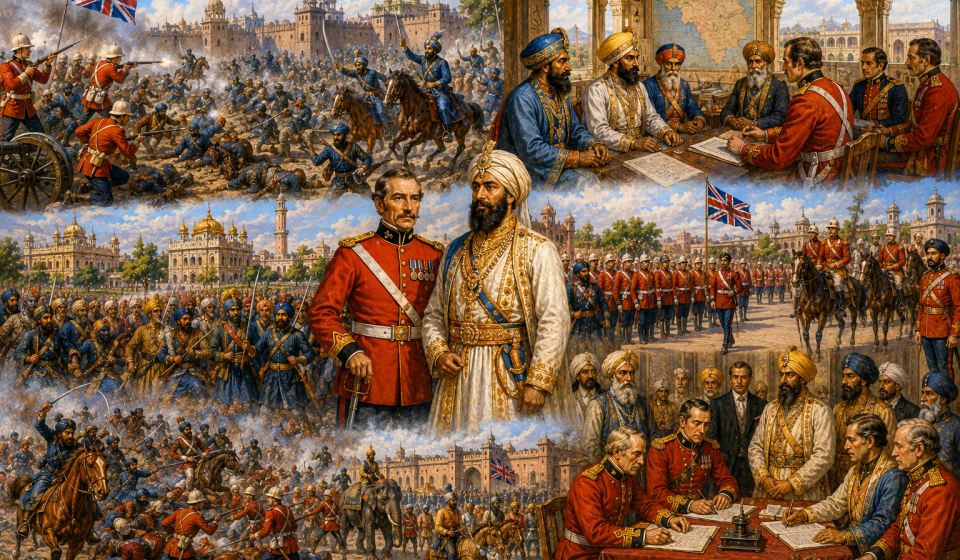
For forty years one Indian state stood outside the Company’s reach and beyond its condescension. The Sikh kingdom of Maharaja Ranjit Singh, built from the misls of the Punjab into an empire running from the Sutlej to the Khyber and from Kashmir to Multan, maintained the only army in Asia that British officers privately acknowledged as the equal of their own, the Khalsa, drilled by European veterans of Napoleon’s wars, with an artillery the Company’s gunners respected and feared. While the one eyed Maharaja lived, the treaty line of 1809 on the Sutlej held, and the two powers watched each other with the courtesy of duellists. He died in June 1839, and within a decade his kingdom had destroyed itself and been devoured.
The collapse of the Lahore durbar was Shakespearean in body count. In six years the throne consumed Kharak Singh, Nau Nihal Singh, killed by a falling gateway on the day of his father’s funeral rites, Sher Singh, assassinated with his son in 1843, and a procession of ministers murdered in palace coups, until the crown rested on the child Duleep Singh under his mother, the regent Maharani Jind Kaur, whose intelligence contemporaries acknowledged and whose position was impossible. Real power lay with the army panchayats, the elected regimental committees of a Khalsa grown political, unpaid and enormous, while across the Sutlej the Company massed troops in a manner that Lahore read, not unreasonably, as a gathering siege. In December 1845, urged by a court that half hoped its own army would be broken, the Khalsa crossed the river, and the British declared war.
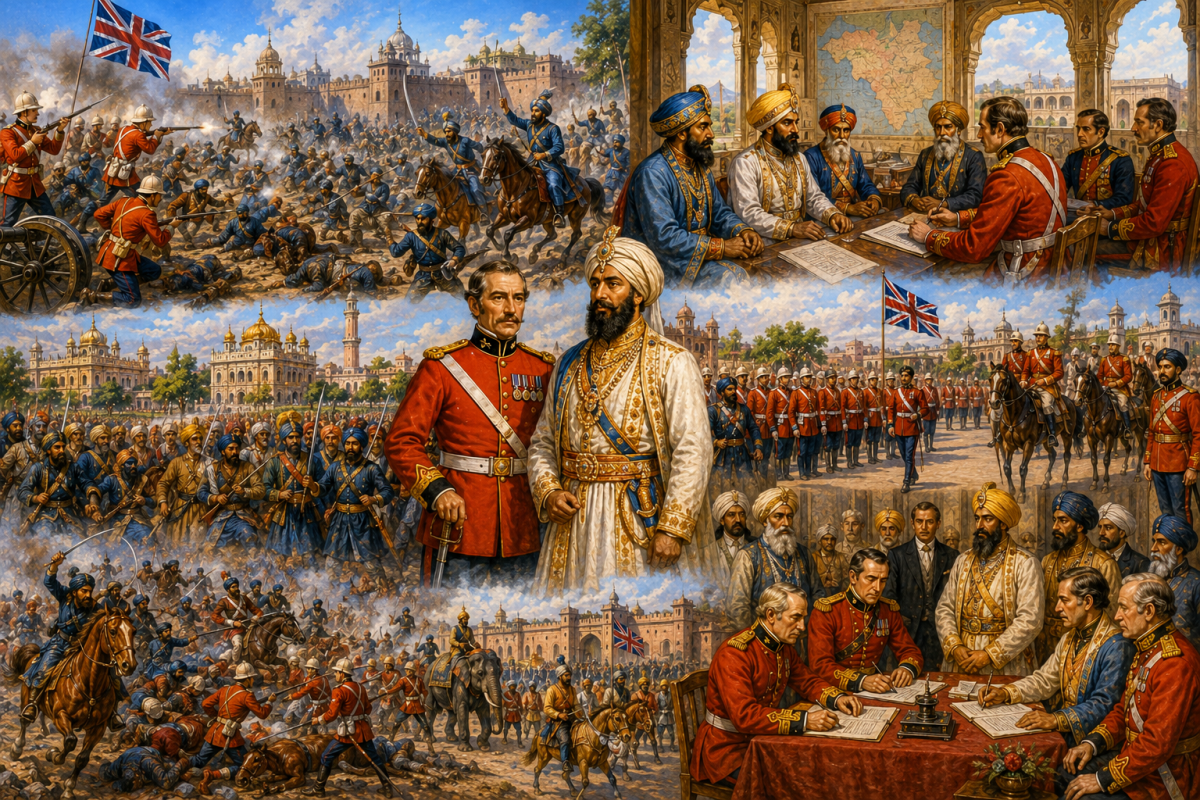
The First Anglo Sikh War was the hardest fighting the Company ever faced in India. At Mudki and above all at Ferozeshah, where the British line spent a winter night among the Sikh guns with the campaign and perhaps the empire in the balance, the Khalsa fought with a discipline and gunnery that appalled its enemies, and the treachery of its own supreme commanders, Lal Singh and Tej Singh, who withheld reserves and abandoned fields at the crisis, has burdened Punjabi memory ever since. The guns of Sobraon in February 1846 ended the war, and the peace was designed to bleed what it did not annex. The Jalandhar Doab was taken, the army capped, a Resident installed at Lahore, and Kashmir, detached from the kingdom, was sold by the Treaty of Amritsar for seventy five lakhs of rupees to the Dogra chief Gulab Singh, whose descendants ruled it until 1947, a transaction whose invoice history is still auditing.
The Second war rose from the ashes of the first. The Multan revolt of 1848, spreading to the durbar’s army under Sher Singh Attariwala while the regent Jind Kaur was deported and her pension cut, became a national rising, and at Chillianwala in January 1849 the Khalsa remnant fought Lord Gough’s army to a bloody standstill that shook confidence in London itself. Gujrat in February, an artillery battle the British called the battle of the guns, finished it. In March 1849 Dalhousie annexed the Punjab entire, the child Duleep Singh signed away his kingdom and the Koh i Noor, and was raised thereafter in England as a Christian country gentleman, the empire’s favourite exile, whose late attempts to return to his people and his faith were quietly smothered.
The government of the conquered province became the Victorian empire’s proudest exhibit. The Lawrence brothers and their picked officers, the Punjab school, disarmed the population, cut the canals, settled the revenue and courted the peasantry with a paternal energy that within eight years faced its test. In 1857, when the Bengal Army rose, the Punjab, held by John Lawrence’s nerve and the calculated loyalty of Sikh chiefs and soldiers to whom the fallen durbar’s enemies were now offering service against Hindustan, not only stayed quiet but furnished the army that retook Delhi. The kingdom of Ranjit Singh had been the Company’s last conquest, and its soldiers became the saviours and thereafter the sword arm of the Raj, the beginning of the Punjab’s long, paradoxical career at the centre of the empire’s armies and, in time, at the centre of the struggle that ended the empire.
1818 to 1856 - Consolidation and Reform
Part 7 of 10 in this chapter.