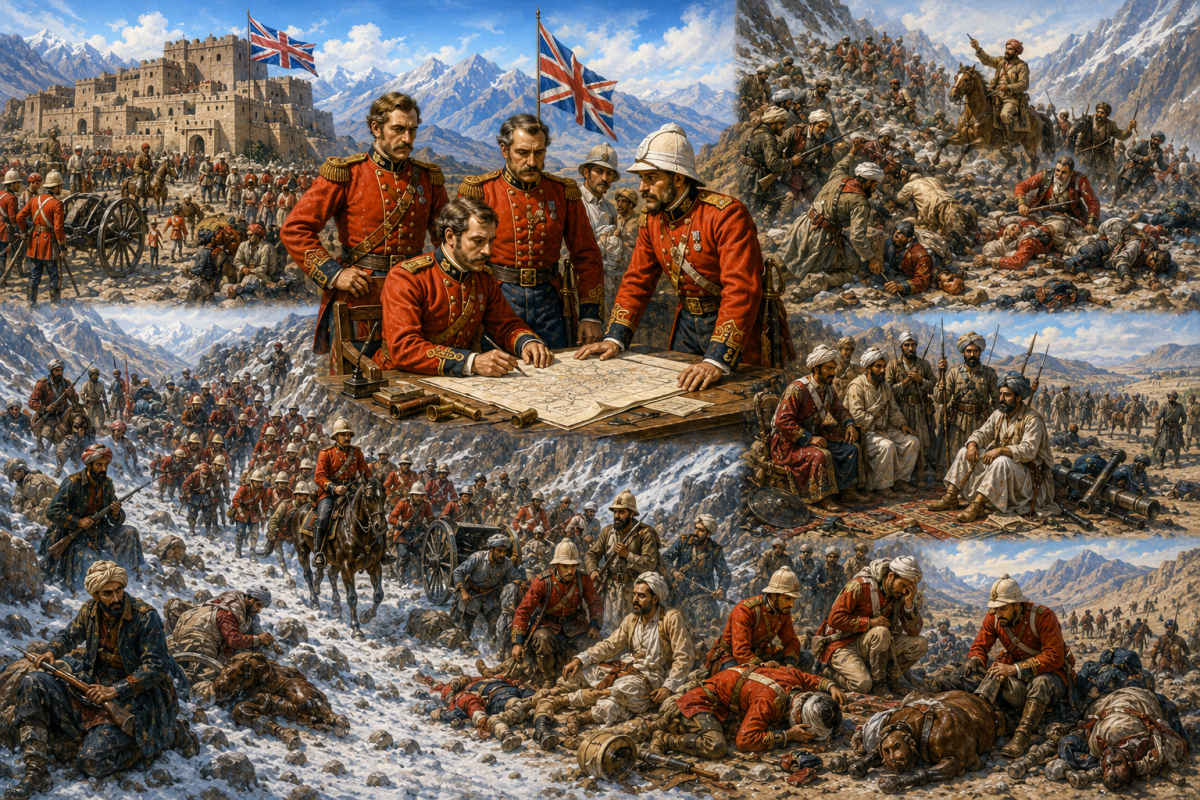
 In 30 Seconds




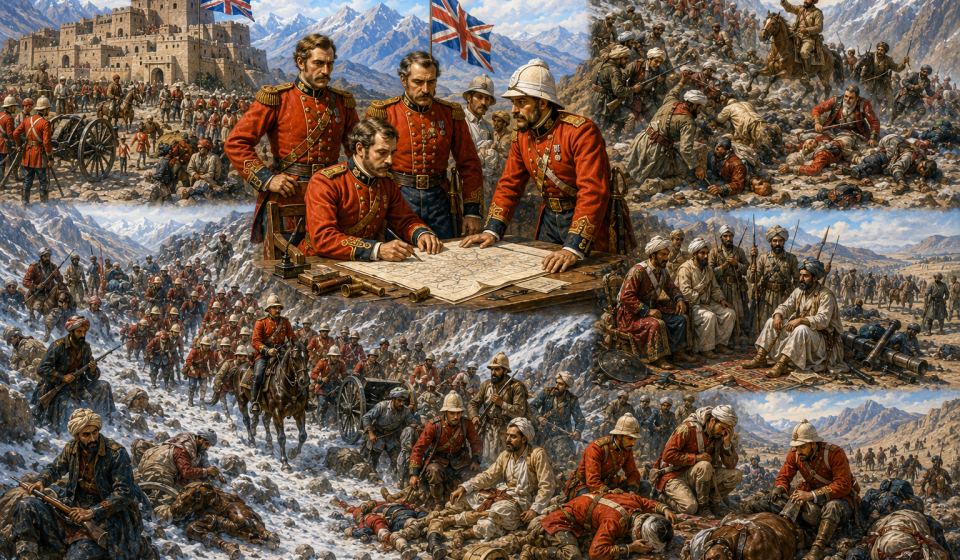
On 13 January 1842 a sentry on the walls of Jalalabad saw a single exhausted rider approaching across the plain, slumped on a dying pony. Dr William Brydon, an army surgeon, part of his skull sheared away by an Afghan blade, was asked where the army was, and answered that he was the army. Of the sixteen and a half thousand soldiers and camp followers who had marched out of Kabul a week earlier, he was the only Briton to reach Jalalabad, a handful of sepoys and prisoners surviving elsewhere. The destruction of the Kabul garrison was the worst military catastrophe in British imperial history to that day, and the war that produced it stands as the founding tragedy of the Great Game.
The war was conceived in a map and a fear. Russian influence was advancing across Central Asia, a Russian backed Persian army was besieging Herat, and the Governor General, Lord Auckland, was persuaded by his advisers that Afghanistan under its formidable Barakzai ruler, Dost Mohammad Khan, must be secured for British India. Dost Mohammad himself asked nothing better than a British alliance, at the price of British help against Sikh occupied Peshawar. Since the friendship of Ranjit Singh was worth more than Kabul’s, Calcutta chose instead to remove him, and the Simla Manifesto of 1838 announced, in prose that contemporaries already found dishonest, that the Company would escort back to his throne the exiled Sadozai king Shah Shuja, at the invitation of a nation that had never invited him.
The invasion of 1839 succeeded with deceptive ease. The Army of the Indus took Kandahar without a fight, stormed the fortress of Ghazni, and entered Kabul in August. Dost Mohammad eventually surrendered and was honourably interned in India, Shah Shuja was enthroned, and the occupying force settled into cantonments, sending for wives, racehorses and cricket gear. Beneath the calm, everything was false. Shah Shuja commanded no loyalty beyond British bayonets, the occupation’s cost drove Calcutta to cut the subsidies that bought the tribes’ quiet on the passes, and the presence of a foreign army with its money and its manners inflamed both interest and honour. In November 1841 Kabul rose. Alexander Burnes, the envoy’s deputy, was cut down by a crowd at his house, the aged and irresolute commander General Elphinstone let each day’s crisis grow into the next, and the political envoy William Macnaghten was seized and killed at a parley with Dost Mohammad’s son, Akbar Khan.
What followed was capitulation dressed as convention. The garrison agreed to evacuate Afghanistan in exchange for safe conduct, and on 6 January 1842 the column, four and a half thousand fighting men, mostly sepoys, and some twelve thousand followers, with women and children, marched into the snowbound passes toward Jalalabad. The safe conduct was worthless whether or not it was ever sincere. Through a week of ambush, cold and massacre in the defiles of Khurd Kabul and Gandamak, the column was annihilated, the last stand of the 44th Foot on the hill at Gandamak passing into imperial iconography, until Brydon’s pony carried the news to Jalalabad. Shah Shuja was assassinated in the spring. That autumn an Army of Retribution forced the passes, retook Kabul, blew up its great bazaar in reprisal and marched back to India, whereupon the new Governor General, Lord Ellenborough, released Dost Mohammad, who resumed the throne of Kabul and reigned, on excellent terms with the British, for twenty more years. The war had killed tens of thousands, cost fifteen million pounds, and restored precisely the ruler it had been fought to remove.
The consequences ran beyond the ledger. In Afghanistan the war founded a national memory of invincibility against empires that every later invader would feed. In India the spell of British invincibility was broken in every bazaar, and historians have traced lines from the Kabul disaster to the confidence of the sepoys who rose in 1857. In Britain the war became the textbook of imperial folly, its warnings solemnly cited and serenely ignored before each of the later Afghan adventures, British, Russian and American in turn. The First Afghan War proved, at the empire’s own expense, the oldest rule of the region, that Afghanistan is easy to enter and ruinous to hold, a lesson written in the snow of the passes in the winter of 1842 and never yet unlearned by anyone.
1818 to 1856 - Consolidation and Reform
Part 6 of 10 in this chapter.