 In 30 Seconds




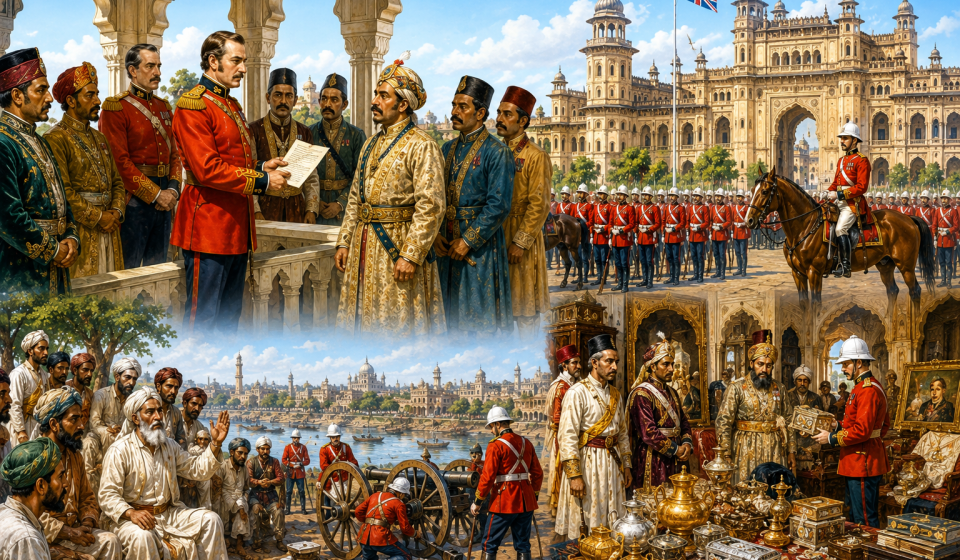
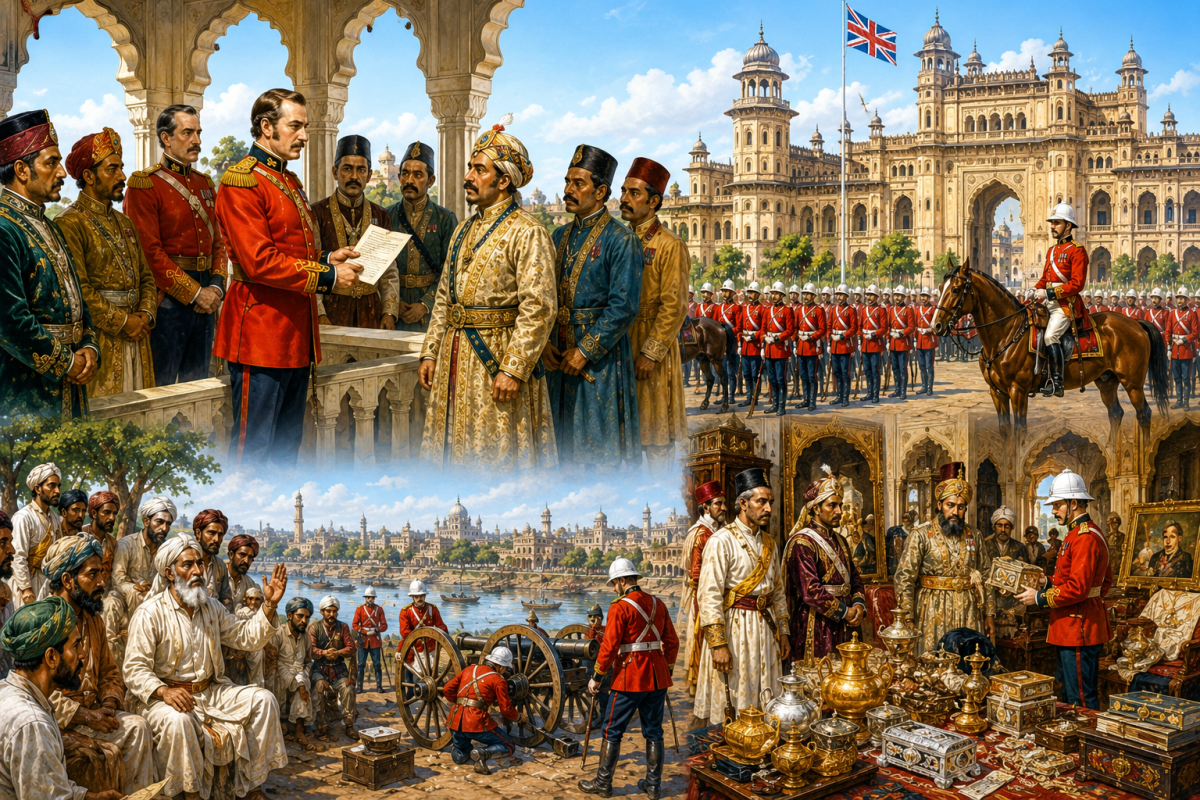
On 7 February 1856 the East India Company annexed the kingdom of Awadh, deposing without a battle the ally whose house had stood by the British, in the official phrase itself, with unswerving fidelity for a hundred years. It was the last annexation of Company rule and the most consequential. Fifteen months later the Bengal Army, whose villages lay in Awadh, rose in the greatest rebellion of the century, and the deposed kingdom became its stubbornest battlefield.
Awadh had lived for two generations inside the slow trap of the subsidiary system. The treaty of 1801, which took half the kingdom’s territory to pay for its British garrison, left the Nawabs sovereigns of the remainder, forbidden their own effective army, guaranteed against every rebellion, and lectured perpetually on the disorder that the arrangement itself guaranteed. Denied the sinews of real government, the court of Lucknow turned its genius elsewhere, and the capital became the last great flowering of Indo Islamic civilisation, its poetry and music, its cuisine and manners, its Urdu the standard of refinement, patronised by rulers whom British reports painted, decade after decade, as debauched ornaments of a rotting state. The portrait served a purpose that was eventually avowed. Sleeman, sent as Resident, reported oppression and anarchy in the countryside while warning, with honesty his masters ignored, that annexation would be a breach of faith and might convulse the very army the Company relied on. His successor Outram’s harsher report supplied the final brief, and Dalhousie, in his last month, executed the seizure he had long recommended, on the ground not of lapse but of chronic misgovernment, the paramount power dismissing its oldest ally for failing standards the paramount power had made unattainable.
The King, Wajid Ali Shah, refused to sign away his house’s honour, and chose instead a dignity history has been slow to credit him. A gifted poet and composer, a shaper of kathak and of the thumri, he departed for Calcutta with his court to appeal to the Queen, a mission carried to London by his indomitable mother without result, and settled at Metiabruz on the Hooghly, where for thirty one years he rebuilt in exile a miniature Lucknow whose music and cooking seeded Calcutta itself. The annexation’s beneficiaries were meant to be the peasantry, freed from the talukdars whom British theory cast as parasite barons. The first revenue settlement accordingly dispossessed much of the old aristocracy, and achieved the remarkable feat of alienating landlord and peasant together, for the villager, whatever his quarrels with the talukdar, saw his hereditary protector humbled by a foreign collector and his own assessment screwed upward in the same season.
Most fatally of all, Awadh was the nursery of the Bengal Army. Some three quarters of that army’s infantry were high caste men of Awadh and its neighbourhood, sepoys to whom service had meant, among much else, the prestige of the Company’s uniform in a sovereign homeland and the right of appeal through the Resident at Lucknow. Annexation cancelled the pride and the privilege at a stroke, subjected their families to the new revenue and the new courts, and confirmed every rumour that nothing old, neither kingdom nor faith, was safe. The sepoy of 1857, wrote more than one historian, mutinied as a peasant of Awadh in uniform.
The reckoning was not long delayed. When the rising came, Awadh did not merely mutiny, it revolted as a nation, sepoys, talukdars and villagers together, in the name of the boy prince Birjis Qadr and the regency of his mother, Begum Hazrat Mahal, whose defence of Lucknow and defiant proclamation answering Queen Victoria’s belong among the great documents of 1857. The reconquest of the province took the British longer than any other campaign of the war, and the settlement that followed restored, in supreme irony, the very talukdars the annexation had broken, as pillars of the new order. Lord Canning’s confiscation proclamation and its retreat, and the Crown’s promise never again to annex, were Awadh’s posthumous victories. The kingdom died in February 1856, and its ghost, within the year, came very near to taking the empire with it.
1818 to 1856 - Consolidation and Reform
Part 10 of 10 in this chapter.