 In 30 Seconds




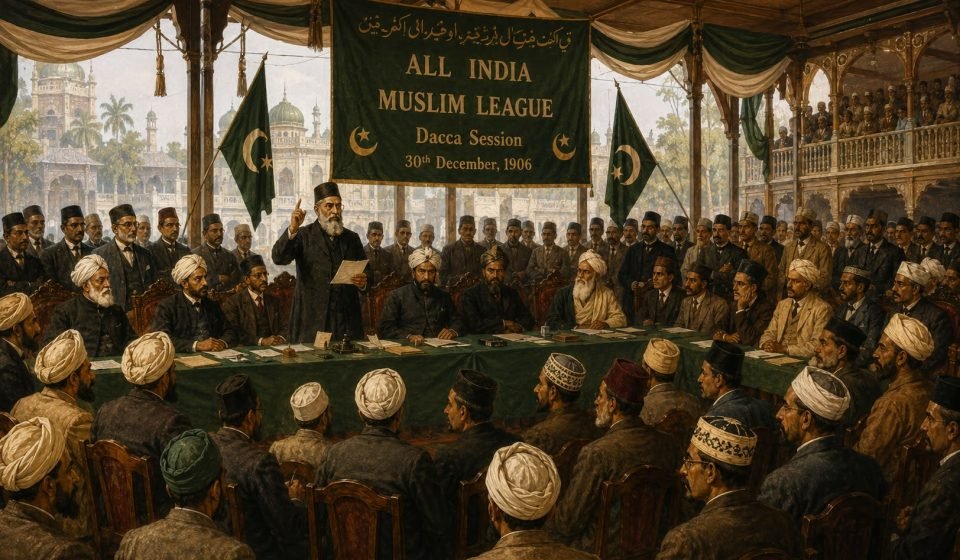
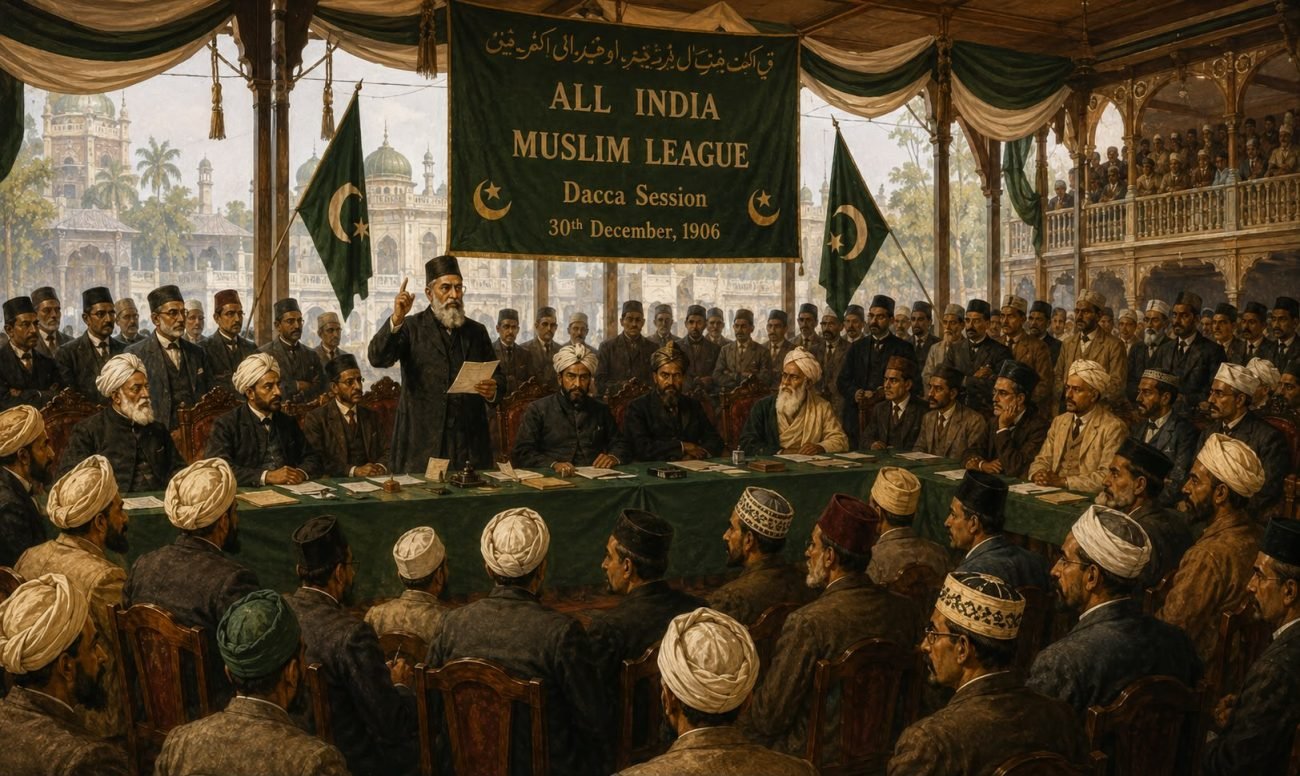
In the last days of December 1906, several thousand delegates of the All India Muhammadan Educational Conference gathered at Dacca, capital of the year old province of Eastern Bengal, and on 30 December, at the Ahsan Manzil palace of their host Nawab Salimullah, they resolved themselves into a political body, the All India Muslim League. The organisation founded that afternoon would live two lives, four decades as a society of notables loyal to the Raj, and a final decade as the mass movement that carried Jinnah’s demand and divided the subcontinent, and both lives were present, in embryo, in the circumstances of its birth.
The road to Dacca ran through Simla. In October 1906 a deputation of thirty five Muslim notables, headed by the Aga Khan and organised with the busy assistance of Mohsin ul Mulk of Aligarh and, the record shows, the encouragement of officials around the Viceroy, waited upon Lord Minto with an address whose requests defined Muslim constitutional politics for forty years. The community, it argued, must be treated as a distinct political interest, its weight assessed not by mere numbers but by historic importance and service to the empire, and its representatives chosen in every council and body by Muslim electors voting separately. Minto’s reply, welcoming the principle that any electoral representation must safeguard the community’s interests, was celebrated by an official of his household in a phrase that entered the history books, the pulling back, as he wrote, of sixty two millions of people from joining the ranks of the seditious opposition. Nationalist historiography long treated the deputation as a command performance arranged by the Raj, and the encouragement was real, but the anxieties it voiced were also authentically Muslim and older than 1906, the fears of an elite that had lost an empire, lagged in English education and services, and watched representative government approach with the arithmetic of permanent minority, fears that Sir Syed Ahmed Khan had articulated a generation before in counselling Muslims away from the Congress.
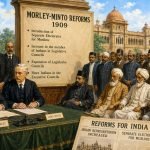
The partition of Bengal supplied the immediate spur. The new eastern province promised the Muslim majority of Bengal patronage, education and place long monopolised by Calcutta, and its most powerful supporter, Nawab Salimullah of Dacca, took the lead in converting the Simla principle into permanent organisation, against the caution of some Aligarh men. The League’s founding resolutions were a mirror of its makers, promotion of loyalty to the British government among the Muslims of India, protection and advancement of their political rights and interests, and prevention of hostility toward other communities, in that order. Its constitution enfranchised the community’s aristocracy, landlords, lawyers and title holders, with the Aga Khan as permanent president, and its early politics matched, lobbying, memorials, and the single triumph of the Morley Minto reforms of 1909, which wrote separate Muslim electorates into the constitution of India, the Simla demand made law and the seed, watered for decades, of everything that followed.
Yet the League’s first life contained more turnings than its ending suggests. The annulment of Bengal’s partition in 1911 taught its loyalists the worth of loyalty, the Kanpur mosque affair and the empire’s war on Ottoman Turkey stirred its younger men, and by 1913 the League had amended its creed to self government suitable to India, opening its doors to the generation of Muhammad Ali and to a rising Congress barrister named Muhammad Ali Jinnah, who joined while remaining in the Congress and made himself the broker of unity. At Lucknow in 1916 League and Congress signed the pact that traded separate electorates for a common demand, and through the Khilafat years the two movements marched, briefly, as one. That the same League, hollowed by the twenties and thirties and recaptured by Jinnah on the rebound of 1937, should end as the instrument of partition was not written at Ahsan Manzil. What was written there was the premise all later chapters assumed, that the Muslims of India constituted a single political community with interests requiring separate safeguard, a premise the Raj had encouraged, the Simla deputation had voiced, and the twentieth century would test to destruction.
1905 to 1911 - Swadeshi, Revolutionaries and Reform
Part 4 of 10 in this chapter.