 In 30 Seconds




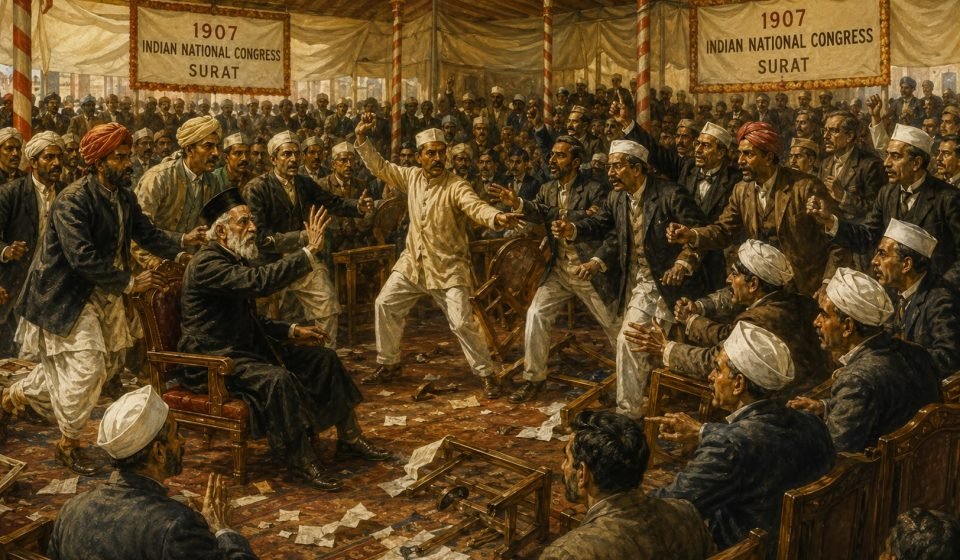
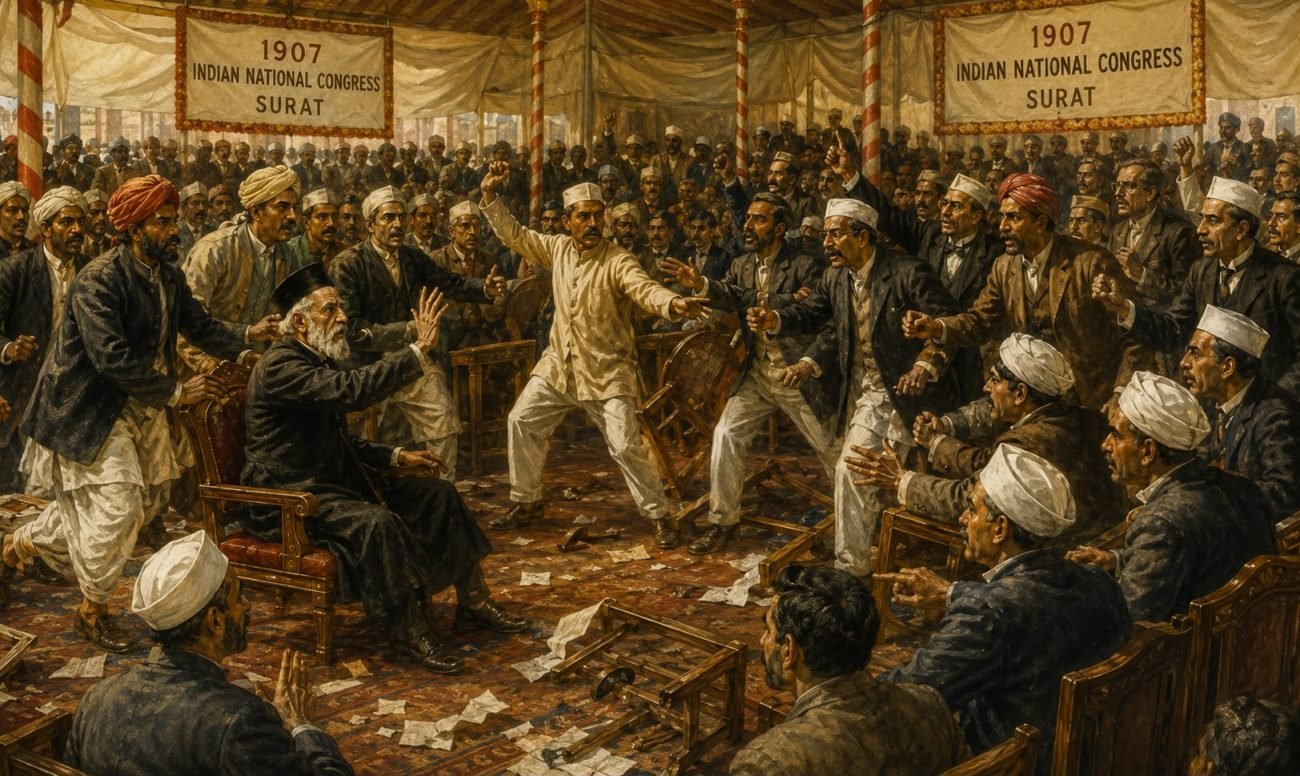
On 27 December 1907, in a pandal on the banks of the Tapti at Surat, the Indian National Congress dissolved into a riot of its own delegates. A shoe flew through the air toward the platform, striking, by the various accounts, at or near the persons of Pherozeshah Mehta and Surendranath Banerjee, chairs followed, lathis appeared, and the police closed a session that never transacted a word of business. The Surat split, the divorce of Moderates and Extremists, broke the national movement’s only institution for nearly a decade, and its story is the essential study of how movements devour themselves at the moment of their first success.
The quarrel was about pace, method and ultimately about the nature of the struggle. The partition agitation had given the Extremists, Tilak, Lajpat Rai, Bipin Chandra Pal and behind them Aurobindo, both a program and a following, and at the Calcutta Congress of 1906, under the shield of the aged Naoroji’s presidency, they had carried the famous four resolutions, on swadeshi, boycott, national education and self government as the goal. To the Extremists these were the movement’s new constitution, to be extended from Bengal to all India and from British goods to the British administration itself. To the Moderate old guard they were emergency measures of a wounded province, already straining the movement’s legality and its unity, and with a reforming Liberal government in London and the Morley reforms in negotiation, the hour called for consolidation, not escalation. Beneath the resolutions lay the deeper difference, whether the Congress existed to petition the empire toward association or to train the nation for its replacement.
The mechanics of the split were the small treasons of procedure. The Extremists wanted the 1907 session at Nagpur, where their strength lay, and proposed Lajpat Rai, freshly returned from deportation, for the presidency. The Moderate managers moved the venue to Surat, deep in Mehta’s Gujarat, and settled the chair on Rashbehari Ghosh, and rumours ran through the Extremist camp, not baseless, that the reception committee’s draft constitution would quietly bury the Calcutta resolutions. Tilak sought guarantees, was refused a hearing on procedure, and when the session opened he stood before the platform demanding to move his adjournment amendment, standing his ground as the shouting rose, until the missile flew and the pandal exploded. Who threw the first shoe, like who fired at Lexington, belongs to legend, and each side wrote the other the aggressor within the week.
The aftermath was decided by the Moderates in convention the following days, a new Congress constitution with a creed, adherence to self government within the empire by strictly constitutional means, subscription to which was the ticket of membership. The Extremists, unable to sign, were out, and the government, watching with satisfaction its officials did not conceal, moved within months upon the party now separated from respectability’s shelter, Tilak transported to Mandalay in 1908, Aurobindo in the Alipore dock, Pal withdrawn from politics, the Punjab leaders harried. The Moderate Congress kept the name, the machinery and Gokhale’s negotiation with Morley, and paid for it in relevance, its sessions thinning year by year into what critics called a three day tamasha of the loyal. The Extremists kept the country’s imagination and paid in organisation, their energy flowing into the revolutionary underground that the state’s repression had made the only open channel.
The reunion took nine years and a changed world. Tilak returned from Mandalay in 1914 chastened in tactics and unchanged in aim, Mrs Besant’s Home Rule agitation rebuilt the national platform, and at Lucknow in 1916 the two wings reunited on terms that were, in substance, the Extremists’ terms of 1907, self government the goal, mass agitation the method soon to come. Mehta was dead, Gokhale was dead, and the instrument they had preserved passed, within four more years, to a leader who fused the Moderates’ discipline and the Extremists’ energy into something neither had imagined. Surat entered the movement’s memory as its cautionary scripture, cited at every later crisis, by Gandhi in 1920, by the managers of a hundred factional truces, as the price of preferring victory over colleagues to victory over the Raj. The empire celebrated the split of 1907. It should have studied instead how bitterly both halves of the broken house remembered it, for nations, like families, are welded strongest along their mended cracks.
1905 to 1911 - Swadeshi, Revolutionaries and Reform
Part 3 of 10 in this chapter.