 In 30 Seconds



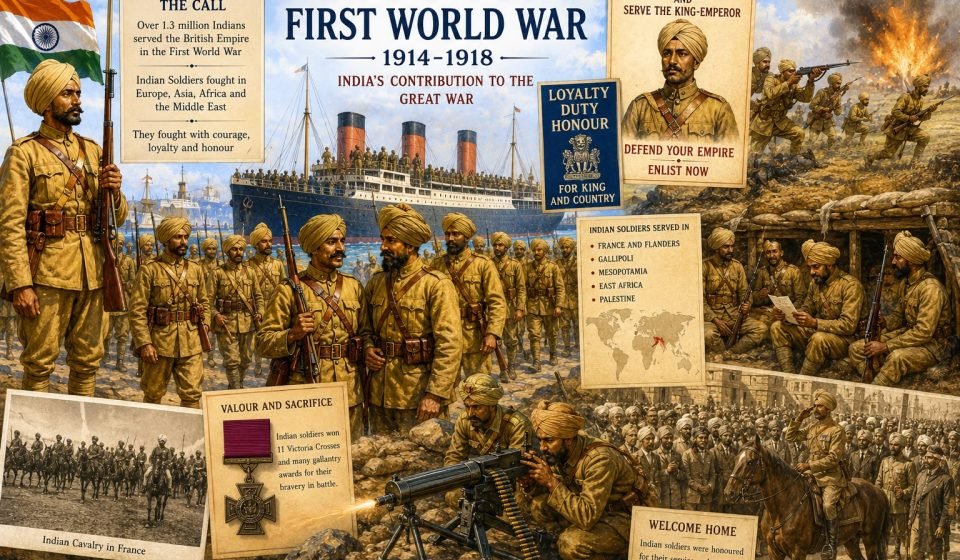
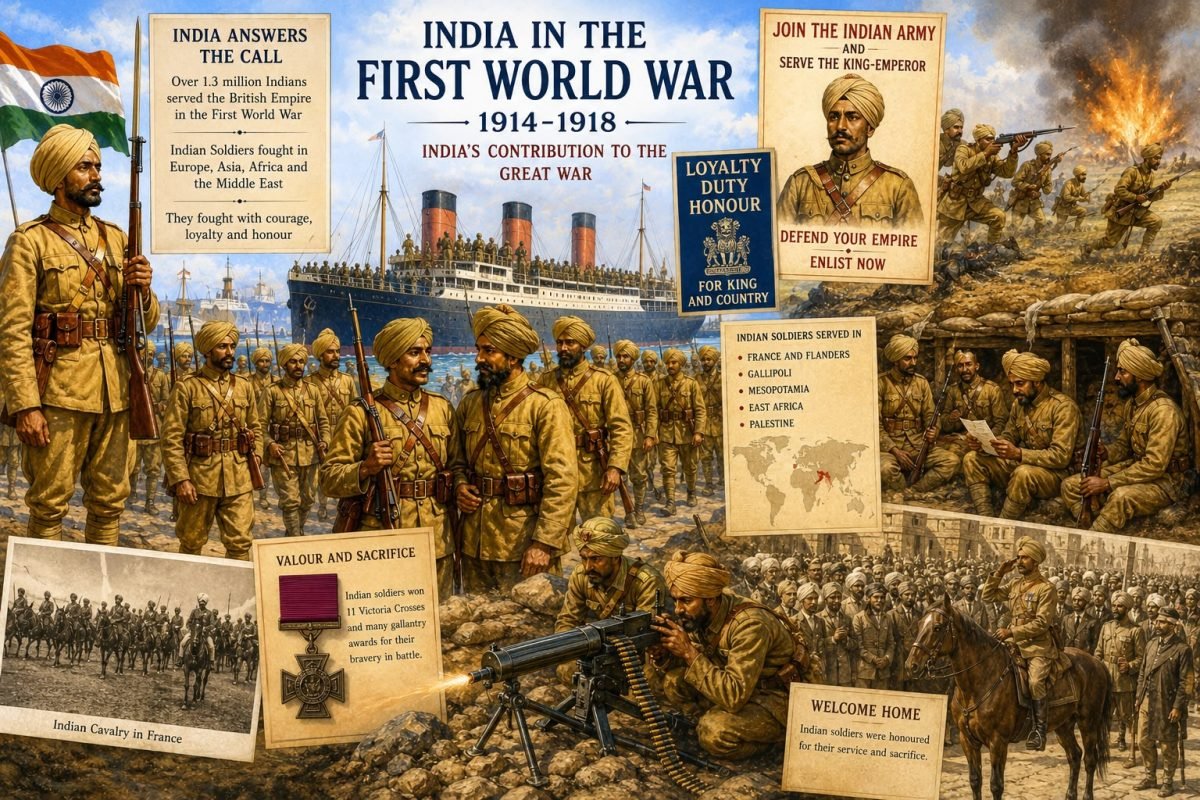
When Britain declared war in August 1914, it declared war for India without asking India, and India, to the astonishment of many in both countries, answered with an outpouring of men, money and loyalty that reshaped the war and, in its disappointed aftermath, reshaped India. Over the four years some one million four hundred thousand Indians served, combatants and labourers together, the largest volunteer force the world had then seen, and roughly seventy four thousand never returned. Their war, long a footnote in both British and Indian memory, has been restored in recent decades to its place as one of the hinges of the national story.
Indian soldiers were in action within weeks and everywhere thereafter. The Lahore and Meerut divisions reached the Western Front in the autumn of 1914 in time to help hold the broken line of First Ypres, sepoys from the Punjab plains freezing in Flanders mud in cotton drill, and Khudadad Khan of the 129th Baluchis won at Hollebeke the first Victoria Cross awarded to an Indian. Indians fought at Neuve Chapelle, where the Indian Corps led the assault and where their memorial now stands, and at Gallipoli beside the Anzacs. East Africa consumed divisions in a four year pursuit of von Lettow. Above all there was Mesopotamia, the Indian Army’s own theatre, where the drive on Baghdad ended in 1916 in the surrender of Kut, thirteen thousand troops, the greater part Indian, marched into a captivity that killed thousands, before a rebuilt, largely Indian force took Baghdad in 1917 and Palestine’s cavalry victories at Megiddo in 1918 gave the Indian sowar his last great charge. India paid in treasure as well as blood, a direct gift of one hundred million pounds to Britain’s war costs, war loans pressed from every province, and the doubling burden of taxation and prices at home, where recruitment in the Punjab, supplying three fifths of the combatants, slid from enthusiasm through quota pressure into methods villages remembered with bitterness, one strand in the tinder of 1919.
Political India, in a decision that defined the era, backed the war almost unanimously. The Congress pledged support, the princes emptied treasuries and led contingents, and Gandhi, newly returned, recruited for the army in Gujarat’s villages to the bewilderment of admirers, all on a common calculation, stated openly, that India’s sacrifice would purchase India’s advance, that a nation which had bled for the empire’s freedom could not be denied a share of its own. Even the war’s opponents strengthened the same conclusion from the other side, the Ghadar rising, the Berlin committee’s plots and the Silk Letter conspiracy demonstrating what a fraction of disloyalty could threaten, while Turkey’s entry into the war strained Muslim loyalty toward the Khilafat crisis to come. The bargain seemed, for one moment, to be honoured. Montagu’s declaration of August 1917 promised responsible government as the goal of British policy, Indians were admitted at last to King’s commissions, and an Indian delegation signed the peace and entered the new League of Nations, sovereignty’s costume if not its substance.
The war meanwhile transformed the country that waited at home. Blockade and shipping famine gave Indian industry the protection Lancashire’s lobby had always denied it, Tata’s steel, jute, cement and cotton mills booming into the industrial base the interwar economy inherited, while the same scarcities drove prices to heights that broke the poor, and the influenza of 1918, riding home with the troopships, killed more Indians, twelve million and upward by modern estimates, than the war had killed soldiers of all empires combined. Into this exhausted, expectant country came the peace’s actual instalment, the Rowlatt Act’s wartime powers made permanent, and the Punjab, the province of the soldiers, received Jallianwala Bagh. The sequence was not lost on a single Indian observer, sacrifice, promise, betrayal, and the political history of the next thirty years is the working out of that sequence.
The soldiers themselves came home to villages that folk song shows both proud and scarred, their pensions and grants seeding the Punjab’s canal colonies, their discontents seeding its politics. India Gate in New Delhi carries thirteen thousand of their names, an imperial monument the republic has kept and repurposed, its eternal flame honouring later wars, so that the men of Flanders and Kut stand now, fittingly enough, at the centre of the capital of the nation their unrewarded loyalty helped, by the very scale of its betrayal, to bring into being.
1913 to 1919 - Ghadar, War and Gandhi Arrives
Part 3 of 10 in this chapter.