 In 30 Seconds




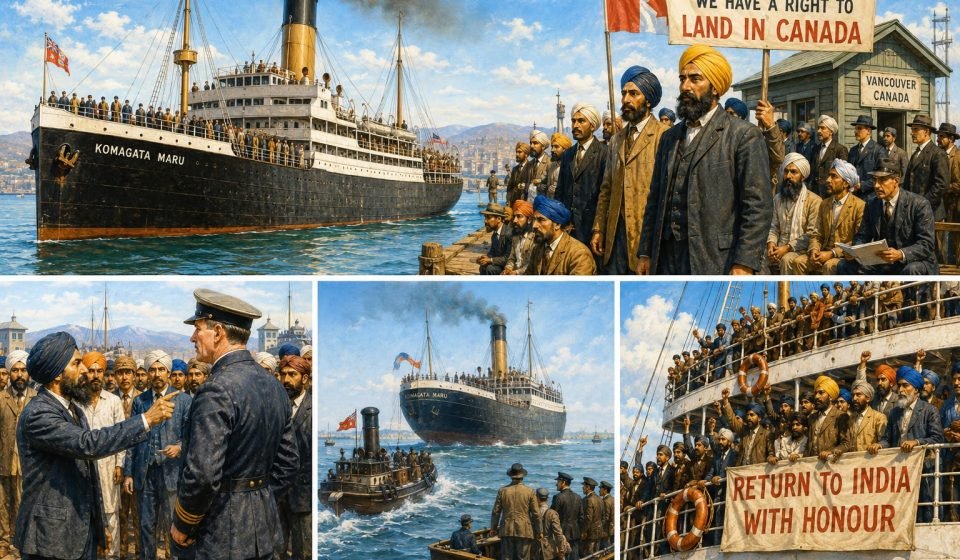
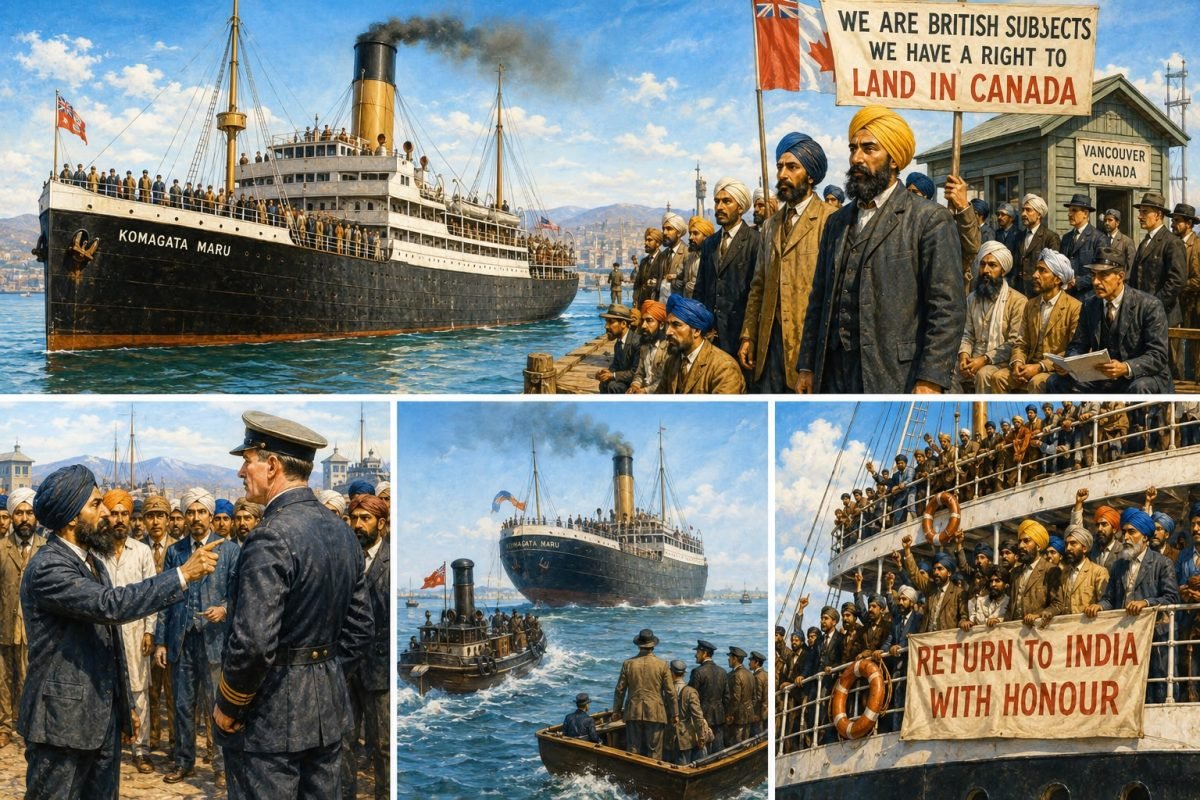
In the spring of 1914 a chartered Japanese steamer crossed the Pacific carrying three hundred and seventy six passengers, Sikhs in the great majority with Muslim and Hindu Punjabis among them, British subjects sailing to a British dominion to test whether the empire’s citizenship meant what its proclamations said. The voyage of the Komagata Maru, turned back at Vancouver after two months of siege in the harbour and ended in gunfire at a Calcutta dockside, became one of the empire’s defining scandals, the case that taught a generation of Indians that the imperial family had a colour bar at every door.
The door in question had been engineered with care. Canada wanted no Indian immigration but could not, within imperial decencies, say so of fellow subjects, and so its regulations of 1908 required immigrants to arrive by continuous journey from their country of birth on tickets purchased there, while steamship companies were quietly forbidden to sell such passages from India. Exclusion by geometry. The man who resolved to break the device was Gurdit Singh, a Sikh contractor of Singapore, part businessman, part crusader, who chartered the Komagata Maru in early 1914, renamed her Guru Nanak Jahaz, and filled her with emigrants from the Punjabi diaspora of East Asia, sailing from Hong Kong by way of Shanghai and Yokohama and anchoring off Vancouver on 23 May 1914.
The two months that followed were a siege conducted by paperwork and hunger. The passengers were forbidden to land, held offshore under immigration guard while provisions and water ran low, the shore committee of Vancouver’s Sikhs, hard men of the Ghadar milieu among them, raising funds, hiring counsel and buying the ship’s charter itself, while the beach filled with hostile crowds and the press of British Columbia demanded the Hindu invasion be repelled. A test case was allowed and lost, the courts upholding the orders in council, and when the exhausted passengers resisted a boarding attempt in mid July, showering the approaching police tug with coal and iron, the government brought up the cruiser Rainbow, half the Canadian navy of the day, and trained its guns on the emigrants. On 23 July the ship sailed, provisioned for departure and nothing else, with only a score of returning residents ever landed.
The empire’s second reception was crueller. War had broken out while the ship recrossed the Pacific, and the government of India, gripped by fear of the Ghadar return then flowing home, met the vessel at the Hooghly’s mouth as an enemy transport, searching her at Kulpi and directing her to Budge Budge, where a special train waited to carry the passengers straight to the Punjab under the new Ingress Ordinance, internment the announced destination of many. The passengers, most of whom had committed no offence and many of whom had business in Calcutta itself, refused entrainment, and marched instead in procession behind the Guru Granth Sahib toward the city. Turned back by police and troops, they returned to the dockside, and there, at dusk on 29 September 1914, in a scuffle whose first shot each side attributed to the other, the police and soldiers fired into the pilgrims. Around twenty were killed, passengers, police and residents together in the official count, scores wounded, over two hundred interned in the following sweep, and Gurdit Singh escaped into seven years of hiding before surrendering, on Gandhi’s counsel, to serve his sentence.
The reckoning outlasted everyone’s convenience. Budge Budge gave Ghadar its rallying massacre, remembered in the movement’s verse, and Kartar Singh Sarabha’s tribunal statement claimed the dead of the ship among the rising’s causes. Canada’s Sikhs kept the memory green through a century at the end of which, in 2016, a Canadian Prime Minister apologised in Parliament for the exclusion, the harbour where the ship was besieged now bearing memorials to her passengers. In the imperial ledger the case entered as precedent and prophecy, the proof, delivered before the war’s loyal sacrifices had even begun, that the equality of British subjects was a fiction maintained only where it cost nothing, and that the empire for which India was about to send a million men to fight would not admit a shipload of them to its own shores.
1913 to 1919 - Ghadar, War and Gandhi Arrives
Part 2 of 10 in this chapter.