 In 30 Seconds




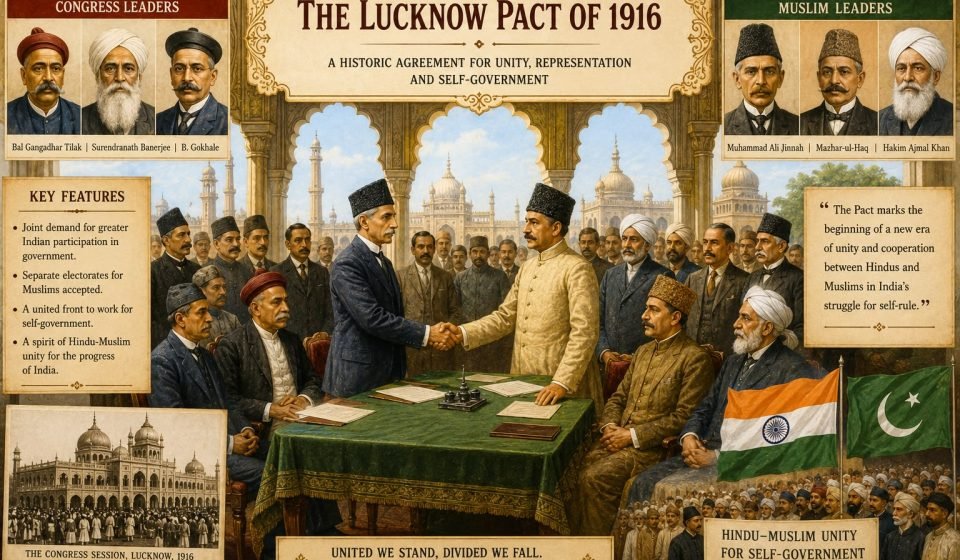
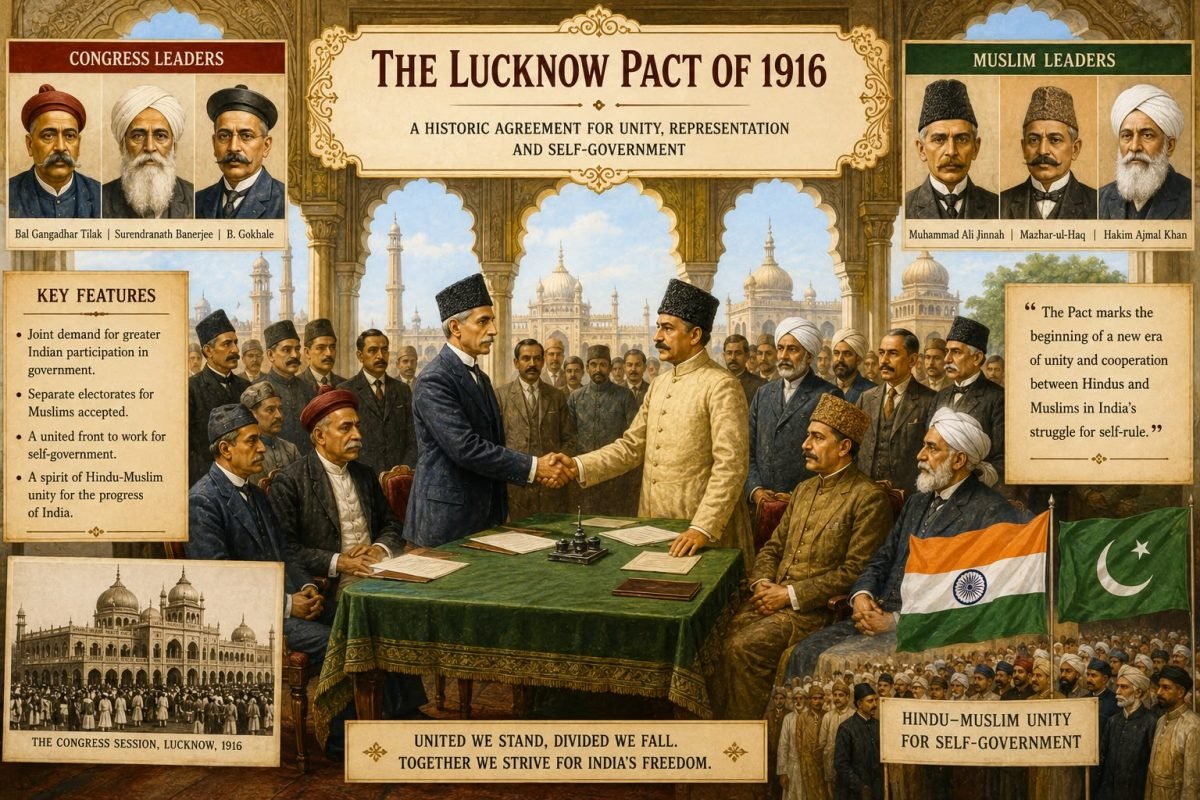
For one December in Lucknow, in 1916, the two organised forces of Indian politics stood on the same platform and asked the empire for the same thing. The Lucknow Pact, the joint constitutional scheme adopted that month by the Indian National Congress and the All India Muslim League in simultaneous session, was the high water mark of Hindu Muslim political unity under the Raj, the treaty whose architects were Tilak and Jinnah, and whose terms, unity purchased by the Congress’s acceptance of separate electorates, contained both the moment’s triumph and the century’s bill.
The convergence had two histories. The League’s young generation, the Ali brothers, Wazir Hasan, and the rising Bombay barrister Muhammad Ali Jinnah, had been pulled from loyalism by the empire’s own conduct, the annulment of Bengal’s partition in 1911 that taught the worth of official promises, the Kanpur mosque firing of 1913, and above all Britain’s war against Ottoman Turkey, seat of the Khilafat, which set Muslim sentiment against the government as nothing in a century had. The League amended its creed to self government in 1913, and Jinnah, already a Congress man of Dadabhai’s school, joined it to build the bridge, earning from Sarojini Naidu the title the age gave him, the ambassador of Hindu Muslim unity. On the Congress side, Tilak returned from Mandalay in 1914 resolved to reunite the broken movement and to present the empire, in its hour of need, with a national demand it could not divide, and at Lucknow the Extremists, readmitted after the nine year exile of Surat, and the Moderates sat together again, with Tilak the session’s uncrowned king.
The pact’s constitutional scheme was the boldest yet framed by Indians, four fifths of the legislative councils elected, half the Viceroy’s executive to be Indian, provincial autonomy in all but name, the demand that India be lifted to the self governing partnership the white dominions enjoyed. Its historic core, though, lay in the communal settlement. The Congress accepted, for the first time and in writing, separate electorates for Muslims, the principle it had condemned since 1909, together with a schedule of weightage that gave Muslims representation above their population in provinces where they were few, one third of the seats at the centre, and, the fateful arithmetic, fixed shares below their population in Punjab and Bengal, where their majorities were traded for gains elsewhere, no measure affecting a community to proceed against three fourths of that community’s representatives. Tilak, challenged by Hindu critics for conceding too much, answered in the spirit of the hour that he cared not if self rule’s instruments were held disproportionately by Muslims, so long as the rule was India’s own.
The pact’s immediate harvest was real. A united political India, amplified by the Home Rule Leagues then sweeping the provinces, confronted the war weary Raj with a single demand, and the Montagu declaration of August 1917, promising responsible government as the goal, was in significant measure Lucknow’s extraction. The unity itself deepened, through Khilafat and Rowlatt, into the fused mass movement of 1919 to 1922, the closest the two communities ever marched.
The longer ledger is darker, and historians still dispute its entries. By accepting separate electorates, the national movement itself ratified the principle that Muslims were a distinct political entity to be dealt with by treaty between communities, the premise, as later League theorists did not fail to note, of everything argued at Lahore in 1940, and the Punjab and Bengal weightage clauses, which left the two Muslim majority provinces’ politics structurally embittered, were cited for thirty years as the precedent for adjusting majorities by negotiation. The counterfactual, that refusing the concession would have preserved some purer unity, convinces few who study 1916’s actual choices. What the pact proves is both readings at once, that Indian unity was achievable, by leaders of stature bargaining as equals, and that the ground on which it was achieved, the communal category as the unit of politics, was ground the Raj had laid and the nation never afterward escaped. Tilak died in 1920, Jinnah walked out of the Gandhian Congress the same year, and the two men’s handshake at Lucknow remained what it is in every photograph of that December, the freedom struggle’s great might have been.
1913 to 1919 - Ghadar, War and Gandhi Arrives
Part 4 of 10 in this chapter.